



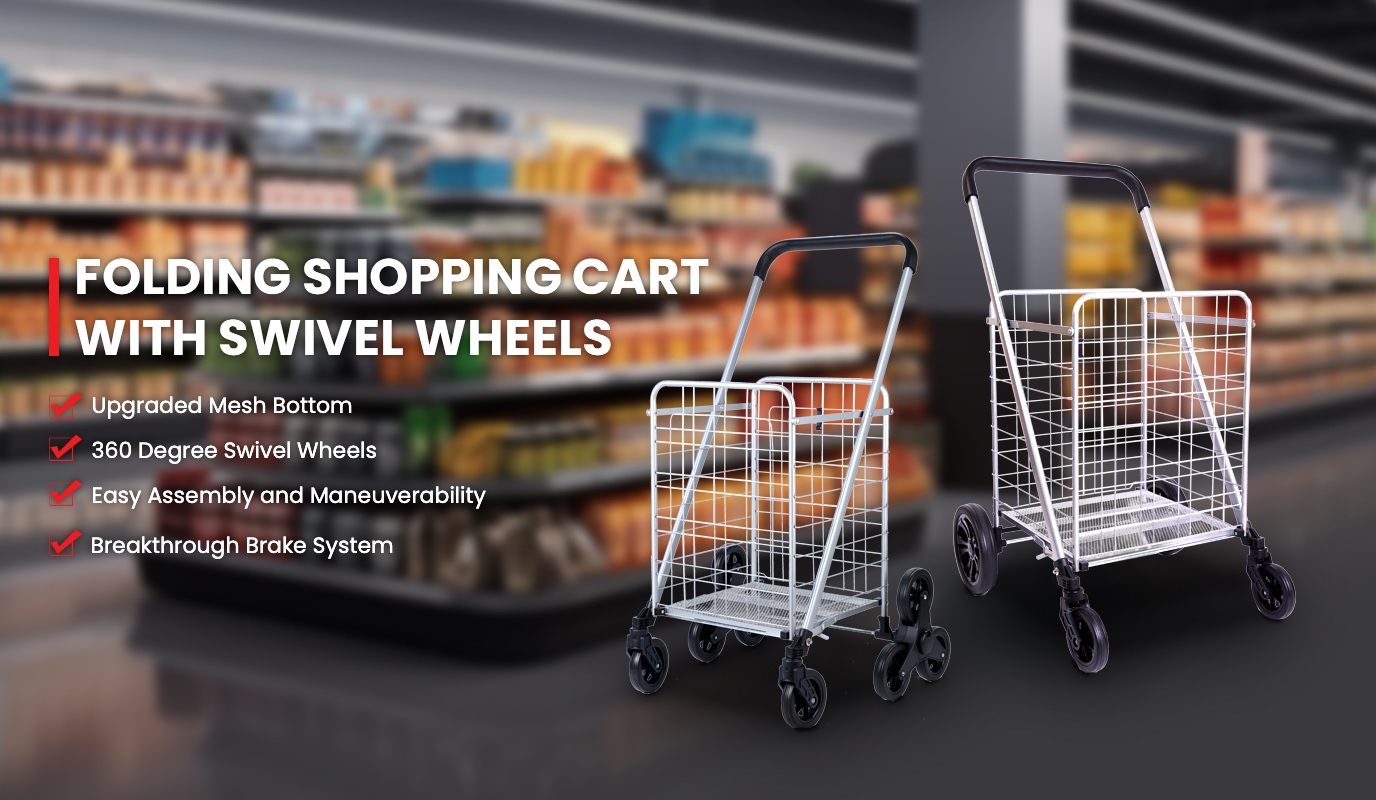
Caster Wheel Cart vs Standard Wheel Cart: Which Is Better for Warehouse Movement?
Caster wheel carts generally provide better maneuverability for warehouse movement, especially when routes involve turns, narrow aisles, and frequent repositioning. Standard fixed-wheel carts offer better straight-line stability and can be more predictable for long-distance transport and heavy loads.
What Is the Difference Between a Caster Wheel Cart and a Standard Wheel Cart?
The main difference is how the wheels respond to changes in direction.
A caster wheel cart normally uses swivel casters that rotate around a vertical axis. This allows the trolley to change direction without moving the entire frame into a new alignment.
A standard wheel cart in this comparison refers primarily to a fixed-wheel configuration. The wheels remain aligned with the trolley frame, so movement is more directional.
Some warehouse trolleys combine fixed wheels and swivel casters to balance both characteristics.
For procurement, the wheel configuration should be evaluated according to:
Aisle width
Travel distance
Load weight
Turning frequency
Floor condition
Operator force
Required positioning accuracy
Why Are Caster Wheel Carts Useful in Warehouses?
Warehouse movement rarely consists of perfectly straight routes.
Operators may need to move carts:
Around storage racks
Between workstations
Through narrow aisles
Around loading areas
Into staging zones
Swivel casters allow the trolley to change direction quickly, which can reduce the space required for turning.
This is particularly useful where the operator must frequently reposition the cart rather than simply push it from one fixed point to another.
What Are the Advantages of Fixed-Wheel Carts?
Fixed wheels provide predictable directional movement.
They are particularly useful for:
Long straight routes
Heavy loads
Repetitive transport
Narrow straight aisles
Controlled material movement
Because the wheels remain aligned, the trolley is less likely to wander sideways during straight travel.
For warehouse routes that follow a consistent path, this can make movement easier to control.
How Do Caster and Fixed-Wheel Carts Compare?
| Factor | Caster Wheel Cart | Standard Fixed-Wheel Cart |
|---|---|---|
| Maneuverability | Excellent | Moderate |
| Tight turning | Excellent | Limited |
| Straight-line stability | Good | Excellent |
| Heavy-load control | Good to excellent | Excellent |
| Narrow-space positioning | Excellent | Moderate |
| Long-distance movement | Good | Excellent |
| Frequent direction changes | Excellent | Moderate |
| Predictable forward movement | Good | Excellent |
The best choice depends on the warehouse route rather than simply the number or type of wheels.
Which Is Better for Narrow Warehouse Aisles?
Caster wheel carts generally have the advantage.
Narrow aisles require frequent adjustments, and swivel casters allow the trolley to change direction with relatively little forward space.
This can be useful around:
Storage racks
Picking stations
Packing areas
Production lines
Warehouse columns
However, the caster diameter and overall cart dimensions must also be appropriate for the available space.
A trolley with excellent swivel casters can still be difficult to operate if its frame is too wide.
Which Is Better for Long Straight Routes?
Fixed-wheel carts generally perform better.
When the route runs in a straight line, fixed wheels maintain the trolley's direction without requiring continuous steering correction.
Typical examples include:
Warehouse-to-production transport
Loading dock movement
Staging-area transfers
Repetitive internal delivery routes
This makes fixed-wheel configurations particularly suitable for predictable material-handling paths.
Which Is Better for Heavy Warehouse Loads?
Fixed-wheel configurations generally provide stronger directional stability for heavy loads.
A heavily loaded trolley can generate significant forces during acceleration, stopping, and turning.
Fixed wheels help maintain alignment during straight movement.
Caster carts can also handle heavy loads when equipped with correctly rated industrial casters.
For heavy-duty applications, buyers should evaluate:
Caster load rating
Wheel diameter
Wheel width
Bearing capacity
Frame strength
Load distribution
The wheel configuration should match the total working load rather than the empty trolley weight.
Does Load Distribution Affect Caster Performance?
Yes.
An unevenly distributed load can increase stress on individual casters.
This may cause:
Uneven wheel wear
Increased steering effort
Reduced stability
Excessive caster loading
Difficult turning
The center of gravity also matters.
A high or offset load can make a trolley more difficult to control, especially when using swivel casters.
From a manufacturer's perspective, caster selection should be based on the actual load distribution, not simply the maximum total weight.
Are Four Swivel Casters Always Better?
No.
Four swivel casters provide excellent maneuverability, but they may not provide the same straight-line stability as a mixed configuration.
For warehouse applications, a combination of:
two fixed wheels + two swivel casters
can provide a useful balance.
The fixed wheels help maintain direction while the swivel casters allow turning.
The exact arrangement should be determined by trolley size, load position, handle location, and route requirements.
What Are the Benefits of a Mixed Wheel Configuration?
Mixed wheel configurations combine two different movement characteristics.
Fixed wheels provide:
Directional stability
Predictable straight movement
Heavy-load support
Swivel casters provide:
Turning flexibility
Easier repositioning
Better maneuverability
This makes mixed configurations practical for many commercial and warehouse trolleys.
They are particularly useful when a cart needs to travel both long straight sections and tighter work areas.
How Does Wheel Diameter Affect Warehouse Movement?
Wheel diameter has a significant influence on mobility.
Larger wheels can move over:
Floor joints
Thresholds
Small obstacles
Uneven concrete
with less interruption.
They can also reduce the effect of surface irregularities.
Smaller wheels can provide a lower platform height, which may be useful for loading and unloading.
The correct diameter therefore depends on the warehouse floor, load, platform height, and obstacle conditions.
Which Wheel Material Is Better for Warehouses?
Common warehouse wheel materials include:
PU
Rubber
Nylon
TPR
PU wheels are often suitable for smooth industrial floors because they provide good wear resistance and rolling efficiency.
Rubber can be useful where shock absorption, traction, and lower noise are priorities.
Nylon can provide strong load performance on suitable smooth surfaces.
The wheel compound should be selected according to:
floor + load + noise + wear + operating environment.
How Does the Warehouse Floor Affect Wheel Selection?
Floor condition can completely change the preferred wheel configuration.
Smooth concrete favors wheels with efficient rolling characteristics.
Uneven floors may require larger, more resilient wheels.
Potential challenges include:
Cracked concrete
Floor joints
Thresholds
Ramps
Metal plates
Outdoor transitions
A caster system that performs well on a smooth warehouse floor may require a different wheel specification for rougher surfaces.
Which Is Better for Frequent Turning?
Caster wheel carts are generally better.
Swivel casters allow the trolley to change direction without requiring a large turning radius.
This is useful for:
Picking operations
Packing stations
Work cells
Maintenance areas
Narrow storage zones
However, frequent turning also increases caster and wheel stress, so the caster must have an appropriate load rating and bearing system.
Does Handle Design Affect Warehouse Control?
Yes.
The handle determines where the operator applies force.
Important factors include:
Handle height
Grip diameter
Handle width
Frame rigidity
Connection strength
A well-designed handle can improve steering control and reduce unnecessary wrist and shoulder movement.
For heavy carts, the handle connection must also withstand repeated pushing and pulling forces.
The handle and caster system should therefore be engineered together.
How Does Braking Affect Warehouse Safety?
Brakes can be important when a trolley must remain stationary after movement.
Brake requirements depend on:
Floor slope
Load weight
Trolley size
Operator workflow
Loading and unloading procedures
Swivel casters with brakes can help secure carts at workstations.
For heavy industrial carts, the brake should be rated for the actual trolley and working load.
Can Caster Wheel Carts Be Used for Outdoor Warehouse Movement?
Yes, but the wheel system should be selected for the surface.
Outdoor movement may involve:
Rough concrete
Asphalt
Uneven pavement
Water exposure
Debris
Larger wheels and suitable resilient compounds can improve movement.
For outdoor applications, corrosion-resistant caster components may also be important.
A warehouse trolley intended for both indoor and outdoor use should be specified according to the more demanding operating environment.
Which Cart Requires Less Steering Effort?
There is no universal answer.
Caster carts can reduce effort during frequent turns because the wheels pivot with the direction of movement.
Fixed-wheel carts can reduce steering corrections during long straight movement.
Actual pushing force also depends on:
Load
Wheel diameter
Wheel material
Bearing quality
Floor condition
Wheel alignment
A well-designed caster system can improve maneuverability, but poor caster geometry can increase resistance.
How Does Bearing Quality Affect Movement?
Bearings influence both rolling and swivel performance.
Poor-quality bearings may increase:
Starting force
Rolling resistance
Swivel resistance
Wheel wear
High-quality bearings can provide smoother movement under repeated warehouse use.
For commercial trolleys, the caster should therefore be evaluated as a complete assembly rather than selecting wheels based only on material and diameter.
Can Warehouse Carts Be Customized?
Yes.
Commercial trolley manufacturers can customize:
Cart dimensions
Platform size
Wheel diameter
Wheel material
Fixed/swivel configuration
Brake system
Handle height
Surface treatment
For example, a narrow picking trolley may use more swivel capability, while a heavy-duty transport cart may prioritize fixed-wheel stability.
OEM designs can also combine different caster types to suit specific warehouse routes.
What Should Buyers Check Before Ordering?
Commercial buyers should evaluate:
Travel route
Determine whether movement is primarily straight, curved, or mixed.
Aisle width
Measure the narrowest operating area.
Load
Specify both average and maximum working loads.
Floor condition
Identify smooth, rough, uneven, wet, or outdoor surfaces.
Turning frequency
Frequent turns favor greater swivel capability.
Wheel specification
Check diameter, width, material, bearings, and load rating.
Caster configuration
Choose fixed, swivel, or mixed arrangements based on the route.
Manufacturer capability
Evaluate frame engineering, caster selection, wheel assembly, load testing, quality control, customization, and production capacity.
Which Is Better for Warehouse Movement: Caster Wheel Cart or Standard Wheel Cart?
Caster wheel carts are generally better for warehouses requiring frequent turns, narrow-aisle maneuvering, and flexible positioning. Standard fixed-wheel carts are better for long straight routes, heavy loads, and applications where directional stability is the main priority.
For many warehouses, the most practical solution is not choosing one configuration exclusively.
A mixed wheel system can provide fixed-wheel stability for straight movement while retaining swivel-caster maneuverability for turns.
From a manufacturer's perspective, the right warehouse trolley should be specified around the route + load + floor + turning radius + wheel diameter + caster configuration, rather than choosing wheels based only on general labels such as "heavy duty" or "industrial."