



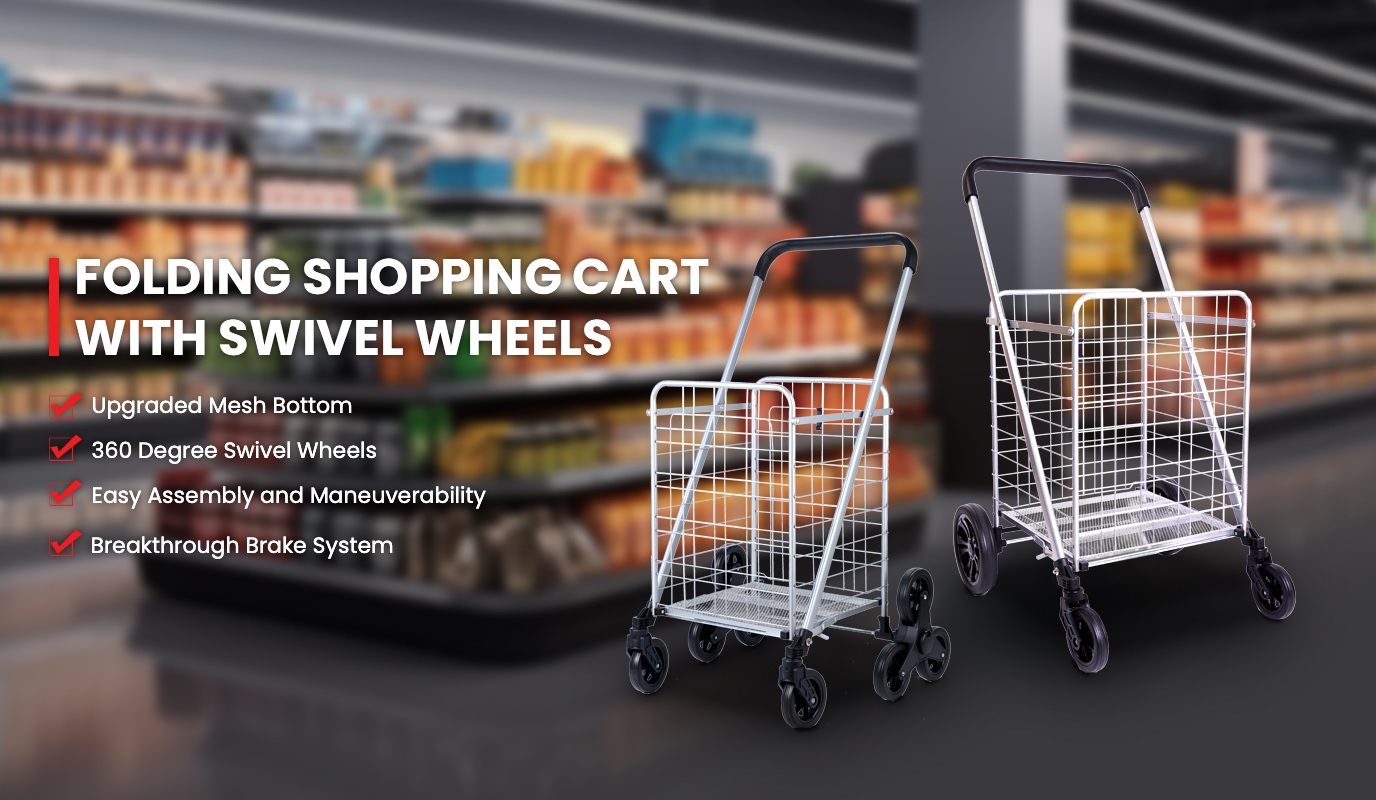
Rubber Wheel vs PU Wheel for Shopping Cart: Which Provides Better Performance?
Rubber wheels generally provide quieter movement, better floor grip, and improved shock absorption, while PU wheels offer stronger wear resistance, higher load performance, and lower rolling resistance on smooth floors. The better choice depends on flooring, load, noise requirements, and operating conditions.
What Is the Difference Between Rubber and PU Shopping Cart Wheels?
The main difference is the wheel compound and how it behaves under load and movement.
Rubber wheels are valued for elasticity, grip, and vibration absorption. They can perform well on floors where quiet movement and floor protection are important.
PU wheels, made with polyurethane, offer a harder and more wear-resistant running surface. They are commonly selected when carts need to move efficiently under frequent commercial use.
The wheel material should be considered together with:
Wheel diameter
Wheel width
Load rating
Bearing design
Floor condition
Cart weight
Noise requirements
Operating temperature
Why Are Rubber Wheels Commonly Used on shopping carts?
Rubber has a naturally resilient structure that helps absorb vibration.
This can make rubber wheels suitable for:
Supermarkets
Retail stores
Hotels
Indoor service areas
Customer-facing environments
When a cart moves over small floor joints or uneven sections, rubber can absorb part of the vibration before it reaches the frame and handle.
This can create a smoother and quieter user experience.
Why Are PU Wheels Used for Commercial Carts?
Polyurethane provides a useful combination of wear resistance, load capacity, and rolling efficiency.
PU wheels can be suitable for:
High-frequency commercial use
Warehouses
Distribution areas
Retail stockrooms
Industrial environments
Their relatively hard running surface can reduce deformation under load and provide efficient movement on suitable smooth floors.
How Do Rubber and PU Wheels Compare?
| Factor | Rubber Wheel | PU Wheel |
|---|---|---|
| Shock absorption | Excellent | Good |
| Noise reduction | Excellent | Good |
| Floor grip | Excellent | Good to excellent |
| Wear resistance | Good | Excellent |
| Load performance | Good | Excellent |
| Rolling efficiency | Good | Excellent on smooth floors |
| Uneven floors | Excellent | Good |
| Smooth floors | Very good | Excellent |
| Floor protection | Excellent | Excellent |
| High-frequency use | Good | Excellent |
Neither wheel material is universally superior. The operating environment determines which characteristics matter most.
Which Wheel Is Quieter?
Rubber wheels generally provide quieter operation.
Their elasticity absorbs vibration and reduces impact noise when the trolley passes over:
Floor joints
Small thresholds
Uneven tiles
Concrete transitions
This makes rubber attractive in customer-facing locations where excessive wheel noise can affect the shopping environment.
PU wheels can also operate relatively quietly, particularly on smooth floors, but rubber normally has the stronger advantage in vibration absorption.
Which Provides Better Floor Grip?
Rubber generally provides stronger grip.
This can be useful when the cart needs controlled movement on:
Slightly uneven floors
Smooth but less predictable surfaces
Sloped areas
Wet-prone environments
However, excessive grip can also increase rolling resistance.
A wheel should therefore provide enough traction without making the cart unnecessarily difficult to push.
Which Rolls More Easily?
PU wheels often provide excellent rolling efficiency on smooth, hard floors.
Their relatively hard surface reduces deformation as the wheel rolls.
This can be useful for:
Supermarkets
Warehouses
Distribution centers
Factory floors
However, floor quality matters.
On rough or uneven surfaces, a softer rubber wheel may absorb irregularities more effectively and maintain smoother movement.
Which Is Better for Heavy Shopping Carts?
PU wheels generally have an advantage when higher load capacity and frequent movement are required.
A heavy shopping cart places greater force on the wheel.
The wheel must resist:
Compression
Deformation
Abrasion
Repeated impact
PU can provide strong performance under these conditions when the wheel dimensions and formulation are correctly selected.
Rubber can also support commercial loads, but the correct rubber compound and wheel construction are important.
Does Wheel Diameter Matter More Than Material?
Wheel diameter can have a major effect on performance.
A larger wheel can make it easier to cross:
Thresholds
Floor joints
Small obstacles
Uneven surfaces
It can also reduce the impact caused by surface irregularities.
A high-quality wheel compound cannot completely compensate for an undersized wheel.
For this reason, commercial buyers should evaluate wheel material + diameter + width + load rating as one specification.
Which Is Better for Uneven Floors?
Rubber generally performs better on uneven surfaces.
Its elasticity allows the wheel to deform around small irregularities.
This can improve:
Shock absorption
Traction
Ride smoothness
Operator comfort
PU wheels are often more effective on smooth industrial or retail flooring where rolling efficiency is the priority.
Which Is Better for Smooth Floors?
PU wheels generally have an advantage on smooth floors.
Their harder running surface can provide:
Low rolling resistance
Good wear resistance
Stable movement
High load efficiency
This makes PU attractive for indoor commercial environments with relatively consistent flooring.
Rubber remains a strong choice when quiet operation and grip are more important than maximum rolling efficiency.
How Does Floor Type Affect Wheel Selection?
Floor type should be one of the first factors considered.
| Floor Condition | Preferred Wheel Characteristic |
|---|---|
| Smooth tile | Low rolling resistance |
| Polished concrete | Wear resistance |
| Uneven concrete | Shock absorption |
| Rough outdoor pavement | Elasticity and durability |
| Retail flooring | Low noise and floor protection |
| Warehouse flooring | Load capacity and wear resistance |
The wheel should be selected based on the actual surface rather than choosing rubber or PU simply because one material is considered more durable.
Which Wheel Is Better for Supermarkets?
Rubber wheels can be an excellent choice for customer-facing supermarket carts because low noise and comfortable movement are important.
Customers may push carts through:
Tile floors
Concrete areas
Checkout zones
Narrow aisles
Quiet movement can improve the overall shopping environment.
PU wheels can also work very well when the supermarket has smooth floors and requires high wear resistance.
Which Is Better for Warehouse Shopping Carts?
PU wheels are often more suitable for stockroom and warehouse applications.
These environments can involve:
Higher loads
Longer transport distances
Frequent cart movement
Smooth concrete floors
The stronger wear resistance and rolling efficiency of PU can support high-frequency material handling.
However, rough warehouse flooring may favor a more resilient wheel compound.
Are Rubber Wheels Better for Outdoor Use?
Rubber can be advantageous when outdoor surfaces are uneven.
Its elasticity helps absorb shocks from:
Cracks
Pavement joints
Small stones
Uneven concrete
However, outdoor wheel selection should also consider:
UV exposure
Temperature
Moisture
Abrasion
Load
Not every rubber formulation provides the same outdoor durability.
Can PU Wheels Be Used Outdoors?
Yes, but the application needs to be evaluated carefully.
PU wheels can provide good wear resistance, but very rough surfaces can accelerate wear or increase impact forces.
For Outdoor Carts, buyers should specify:
Wheel diameter
Wheel hardness
Wheel width
PU formulation
Load rating
Temperature range
A larger, appropriately formulated PU wheel may perform well on moderate outdoor surfaces.
Which Wheel Lasts Longer?
PU generally has an advantage in wear resistance.
However, service life is affected by:
Total load
Travel distance
Floor condition
Wheel hardness
Temperature
Chemical exposure
Bearing quality
A PU wheel used beyond its intended load can fail earlier than a properly selected rubber wheel.
Likewise, a rubber wheel operating on a suitable retail floor can provide a long service life.
Durability should therefore be evaluated under the actual working conditions.
How Does Temperature Affect Wheel Performance?
Temperature can change wheel behavior.
Rubber and PU formulations respond differently to:
Cold environments
High temperatures
Direct sunlight
Heated floors
Cold temperatures can make some elastomer compounds harder.
High temperatures can affect certain polyurethane formulations.
For refrigerated storage, outdoor winter use, or hot industrial environments, the manufacturer should confirm the suitable operating temperature range.
How Do Cleaning Chemicals Affect Wheels?
Commercial carts may encounter:
Detergents
Disinfectants
Oils
Cleaning solutions
Food residues
Chemical compatibility depends on the exact wheel formulation.
This is particularly important for carts used in:
Food retail
Healthcare
Commercial kitchens
Laundry facilities
Buyers should provide the manufacturer with information about cleaning chemicals when selecting the wheel compound.
Does Wheel Hardness Affect Performance?
Yes.
Harder wheels can provide:
Lower rolling resistance
Better wear resistance
Strong load performance
Softer wheels can provide:
Better shock absorption
Higher grip
Lower noise
The ideal hardness depends on the floor and application.
A harder PU wheel may be excellent on smooth concrete but less comfortable on rough surfaces.
A softer rubber wheel may provide a smoother ride but can experience greater deformation under heavy loads.
How Important Are Bearings?
Bearings have a major influence on rolling performance.
A high-quality wheel with a poor bearing system can still require excessive pushing force.
Important bearing considerations include:
Bearing type
Sealing
Lubrication
Load capacity
Alignment
Manufacturing tolerance
For frequently used commercial carts, bearing quality should be evaluated alongside the wheel material.
How Does Wheel Configuration Affect Performance?
Wheel material is only one part of the mobility system.
The trolley may use:
Fixed wheels
Swivel casters
Braked casters
Mixed configurations
For example, a rubber swivel caster may prioritize quiet maneuverability, while a PU fixed wheel may prioritize efficient straight-line movement.
The final configuration should match the cart's route and load.
Can Rubber and PU Wheels Be Customized?
Yes.
Commercial trolley manufacturers can customize:
Wheel diameter
Wheel width
Wheel hardness
Wheel material
Bearing configuration
Caster type
Brake options
Mounting structure
Load rating
OEM buyers can also specify different wheel combinations for different trolley models.
This allows the same trolley platform to be adapted for retail, warehouse, hospitality, or industrial applications.
What Should Buyers Check Before Ordering?
Commercial buyers should evaluate:
Floor condition
Identify smooth, rough, wet, uneven, indoor, or outdoor surfaces.
Cart load
Calculate the trolley weight plus the maximum expected cargo.
Travel distance
Long routes can increase wheel wear and bearing requirements.
Noise requirements
Customer-facing environments may require quieter wheel materials.
Wheel dimensions
Check diameter, width, and load rating.
Temperature
Confirm performance under the actual operating temperature.
Chemical exposure
Provide details about cleaning agents and other chemicals.
Manufacturer capability
Evaluate wheel selection, caster assembly, frame design, load testing, quality control, customization, and production capacity.
Which Is Better: Rubber or PU Wheel for Shopping Carts?
Rubber wheels are generally better when quiet movement, grip, shock absorption, and uneven-floor performance are priorities. PU wheels are generally better when wear resistance, load capacity, and efficient rolling on smooth floors are more important.
For supermarkets and customer-facing retail areas, rubber can provide a more comfortable and quieter shopping experience. For warehouse and high-frequency commercial applications, PU can offer stronger wear and load performance.
From a manufacturer's perspective, the correct wheel should never be selected by material name alone. The most reliable selection considers wheel compound + hardness + diameter + bearing + caster configuration + load + floor condition.
A well-matched wheel system can improve the trolley's service life and reduce pushing effort more effectively than simply choosing the material with the highest nominal durability.