



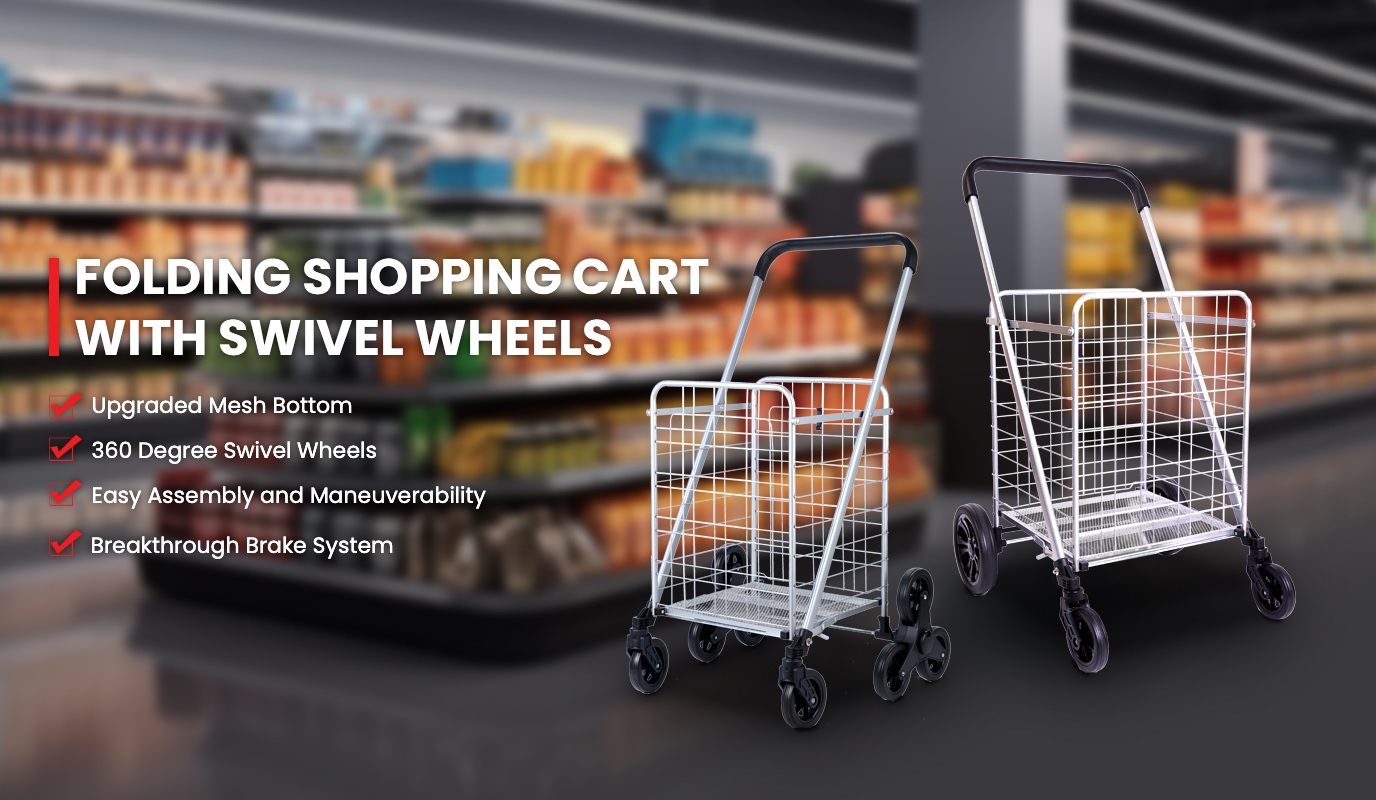
Fixed Wheel Trolley vs Swivel Wheel Trolley: Which Offers Better Control?
Fixed wheel trolleys generally offer better directional control and straight-line stability, while swivel wheel trolleys provide superior maneuverability in tight spaces. The better configuration depends on travel distance, turning frequency, floor conditions, load distribution, and the required handling speed.
What Is the Difference Between Fixed and Swivel Wheels?
The main difference is how the caster or wheel assembly responds when the trolley changes direction.
A fixed wheel trolley uses wheels aligned in a fixed direction. The wheels roll forward and backward along a predetermined path, making straight-line movement predictable.
A swivel wheel trolley uses casters that rotate around a vertical axis. This allows the trolley to change direction more easily and move through tighter spaces.
Commercial trolleys may also combine both configurations, such as two fixed wheels and two swivel casters, to balance stability with maneuverability.
Why Do Fixed Wheels Provide Better Directional Control?
Fixed wheels naturally resist unwanted lateral movement.
When a trolley is pushed forward, the wheels maintain their alignment with the direction of travel.
This provides advantages for:
Long straight routes
Narrow warehouse aisles
Repetitive transport paths
Heavy loads
Controlled positioning
The operator does not need to make constant steering corrections, which can make straight-line transportation more predictable.
For material handling, this characteristic can be particularly useful when the trolley carries a heavy or unevenly distributed load.
Why Are Swivel Wheels Better for Maneuverability?
Swivel casters can rotate independently of the trolley frame.
This allows the trolley to:
Turn within a small radius
Change direction quickly
Move around obstacles
Enter narrow spaces
Position beside workstations
This makes swivel-wheel configurations attractive for retail stores, hospitality environments, service areas, and other locations where frequent turning is required.
The trade-off is that a fully swivel configuration can require more steering input, especially under heavy loads.
How Do Fixed and Swivel Wheel Trolleys Compare?
| Factor | Fixed Wheel Trolley | Swivel Wheel Trolley |
|---|---|---|
| Straight-line control | Excellent | Good |
| Tight turning | Limited | Excellent |
| Direction changes | Controlled | Very easy |
| Heavy-load stability | Excellent | Good to excellent |
| Narrow-space maneuverability | Moderate | Excellent |
| Long-distance movement | Excellent | Good |
| Positioning flexibility | Moderate | Excellent |
| Steering effort | Predictable | Highly maneuverable |
| Best environment | Long routes | Crowded spaces |
Neither wheel configuration is universally better. The correct choice depends on how the trolley moves through the workplace.
Which Is Better for Heavy Loads?
Fixed wheels generally provide stronger directional stability under heavy loads.
When a heavily loaded trolley is pushed along a long route, fixed wheels help maintain a predictable path.
However, heavy-duty trolleys can also use a combination of fixed and swivel casters.
A common configuration is:
Two fixed wheels + two swivel casters
This arrangement provides directional stability while retaining reasonable turning capability.
For very heavy applications, caster load rating and wheel diameter are just as important as wheel orientation.
Which Is Better for Narrow Aisles?
Swivel wheels generally have the advantage.
Narrow aisles require frequent direction changes, and swivel casters make these movements easier.
Typical applications include:
Retail aisles
Hotel corridors
Hospital areas
Commercial kitchens
Maintenance spaces
Small warehouses
A trolley that can rotate and reposition easily can reduce the space required for maneuvering.
Which Is Better for Long-Distance Transportation?
Fixed wheels are often better for long, predictable routes.
Examples include:
Warehouse-to-production transport
Loading-area movement
Factory floor transportation
Distribution routes
When the trolley mainly travels forward, excessive swivel movement can make steering less predictable.
Fixed wheels maintain a stable direction and can make repetitive transportation more efficient.
Does Wheel Configuration Affect Operator Effort?
Yes.
The force required to move a trolley depends on:
Total load
Wheel diameter
Wheel material
Bearing quality
Floor condition
Caster design
Wheel configuration
Swivel casters can reduce the effort required for turning.
Fixed wheels can reduce unnecessary steering corrections during straight movement.
The most comfortable configuration is therefore determined by the route rather than the wheel type alone.
How Does Load Distribution Affect Control?
Load distribution has a major effect on trolley stability.
An uneven load can cause:
Steering deviation
Wheel overload
Increased caster resistance
Frame instability
Difficult turning
A trolley should be designed so that the load is distributed appropriately across the wheel system.
For heavy commercial trolleys, the manufacturer's calculation should consider both the total load and the position of the load.
A high center of gravity can also make a trolley more difficult to control during turns.
Are Four Swivel Casters Always Better?
No.
Four swivel casters provide excellent maneuverability, but they may not provide the same straight-line stability as a suitable fixed-and-swivel combination.
When all four casters swivel, the trolley can respond quickly to steering input.
This is useful for:
Tight workspaces
Short-distance movement
Frequent repositioning
For long straight routes or heavy loads, a mixed caster configuration can provide better control.
What Is the Advantage of Two Fixed and Two Swivel Wheels?
A two-fixed/two-swivel configuration provides a practical compromise.
The fixed wheels help maintain direction, while the swivel casters allow the trolley to turn.
This configuration is commonly useful for:
Platform carts
Service carts
Commercial material handling
Heavy-duty utility carts
The exact caster placement matters.
The design should account for:
Load center
Handle position
Turning radius
Wheel spacing
Overall trolley dimensions
How Does Wheel Diameter Affect Control?
Wheel diameter influences both mobility and stability.
Larger wheels can:
Cross thresholds more easily
Reduce rolling resistance
Handle uneven floors better
Maintain smoother movement
Smaller wheels can provide a lower platform height and compact design.
For outdoor or industrial applications, larger wheels are often more practical because floor conditions are less predictable.
Which Wheel Material Is Best?
The appropriate wheel material depends on the floor and load.
Common options include:
Rubber
PU
TPR
Nylon
Other engineered wheel compounds
Rubber can provide good grip and noise reduction.
PU can provide a balance of durability and floor protection.
Nylon can provide strong load performance on suitable smooth floors.
The wheel compound should be selected according to:
load + floor + noise requirements + chemical exposure + temperature.
How Do Floor Conditions Affect Wheel Control?
Floor conditions can change the best wheel configuration.
Smooth floors generally require less rolling resistance.
Uneven surfaces can create greater steering forces.
Potential obstacles include:
Thresholds
Ramps
Floor joints
Cracks
Uneven concrete
Outdoor pavement
A swivel caster that works well on a smooth retail floor may behave differently on rough industrial flooring.
Testing should therefore be performed on the actual or equivalent operating surface.
Which Is Better for Outdoor Trolleys?
The answer depends on the route.
Fixed wheels can provide better directional stability on long outdoor routes.
Swivel wheels can be more useful when the trolley must navigate:
Crowded areas
Outdoor markets
Building entrances
Irregular workspaces
For outdoor applications, wheel diameter and wheel material are particularly important because uneven surfaces can increase steering resistance.
Which Is Better for Retail Stores?
Swivel-wheel configurations are generally more suitable for retail environments where space is limited and frequent turns are required.
Shopping and service carts may need to:
Move between shelves
Turn around displays
Enter narrow aisles
Reposition near checkout areas
For larger retail stockrooms with longer straight transport routes, a mixed wheel configuration can provide a better balance.
Which Is Better for Warehouses?
Warehouses often benefit from fixed or mixed wheel configurations.
Long aisles favor directional stability.
Heavy loads favor predictable movement.
A mixed configuration can provide sufficient maneuverability without sacrificing straight-line control.
The optimal setup depends on:
Aisle width
Route length
Load weight
Turning frequency
Floor condition
Manual pushing force
How Does the Handle Affect Wheel Control?
Wheel configuration and handle design work together.
A handle provides the steering force that determines how the caster system responds.
Important handle factors include:
Handle height
Grip position
Handle width
Frame rigidity
Connection strength
A flexible frame can reduce steering precision even when high-quality casters are installed.
For commercial trolley design, the handle, frame, and caster system should therefore be developed as one control system.
Can Wheel Configuration Be Customized?
Yes.
Commercial trolley manufacturers can customize:
Number of wheels
Number of swivel casters
Fixed-wheel position
Wheel diameter
Wheel material
Brake configuration
Caster load rating
Wheel spacing
For example, a trolley designed for narrow retail aisles may prioritize swivel maneuverability, while an industrial trolley may prioritize fixed-wheel stability.
What Should Buyers Check Before Ordering?
Commercial buyers should evaluate:
Route
Determine whether the trolley mainly travels straight or requires frequent turns.
Load
Specify normal and maximum working loads.
Floor
Identify smooth, uneven, outdoor, or threshold-heavy surfaces.
Turning space
Measure aisle width and required turning radius.
Wheel diameter
Select a size appropriate for the floor and load.
Wheel material
Consider grip, noise, wear, and floor protection.
Caster configuration
Decide between fixed, swivel, or mixed arrangements.
Manufacturer capability
Evaluate caster selection, frame design, wheel installation, load testing, quality control, customization, and production capacity.
Which Offers Better Control: Fixed or Swivel Wheel Trolley?
Fixed wheel trolleys generally provide better straight-line control and directional stability, while swivel wheel trolleys provide better maneuverability and turning control. For many commercial applications, a combination of fixed and swivel wheels offers the best balance between stability and flexibility.
The correct wheel system should be selected according to the trolley's actual route.
For long warehouse aisles and heavy loads, fixed wheels can provide predictable directional control. For retail aisles, service areas, and confined spaces, swivel casters offer greater maneuverability.
From a manufacturer's perspective, wheel control should be evaluated through caster configuration + wheel diameter + wheel material + load distribution + handle position + floor conditions.
A well-designed trolley is not simply equipped with the "best" wheels. It uses the right wheel arrangement for the way the trolley will actually move.