



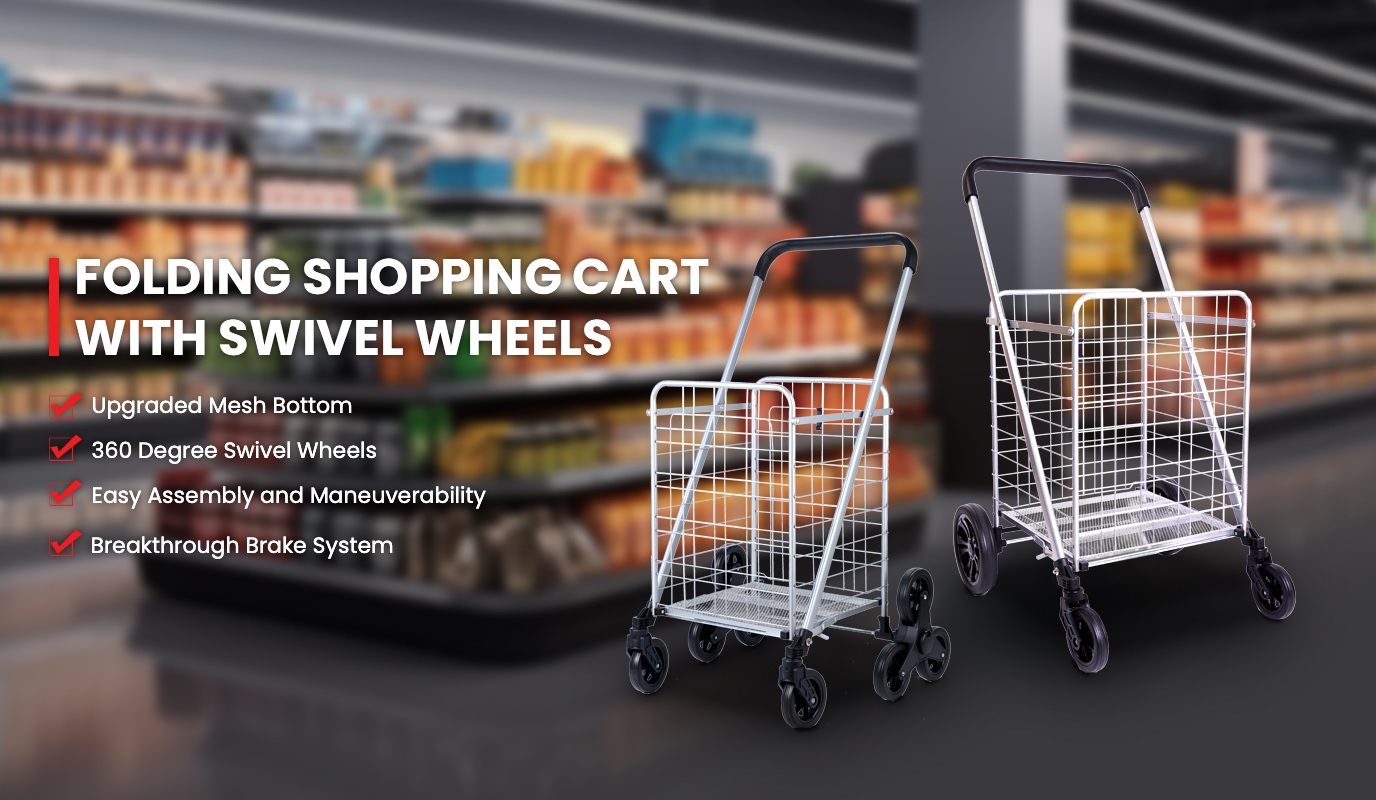
Mixed Material Trolley vs Single Material Trolley: Which Provides Better Manufacturing Value?
Mixed material trolleys often provide better manufacturing value because each component can use a material suited to its specific function. Single material trolleys simplify production and recycling, but may sacrifice weight, strength, corrosion resistance, or ergonomic performance. The better approach depends on the trolley's application and production volume.
What Is the Difference Between Mixed Material and Single Material trolleys?
A mixed material trolley combines two or more materials within the same product.
For example, a commercial trolley may use:
Steel for the main frame
Plastic for the basket
Rubber or polymer for the handle grip
PU or TPR for wheels
Stainless steel for selected contact components
A single material trolley relies primarily on one material family for its main structure and components.
The key difference is therefore not simply the number of materials. It is how effectively the manufacturer assigns each material to the function it performs best.
Why Are Mixed Material trolleys Used in Manufacturing?
Different trolley components experience different types of stress.
The frame needs structural strength, while the handle needs comfortable contact. Wheels need abrasion resistance and suitable rolling characteristics. A basket may require low weight, easy cleaning, or corrosion resistance.
Using one material for every component can create unnecessary compromises.
A mixed-material design allows manufacturers to optimize:
Structural strength
Product weight
User comfort
Corrosion resistance
Mobility
Manufacturing cost
Appearance
This can make the overall product more efficient than simply selecting one material for everything.
What Are the Advantages of Single Material Trolleys?
Single material construction can simplify manufacturing.
Potential advantages include:
Fewer raw materials
Simpler purchasing
Easier production planning
Reduced material separation
Straightforward recycling
More consistent appearance
For simple trolley designs and high-volume production, this simplicity can create meaningful manufacturing value.
However, the selected material must be capable of meeting all major functional requirements.
How Do Mixed Material and Single Material Trolleys Compare?
| Factor | Mixed Material Trolley | Single Material Trolley |
|---|---|---|
| Functional optimization | Excellent | Moderate |
| Material efficiency | Excellent | Moderate |
| Production complexity | Higher | Lower |
| Weight optimization | Excellent | Application dependent |
| Ergonomic options | Excellent | Moderate |
| Corrosion resistance | Can be targeted | Material dependent |
| Component replacement | Often flexible | Design dependent |
| Recycling simplicity | More complex | Easier |
| Customization | Excellent | Good |
| High-volume production | Excellent when standardized | Excellent |
The better manufacturing value depends on whether the project prioritizes functional optimization or production simplicity.
Which Provides Better Cost Performance?
Neither design is automatically cheaper.
A single-material trolley may have lower manufacturing complexity, but using one premium material across every component can increase material costs.
A mixed-material trolley may require more assembly steps, but less expensive materials can be used where premium performance is unnecessary.
For example, using steel for the frame and molded plastic for a basket can provide a practical balance between strength and weight.
The relevant calculation is:
Total manufacturing cost = material + processing + assembly + tooling + quality control + logistics + expected service life.
Does Mixed Material Construction Reduce Trolley Weight?
It can.
Manufacturers can select lightweight materials for components that do not require maximum structural strength.
For example:
Polymer basket → lower weight
Steel frame → high rigidity
Polymer grip → comfortable handling
Lightweight caster components → reduced rolling mass
Reducing unnecessary structural weight can improve both manufacturing efficiency and user handling.
However, weight reduction should never compromise the required working load.
Does Single Material Construction Improve Durability?
Not necessarily.
Durability depends on whether the material is appropriate for each component.
A steel-only trolley may provide excellent structural strength, but the handle can feel cold and the overall trolley may become unnecessarily heavy.
A plastic-only trolley can be lightweight and corrosion resistant, but may not provide sufficient rigidity for heavy industrial applications.
A mixed-material design can assign stronger materials to high-stress components and lighter materials to low-stress components.
This can improve overall performance without overengineering every part.
Which Design Is Better for Heavy-Duty Trolleys?
Mixed-material construction can provide strong advantages for heavy-duty applications.
A manufacturer can use:
Reinforced steel for the frame
Heavy-duty polymer or metal for the platform
High-capacity casters
Impact-resistant handle components
Suitable protective finishes
This allows each component to perform a defined role.
For extremely demanding applications, a predominantly metal construction may still be the most appropriate solution.
The correct decision depends on load, impact frequency, operating environment, and required service life.
How Does Material Selection Affect Trolley Mobility?
Mobility depends heavily on weight distribution and caster design.
A mixed-material trolley can reduce unnecessary weight while maintaining strength in the frame.
However, the wheel system remains critical.
Important factors include:
Wheel diameter
Wheel material
Bearing quality
Caster configuration
Load rating
Floor conditions
A lighter trolley does not automatically roll better if the caster system is poorly designed.
From a manufacturing perspective, frame weight and caster performance should be developed as one mobility system.
Can Mixed Materials Improve User Comfort?
Yes.
Different materials can be selected according to how users interact with each component.
For example, a trolley may use:
Rigid metal for the structural frame
Soft-touch polymer for the handle
Molded plastic for frequently touched surfaces
Low-noise wheels for quieter movement
This approach can improve:
Grip
Pushing comfort
Noise performance
Temperature feel
Handling control
A single-material trolley has fewer opportunities to optimize these characteristics independently.
Which Is Better for Corrosion Resistance?
Mixed-material construction can provide targeted corrosion protection.
For example, a trolley operating in a wet environment could combine:
Stainless steel frame
Plastic basket
Polymer handle
Corrosion-resistant casters
A single-material steel trolley would require a suitable protective treatment across the entire structure.
However, mixed-material designs also introduce interfaces between different materials, which must be engineered carefully.
Fasteners, joints, and metal contact points should be evaluated for corrosion and material compatibility.
Does Mixed Material Construction Increase Manufacturing Complexity?
Usually, yes.
More materials can mean:
More suppliers
More incoming inspections
Additional assembly steps
More component specifications
More inventory management
This complexity must be controlled through standardized production.
A capable manufacturer should establish clear specifications for each component and maintain consistency across batches.
The additional complexity is justified when the performance benefits are commercially meaningful.
Can Single Material Trolleys Be Easier to Manufacture?
Yes.
A simplified product can reduce the number of manufacturing processes.
This can help with:
Production planning
Inventory management
Assembly
Quality inspection
Material purchasing
For straightforward applications, this can make single-material construction attractive.
However, the simplest production process is not necessarily the most economical product over its entire lifecycle.
How Does Production Volume Affect the Decision?
Production volume can change the manufacturing economics.
For high-volume projects, mixed-material components can become highly efficient once:
Tooling is established
Component specifications are standardized
Assembly procedures are optimized
Suppliers are stable
For smaller orders, the additional tooling and component management associated with multiple materials may have a greater impact on cost.
The manufacturer should therefore evaluate the expected quantity before selecting the production structure.
Is Single Material Construction Better for Recycling?
It can be.
A trolley made primarily from one material is generally easier to separate and process at the end of its service life.
Mixed-material products may require disassembly before recycling.
However, recyclability should be evaluated together with service life.
A trolley that lasts significantly longer can reduce the frequency of replacement, which may offset some of the complexity associated with multiple materials.
For commercial buyers, the complete lifecycle should be considered.
How Does Mixed Material Design Affect Repair?
Mixed-material construction can make component replacement more targeted.
For example, if a trolley has:
Replaceable wheels
A separate handle grip
A removable plastic basket
A reinforced metal frame
one damaged component may be replaced without discarding the entire trolley.
This can reduce maintenance costs and extend service life.
A single-material trolley can also use replaceable components, so repairability ultimately depends more on product architecture than material count.
Can Mixed Material Trolleys Support OEM and ODM Projects?
Yes.
Mixed-material construction can provide substantial flexibility for OEM and ODM development.
Manufacturers can customize:
Frame material
Basket material
Handle design
Wheel composition
Surface treatment
Dimensions
Color
Branding
This is useful when a brand wants a specific balance between appearance, weight, durability, and cost.
The manufacturer should confirm that each material and component remains compatible with the production process.
What Manufacturing Capabilities Matter Most?
Material selection creates value only when the manufacturer can process the materials consistently.
Important capabilities include:
Metal cutting
Tube bending
Welding
Plastic molding
Surface treatment
Component assembly
Wheel installation
Dimensional inspection
Load testing
Final quality control
For mixed-material products, assembly accuracy becomes especially important because different components must work together correctly.
From a manufacturer's perspective, the ability to control the complete production chain is often more important than having the lowest individual material price.
What Should Buyers Check Before Ordering?
Commercial buyers should evaluate:
Application
Define whether the trolley is intended for retail, warehouse, hospitality, healthcare, industrial, or outdoor use.
Load requirement
Specify normal and maximum working loads.
Material function
Ask why each material is being used rather than focusing only on the material name.
Service environment
Consider moisture, chemicals, temperature, UV exposure, and impact.
Component replacement
Confirm whether wheels, handles, baskets, or other parts can be replaced independently.
Production volume
Determine whether tooling and multiple component processes are justified.
Quality control
Review material inspection, assembly inspection, load testing, and final inspection.
Manufacturer capability
Evaluate engineering, metal fabrication, molding, welding, surface treatment, assembly, testing, customization, and production capacity.
Which Provides Better Manufacturing Value: Mixed Material or Single Material Trolley?
Mixed material trolleys generally provide better manufacturing value when different components require different performance characteristics, because each material can be optimized for strength, weight, comfort, corrosion resistance, or mobility. Single material trolleys provide better value when simplicity, easy production, and straightforward recycling are the main priorities.
The strongest design is not necessarily the one with the fewest materials.
From a manufacturer's perspective, manufacturing value comes from using the right material in the right location while keeping assembly, quality control, and supply management under control.
For heavy-duty frames, metal may provide the required structural foundation. Plastic can reduce basket weight, polymers can improve handle comfort, and specialized wheel materials can improve mobility.
The objective is not to maximize the number of materials, but to create the best balance of performance + manufacturing efficiency + service life + total cost for the intended application.