



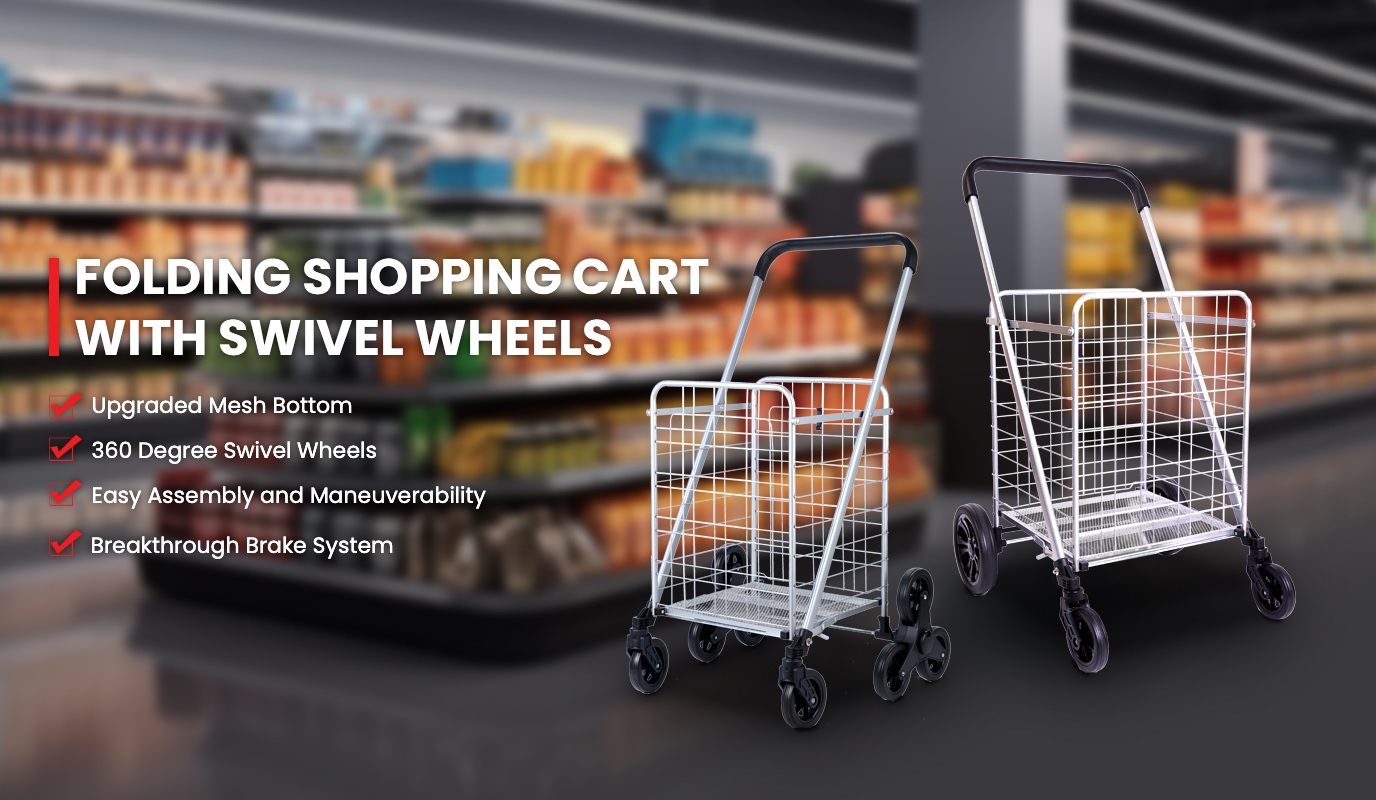
Plastic Handle Cart vs Metal Handle Cart: Which Improves User Comfort?
Plastic handle carts generally provide better hand comfort because plastic can offer a warmer, smoother, and more ergonomic grip. Metal handles can provide excellent strength and durability, especially when paired with a suitable grip sleeve or ergonomic coating. The better choice depends on grip design, temperature, load, and frequency of use.
What Is the Difference Between Plastic and Metal Cart Handles?
The handle is one of the most frequently touched parts of a trolley, so its design directly affects the user's experience.
A plastic handle cart uses molded or covered plastic for the hand-contact area. Plastic allows manufacturers to create rounded profiles, textured surfaces, and ergonomic shapes.
A metal handle cart typically uses steel or aluminum tubing. Metal provides strong structural support and can withstand repeated pushing and pulling forces.
The comfort difference therefore comes from more than the basic material. Important factors include:
Handle diameter
Surface texture
Edge radius
Temperature
Grip shape
Handle height
Load weight
Contact time
Why Can Plastic Handles Improve User Comfort?
Plastic provides several characteristics that are useful for hand-contact surfaces.
A properly designed plastic handle can provide:
Smooth contact
Rounded edges
Better grip texture
Lower perceived coldness
Comfortable hand positioning
Flexible ergonomic shapes
For Shopping Carts and service trolleys, these features can make a noticeable difference when users push the cart for extended periods.
The plastic itself is not automatically comfortable. The shape and surface finish must be designed around the user's hand.
What Are the Advantages of Metal Handles?
Metal handles provide excellent structural strength.
They are suitable for carts exposed to:
Heavy loads
Frequent pushing
Impacts
Continuous commercial use
Metal also provides a rigid connection between the handle and frame.
For heavy-duty trolleys, this rigidity can be more important than the material's direct hand-contact characteristics.
A metal handle can also be covered with plastic, rubber, foam, or another grip material to combine structural strength with improved comfort.
How Do Plastic and Metal Handles Compare?
| Factor | Plastic Handle | Metal Handle |
|---|---|---|
| Hand comfort | Excellent when ergonomically designed | Moderate to good |
| Structural strength | Application dependent | Excellent |
| Grip customization | Excellent | Good with added grip |
| Temperature feel | Generally more comfortable | Can feel hot or cold |
| Surface texture | Highly customizable | Limited without coating |
| Heavy-duty use | Application dependent | Excellent |
| Impact resistance | Material dependent | Excellent |
| Cleaning | Easy | Easy |
| Long-term durability | Design dependent | Excellent |
| Ergonomic shaping | Excellent | Good |
Plastic generally has the advantage for direct hand comfort, while metal has the advantage for structural strength.
Does Handle Shape Matter More Than Material?
Often, yes.
A poorly shaped plastic handle can be less comfortable than a well-designed metal handle with an ergonomic grip.
Important design factors include:
Diameter
A handle that is too thin can create concentrated pressure on the hand.
A handle that is too thick can make gripping difficult.
Profile
Rounded or ergonomically shaped profiles can distribute hand pressure more effectively.
Surface Texture
A suitable texture can improve grip without creating excessive friction.
Edge Radius
Sharp edges should be avoided in the hand-contact area.
For commercial trolley development, handle geometry should be evaluated together with the material.
How Does Handle Height Affect Comfort?
Handle height can significantly influence pushing posture.
A handle positioned too low may force taller users to bend forward.
A handle positioned too high can make pushing less natural for shorter users.
The appropriate height depends on:
User population
Cart dimensions
Wheel configuration
Application
Typical load
For retail shopping carts, the handle should provide a comfortable pushing position for a broad range of users.
For industrial trolleys, handle height can be optimized for the workers and operating environment.
Which Handle Is Better for Long-Term Pushing?
Plastic-covered handles can provide better comfort during extended pushing because the hand-contact surface can be shaped and textured for ergonomic use.
However, the complete handle assembly must remain structurally strong.
For heavy-duty applications, a common approach is to use a strong metal tube as the structural core and add a plastic or polymer grip around the contact area.
This combines:
metal strength + ergonomic grip + controlled surface texture.
Does Metal Feel Colder Than Plastic?
Generally, yes.
Metal conducts heat much more readily than plastic, so a metal handle can feel colder when used in a cold environment.
This can affect comfort in:
Outdoor retail
Cold warehouses
Refrigerated areas
Winter conditions
Plastic has lower thermal conductivity, so it generally feels less cold to the hand.
The same principle also applies to hot environments, where metal can become uncomfortable if exposed to high temperatures.
Is Plastic Better for Outdoor Cart Handles?
Plastic can provide practical advantages outdoors.
It does not rust, and its lower thermal conductivity can make the handle more comfortable under certain weather conditions.
However, outdoor plastic components should be evaluated for:
UV exposure
Temperature changes
Impact resistance
Material aging
A plastic handle designed only for indoor use may not provide the same long-term performance outdoors.
Which Handle Is Easier to Clean?
Both materials can be easy to clean when the surface is properly designed.
Plastic handles can have:
Smooth molded surfaces
Rounded profiles
Integrated textures
Metal handles can also be cleaned effectively, particularly when they have suitable surface finishes.
For carts used in supermarkets, hospitals, food service, or other hygiene-sensitive areas, the handle should minimize unnecessary grooves and areas where dirt can accumulate.
How Does Grip Texture Affect User Comfort?
Texture needs to balance grip and pressure.
A completely smooth surface may become slippery when:
Wet
Oily
Sweaty
An excessively aggressive texture can create uncomfortable pressure points during prolonged use.
A moderate texture can provide sufficient grip while maintaining a comfortable contact surface.
For commercial cart production, the right texture should be selected according to the environment and expected hand contact.
Does Load Weight Affect Handle Comfort?
Yes.
As the cart becomes heavier, the user applies greater force to the handle.
This increases the importance of:
Handle diameter
Grip texture
Handle height
Frame rigidity
Wheel resistance
A comfortable handle cannot compensate for poorly performing wheels.
If the casters create excessive rolling resistance, the user must apply greater pushing force regardless of handle material.
How Important Are Wheels to Overall Comfort?
Wheel performance can be just as important as handle design.
A trolley's pushing effort depends on:
Wheel diameter
Wheel material
Bearing quality
Caster configuration
Floor condition
Load
Larger wheels can make thresholds and uneven surfaces easier to cross.
Smooth-running casters reduce the force transferred through the handle to the user's hands and arms.
From a manufacturer's perspective, handle comfort should therefore be tested as part of the complete trolley system, not as an isolated component.
Which Is Better for Shopping Carts?
Plastic or polymer-covered handles are generally better for customer comfort.
Shopping carts are pushed by a wide range of users, and many customers may hold the handle for extended periods.
A comfortable handle can provide:
Better grip
Lower pressure points
More pleasant touch
Improved control
Metal remains valuable as the structural foundation, especially for commercial shopping carts.
A metal frame combined with a comfortable polymer grip can therefore provide an effective balance.
Which Is Better for Industrial Trolleys?
Metal handles generally have an advantage when structural strength is the primary requirement.
Industrial trolleys may carry:
Heavy components
Tools
Machinery parts
Large cartons
Production materials
Workers may apply substantial force to the handle when starting, stopping, or turning the trolley.
A strong metal handle can tolerate these loads effectively.
Adding an ergonomic grip can improve comfort without sacrificing structural performance.
Can Plastic and Metal Handles Be Customized?
Yes.
Commercial trolley manufacturers can customize:
Handle diameter
Handle height
Grip shape
Surface texture
Frame connection
Handle material
Grip color
Logo placement
For plastic handles, molding can create specific ergonomic profiles.
For metal handles, manufacturers can adjust tube diameter, wall thickness, bending geometry, and add polymer grips or sleeves.
For OEM projects, handle development should begin with the user's working posture and load requirements.
Which Handle Material Is More Durable?
Metal generally has an advantage in structural durability.
However, the hand-contact portion of a trolley handle may experience different types of wear.
Plastic can eventually be affected by:
UV exposure
Temperature
Impact
Chemical exposure
Metal can experience:
Corrosion
Scratches
Surface wear
Deformation from severe impacts
The expected service life depends on the material grade, design, environment, and manufacturing process.
How Does Manufacturing Quality Affect Handle Performance?
A high-quality handle requires more than choosing the correct material.
Manufacturing controls may include:
Tube forming
Bending accuracy
Welding
Joint reinforcement
Plastic molding
Grip installation
Surface finishing
Dimensional inspection
For metal handles, weld quality and frame connection are especially important.
For molded plastic grips, dimensional consistency and material quality affect both comfort and durability.
From a manufacturer's perspective, the handle should be treated as a load-bearing and user-contact component simultaneously.
What Should Buyers Check Before Ordering?
Commercial buyers should evaluate:
User group
Determine whether the trolley is intended for customers, warehouse workers, cleaners, or other operators.
Typical load
Heavy loads increase pushing force and handle stress.
Usage frequency
Daily high-frequency use requires greater attention to ergonomic design.
Handle dimensions
Check height, diameter, profile, and grip length.
Surface texture
Confirm that the grip provides sufficient traction without excessive roughness.
Operating environment
Consider indoor, outdoor, humid, cold, hot, or chemical-exposure conditions.
Wheel performance
Evaluate caster diameter, material, bearings, load rating, and rolling resistance.
Manufacturer capability
Review frame fabrication, handle forming, plastic molding, welding, assembly, quality control, testing, customization, and production capacity.
Which Improves User Comfort: Plastic or Metal Cart Handle?
Plastic handles generally provide better direct hand comfort because they can be molded into ergonomic shapes and offer a warmer, more controllable grip surface. Metal handles provide stronger structural performance but may feel cold or uncomfortable without an added grip.
For commercial trolley design, the best solution is often not a choice between plastic and metal.
A strong metal tube can provide the required structural strength while a plastic or polymer grip improves the user's contact experience.
From a manufacturer's perspective, the most effective handle design combines ergonomic geometry + suitable diameter + controlled texture + structural strength + appropriate temperature and environmental performance.
The right design ultimately depends on who uses the cart, how much it carries, how frequently it moves, and where it operates.