



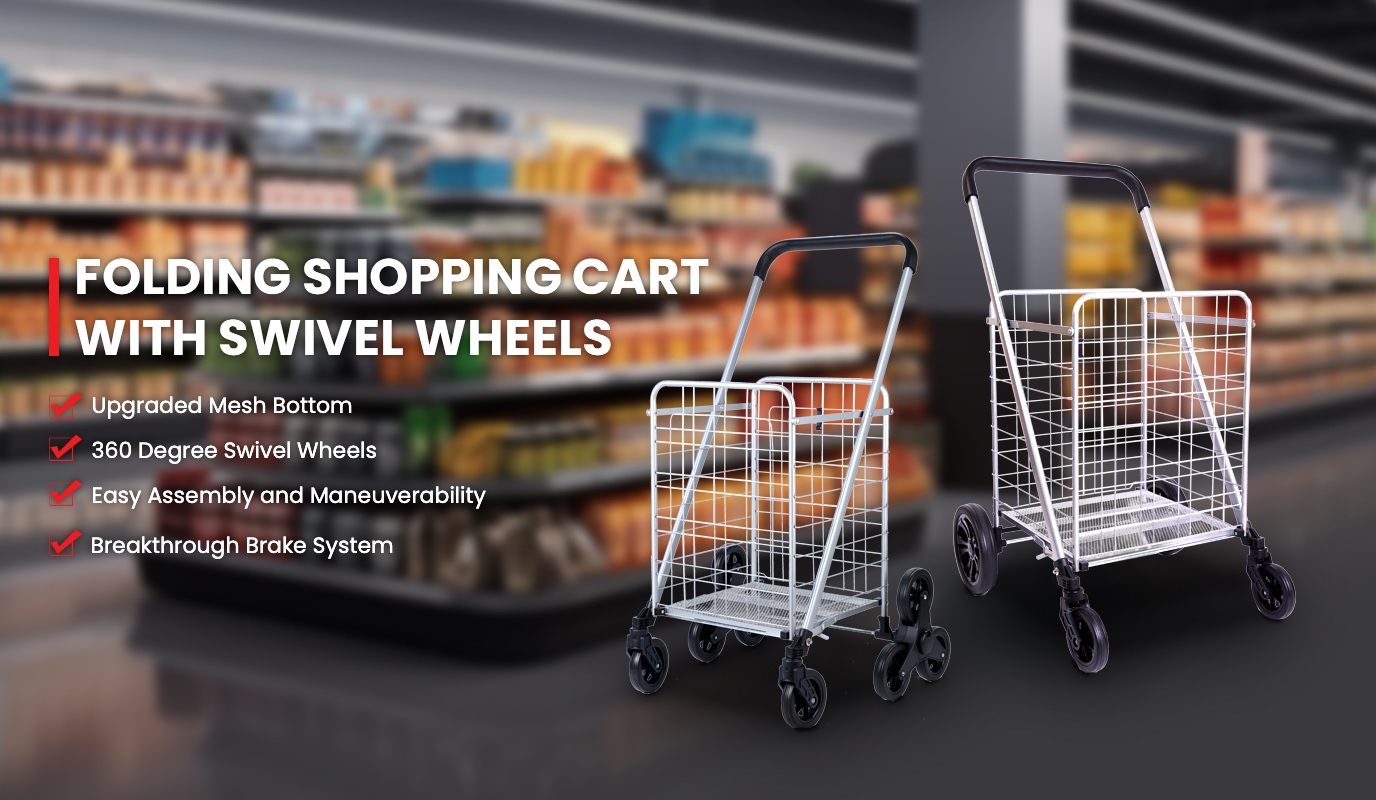
4 Inch Wheels vs 5 Inch Wheels on Trolleys: Which Size Fits Different Applications?
5-inch wheels generally provide better mobility over thresholds, uneven floors, and heavier loads, while 4-inch wheels offer a lower platform height and more compact handling. The right size depends on load, floor condition, obstacle height, trolley dimensions, and operating environment.
What Is the Difference Between 4-Inch and 5-Inch Trolley Wheels?
The main difference is wheel diameter.
A 4-inch wheel has a smaller overall diameter and can help keep the trolley platform relatively low. This can simplify loading and unloading, especially when users frequently place goods onto the trolley by hand.
A 5-inch wheel provides a larger rolling diameter. The additional diameter helps the wheel pass over small floor irregularities and thresholds more smoothly.
The difference of one inch may appear small, but wheel diameter affects:
Rolling resistance
Obstacle crossing
Platform height
Load behavior
Ride smoothness
Trolley stability
Maneuverability
Why Does Wheel Size Matter for Commercial Trolleys?
Wheels are the connection between the trolley and the floor.
Every movement depends on the wheels handling:
Cart weight
Cargo weight
Floor resistance
Surface irregularities
Turning forces
Starting and stopping forces
A wheel that is too small for the environment can make a trolley difficult to push even when the frame is strong.
For commercial trolley design, wheel size should therefore be selected together with the trolley's working load and actual floor conditions.
How Do 4-Inch and 5-Inch Wheels Compare?
| Factor | 4-Inch Wheels | 5-Inch Wheels |
|---|---|---|
| Platform height | Lower | Slightly higher |
| Smooth-floor movement | Excellent | Excellent |
| Threshold crossing | Good | Better |
| Uneven-floor performance | Moderate to good | Good to excellent |
| Heavy-load suitability | Good | Better |
| Compact trolley design | Excellent | Good |
| Maneuverability | Excellent | Very good |
| Rolling over obstacles | Moderate | Better |
| Loading height | Advantage | Slight disadvantage |
| Outdoor suitability | Application dependent | Generally better |
Neither size is universally better. The correct choice depends on what the trolley needs to do.
Are 4-Inch Wheels Better for Low-Profile Trolleys?
Yes.
A smaller wheel can help reduce overall trolley height.
This can be valuable when the trolley is designed for:
Low loading platforms
Under-counter storage
Compact workstations
Small retail areas
Short-distance material handling
A lower platform can reduce the lifting height required when loading goods.
This can be particularly useful when workers repeatedly transfer boxes or containers onto the trolley.
Why Are 5-Inch Wheels Better at Crossing Thresholds?
A larger wheel has a geometric advantage when passing over an obstacle.
When a trolley encounters:
Door thresholds
Floor joints
Small ramps
Uneven concrete
Surface gaps
the larger diameter can roll over the obstacle more smoothly.
A 5-inch wheel generally requires less abrupt climbing over the same small obstacle than a 4-inch wheel.
This difference becomes more noticeable as trolley loads increase.
Which Wheel Size Is Better for Heavy Loads?
5-inch wheels generally provide an advantage for heavier commercial loads.
A larger wheel can offer:
Better obstacle crossing
Smoother movement
Improved load handling
Reduced sensitivity to small floor irregularities
However, wheel diameter alone does not determine load capacity.
The complete caster system must be considered, including:
Wheel width
Wheel material
Bearing design
Axle
Caster frame
Load rating
A properly rated 4-inch industrial wheel can outperform an underspecified 5-inch wheel.
Which Is Better for Smooth Warehouse Floors?
Both sizes can work effectively on smooth warehouse floors.
A 4-inch wheel can be sufficient when:
Floors are level
Loads are moderate
Routes are short
Platform height matters
A 5-inch wheel becomes more attractive when the trolley carries heavier loads or travels longer distances.
For smooth floors, the wheel compound and bearing system may have a greater effect on rolling resistance than the one-inch difference in diameter.
Which Is Better for Uneven Floors?
5-inch wheels generally perform better.
Uneven floors increase the importance of wheel diameter because larger wheels can bridge small surface irregularities more effectively.
Potential examples include:
Rough concrete
Floor joints
Warehouse transitions
Outdoor pavement
Loading docks
For these environments, a larger wheel can provide smoother movement and reduce vibration transferred to the trolley frame.
Which Is Better for Outdoor Use?
5-inch wheels are often the more practical choice for outdoor trolleys.
Outdoor surfaces may contain:
Cracks
Small stones
Pavement joints
Uneven sections
Drainage channels
The larger diameter can make these obstacles easier to cross.
However, outdoor performance also depends on wheel material and construction.
Rubber may be useful where shock absorption and grip are important, while PU can provide strong wear resistance on suitable surfaces.
Does Wheel Size Affect Trolley Stability?
Yes.
Wheel diameter influences how the trolley responds to floor irregularities.
A larger wheel can maintain smoother movement when crossing small obstacles.
However, stability also depends on:
Wheel spacing
Caster arrangement
Trolley width
Center of gravity
Load distribution
Frame rigidity
A 5-inch wheel does not automatically make a trolley more stable if the load is poorly positioned.
Does a 5-Inch Wheel Make the Trolley Harder to Maneuver?
Not necessarily.
A larger wheel can improve movement over obstacles, but the overall turning performance depends on the caster design.
Important factors include:
Swivel radius
Caster offset
Wheel width
Bearing quality
Trolley weight
A well-designed 5-inch swivel caster can remain highly maneuverable.
In tight indoor spaces, however, a compact trolley with 4-inch casters may offer sufficient mobility while maintaining a lower profile.
Which Wheel Size Requires Less Pushing Force?
There is no universal answer.
Rolling resistance depends on:
Wheel diameter
Wheel material
Load
Bearing quality
Floor condition
Wheel alignment
Larger wheels can reduce the effect of small obstacles and surface irregularities.
On a perfectly smooth floor, the difference between 4-inch and 5-inch wheels may be less significant.
On rougher surfaces, the 5-inch wheel can require less effort because it handles irregularities more effectively.
How Does Wheel Material Change the Result?
Wheel diameter should never be evaluated independently of material.
A 4-inch rubber wheel and a 5-inch PU wheel can behave very differently.
Common wheel materials include:
Rubber
PU
TPR
Nylon
Rubber generally provides stronger shock absorption and grip.
PU can provide excellent wear resistance and rolling efficiency.
Nylon can provide strong load performance on appropriate smooth surfaces.
The correct combination depends on the floor and application.
How Does Wheel Width Affect Performance?
Wheel width affects contact with the floor and load distribution.
Wider wheels can provide:
Greater contact area
Better load distribution
Increased stability
However, excessive width can increase rolling resistance or limit clearance around the caster.
For a commercial trolley, diameter and width should be selected together.
Which Size Is Better for Shopping Carts?
4-inch or 5-inch wheels can both work well for shopping carts.
The preferred size depends on:
Store flooring
Cart dimensions
Customer load
Aisle conditions
Thresholds
4-inch wheels can help maintain a compact and relatively low cart structure.
5-inch wheels may provide smoother movement across transitions and heavier loads.
For customer-facing applications, wheel noise and steering response should also be considered.
Which Size Is Better for Warehouse Carts?
5-inch wheels are often more suitable for warehouse carts.
Warehouse carts may need to travel across:
Concrete floors
Floor joints
Loading areas
Long aisles
Production zones
The larger wheel can provide better obstacle handling and smoother movement.
A 4-inch wheel can still be appropriate for compact picking carts and smooth-floor applications where low height is important.
Which Size Is Better for Hospitality Trolleys?
4-inch wheels can be suitable for indoor hospitality trolleys where floor surfaces are relatively smooth and compact handling is important.
Applications may include:
Hotel service carts
Housekeeping carts
Restaurant service carts
Indoor utility trolleys
If the trolley must cross thresholds frequently or carry heavy loads, 5-inch wheels may provide better mobility.
How Does Wheel Size Affect Platform Height?
This is one of the clearest differences.
A larger wheel increases the distance between the trolley frame and the floor unless the frame design compensates for it.
For low-profile platform carts, 4-inch wheels can help keep the loading surface lower.
For heavy-duty carts, the additional height of 5-inch wheels may be acceptable because the mobility benefits are more important.
The correct decision depends on how frequently operators load and unload the trolley.
Does Wheel Size Affect Service Life?
It can.
Larger wheels may reduce impact forces when crossing small obstacles, which can benefit both the wheel and trolley frame.
However, service life is strongly influenced by:
Load
Wheel material
Floor condition
Usage frequency
Bearing quality
Temperature
Maintenance
An overloaded 5-inch wheel can fail earlier than a correctly specified 4-inch wheel.
The working load should therefore always remain within the manufacturer's tested rating.
Can 4-Inch and 5-Inch Wheels Be Customized?
Yes.
Commercial trolley manufacturers can customize:
Wheel diameter
Wheel width
Wheel material
Wheel hardness
Bearing type
Fixed or swivel configuration
Brake system
Caster mounting
Load rating
This allows the same trolley structure to be adapted for different environments.
For example, a retail model may use 4-inch wheels for a compact profile, while a warehouse version may use 5-inch wheels for greater obstacle clearance.
What Should Buyers Check Before Choosing Wheel Size?
Commercial buyers should evaluate:
Floor condition
Identify smooth, uneven, rough, outdoor, or threshold-heavy surfaces.
Maximum load
Include both trolley weight and cargo weight.
Loading height
Determine whether a low platform is important for manual loading.
Obstacle height
Measure thresholds and floor transitions along the route.
Travel distance
Long-distance movement can increase the value of larger wheels and efficient bearings.
Wheel material
Select rubber, PU, TPR, nylon, or another compound according to the environment.
Caster configuration
Check fixed, swivel, or mixed arrangements.
Manufacturer capability
Evaluate wheel selection, caster assembly, frame engineering, load testing, quality control, customization, and production capacity.
Which Is Better: 4-Inch or 5-Inch Wheels for Trolleys?
4-inch wheels are generally better for compact, low-profile trolleys operating on smooth floors, while 5-inch wheels are better for heavier loads, uneven surfaces, thresholds, longer routes, and outdoor movement.
The one-inch difference should not be evaluated in isolation.
For a supermarket or indoor service trolley, 4-inch wheels may provide the desired balance of compactness and maneuverability. For warehouse, industrial, and Outdoor Carts, 5-inch wheels can provide better obstacle crossing and smoother loaded movement.
From a manufacturer's perspective, the correct wheel size should be selected through load + floor + obstacle height + platform height + wheel material + caster design, rather than assuming that a larger wheel is always better.
The best commercial trolley is the one whose wheel system matches the real working environment.