



Warehouse Cart vs Industrial Trolley: What Is the Difference for Material Handling?
Warehouse carts are generally designed for routine goods movement, while industrial trolleys are built around more demanding loads, longer operating cycles, and specialized handling conditions. The right choice depends on load, route, frequency, and working environment.
What Is the Difference Between a Warehouse Cart and an Industrial Trolley?
The terms warehouse cart and industrial trolley can overlap, but they usually describe different levels of material handling requirements.
A warehouse cart is commonly used for moving cartons, bins, packaged goods, tools, and inventory between receiving, storage, picking, packing, and dispatch areas. Platform, basket, cage, and folding carts can all serve warehouse operations. WOCHANG's warehouse trolley range reflects these different structures for different handling tasks.
An industrial trolley generally emphasizes higher structural strength, greater load capacity, durable casters, and repeated use in factories, workshops, production areas, or heavy-duty storage environments.
The distinction is therefore less about the name and more about the working conditions the trolley is engineered to handle.
When Is a Warehouse Cart More Suitable?
Warehouse carts are effective when the main requirement is flexible movement of ordinary inventory.
Typical applications include:
Carton transfer
Order picking
Stock replenishment
Packing operations
Retail backroom movement
Short-distance warehouse transportation
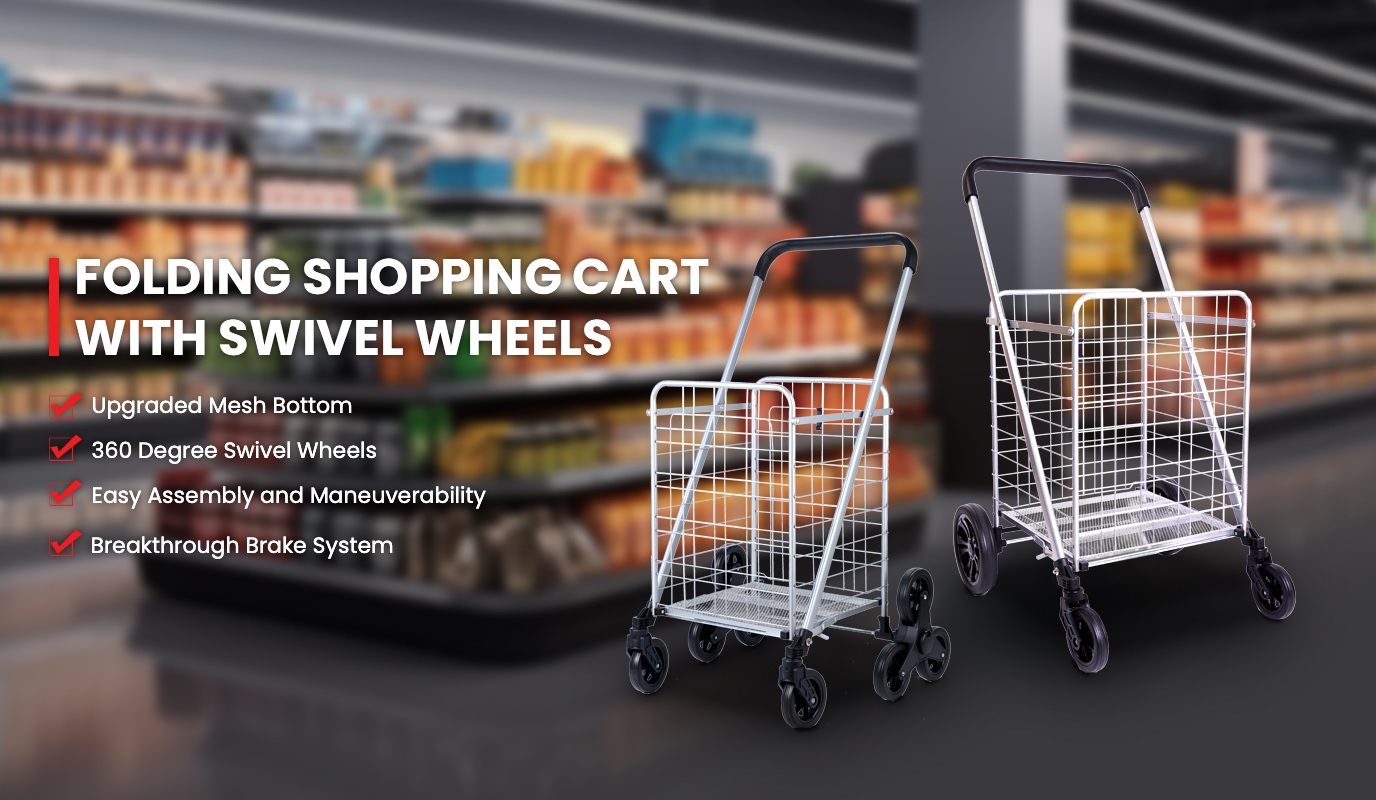
Platform carts are particularly useful when cartons or packaged goods can be placed directly on an open deck. Cage carts provide additional containment for loose or mixed items, while folding carts can save space when the trolley is not being used.
For standard warehouse workflows, selecting a cart that matches the load and route is often more important than simply choosing the highest-capacity model.
What Makes an Industrial Trolley Different?
Industrial trolleys are normally selected when the operating conditions are more demanding.
They may be used for:
Metal components
Machinery parts
Heavy tools
Industrial materials
Large cartons
Production-line components
Bulk goods
Industrial applications often require stronger frames, reinforced joints, higher-capacity wheels, and better resistance to repeated loading.
WOCHANG's manufacturing guidance identifies heavy-duty trolleys as suitable for industrial components, appliances, hardware, and bulk materials, while platform trolleys are used for more general material transfer.
How Do Warehouse Carts and Industrial Trolleys Compare?
| Factor | Warehouse Cart | Industrial Trolley |
|---|---|---|
| Typical load | Light to medium | Medium to heavy |
| Main application | Warehouse goods movement | Industrial material handling |
| Frame requirement | Standard | Reinforced or heavy duty |
| Wheel requirement | Standard commercial casters | Higher-capacity casters |
| Usage frequency | Regular | Often intensive |
| Load types | Cartons, bins, packages | Parts, tools, machinery, bulk materials |
| Customization | Moderate | Often application-specific |
| Main priority | Flexibility and efficiency | Strength and durability |
These categories are not absolute. A heavy-duty warehouse cart can perform industrial tasks, while a lighter industrial trolley may also be suitable for moderate warehouse work.
How Does Load Capacity Affect the Choice?
Load capacity should be the starting point when selecting material handling equipment.
Buyers should consider both:
Maximum possible load
Normal daily working load
A trolley that is technically capable of carrying an occasional heavy load may not be appropriate if it operates at that load every day.
WOCHANG's warehouse trolley guidance suggests that light warehouse applications may require around 150–300 kg, medium applications around 300–500 kg, and heavy-duty applications around 500–1000 kg, depending on frame structure, caster size, wheel material, and platform design.
The correct specification should therefore be based on the complete trolley system, not only the frame.
How Important Are Wheels for Industrial Material Handling?
Wheel performance becomes increasingly important as load and travel distance increase.
A suitable wheel system should consider:
Load Rating
The casters need sufficient capacity for the total trolley weight plus cargo.
Wheel Diameter
Larger wheels can improve movement across thresholds and minor floor irregularities.
Wheel Material
PU wheels can be useful on smooth indoor floors where quiet movement and floor protection matter. Rubber or other heavy-duty wheel options may be more suitable for different floor conditions.
Caster Configuration
Swivel casters improve turning flexibility, while fixed wheels can provide directional stability.
For industrial buyers, caster selection should be treated as part of the trolley's engineering rather than an accessory decision.
Which Is Better for Factory Production Lines?
For production lines, the choice depends on what is being transferred.
A standard warehouse cart can work well for:
Packaging materials
Small cartons
General supplies
Lightweight components
An industrial trolley is more suitable when moving:
Heavy components
Metal parts
Machinery accessories
Bulk production materials
WOCHANG's factory application guidance identifies platform trolleys for transferring components between workstations and heavy-duty trolleys for raw materials, hardware, appliances, and other heavier goods.
The trolley should therefore be selected according to the production stage rather than treating the entire factory as one handling environment.
Which Is Better for Order Picking?
Warehouse carts are generally more suitable for order picking because flexibility and maneuverability are often more important than maximum load capacity.
Different trolley structures can support different picking methods:
Platform carts for cartons
Cage carts for mixed goods
Multi-layer carts for smaller products
Folding carts for temporary picking operations
Heavy-duty carts for heavier products
WOCHANG's order-picking guidance specifically connects trolley selection with aisle width, product size, load capacity, floor conditions, and picking frequency.
For picking operations, a trolley that moves smoothly through aisles can be more productive than a heavier model with unnecessary capacity.
How Does the Working Environment Affect Trolley Selection?
The operating environment can change the appropriate trolley specification.
Smooth Indoor Warehouse
A standard platform trolley with suitable PU casters may provide sufficient performance.
Manufacturing Workshop
A stronger frame and more durable wheel system may be necessary.
Outdoor Handling Area
Weather exposure and surface conditions make corrosion protection and wheel selection more important.
Long-Distance Internal Transport
Comfortable handles, smooth casters, and stable load support become increasingly important.
WOCHANG's industrial application guidance recommends considering load, route, floor condition, aisle width, and handling frequency together rather than selecting a trolley based only on price or appearance.
How Do Materials Affect Warehouse and Industrial Trolley Performance?
The frame is typically the most important structural component.
Steel remains widely used because it provides:
High structural strength
Stable welding performance
Good load support
Practical manufacturing cost
Other materials and components are selected according to the application. Plastic may be used for handles and functional components, while different wheel materials provide different combinations of load capacity, noise control, floor protection, and wear resistance.
Surface treatment is also important. Powder coating, zinc treatment, and other protective finishes can help improve corrosion resistance and service life.
Can Warehouse Carts and Industrial Trolleys Be Customized?
Yes. Customization is particularly valuable when standard products do not match the actual handling process.
A manufacturer can potentially adjust:
Platform dimensions
Basket or cage structure
Frame strength
Load capacity
Handle height
Wheel diameter
Caster configuration
Brake system
Surface treatment
Folding mechanism
For project orders, the manufacturer should understand the cargo weight, dimensions, handling route, floor conditions, daily frequency, storage requirements, and order quantity before recommending a configuration.
What Should Buyers Check Before Ordering?
Before purchasing a warehouse cart or industrial trolley, commercial buyers should evaluate:
Actual working load
Determine the normal and maximum loads rather than selecting only by appearance.
Cargo dimensions
Check whether the platform, basket, or cage can accommodate the largest items.
Handling distance
Longer routes may require better wheels and more ergonomic handles.
Floor conditions
Consider smooth concrete, warehouse flooring, thresholds, ramps, and outdoor surfaces.
Usage frequency
Daily intensive handling requires more durable frames and casters.
Storage requirements
Folding or nesting designs may be useful when warehouse space is limited.
Manufacturer capability
Check frame fabrication, welding, wheel assembly, surface treatment, quality inspection, and customization capability.
Is a Warehouse Cart or Industrial Trolley Better for Material Handling?
A warehouse cart is usually better for flexible, routine inventory movement, while an industrial trolley is better for heavier loads, intensive use, and demanding working environments.
The distinction should not be based on terminology alone. The most appropriate trolley is determined by the relationship between load, cargo dimensions, route, floor condition, handling frequency, and required service life.
From a manufacturer's perspective, this is also why one trolley design cannot efficiently cover every material-handling application. WOCHANG's product guidance separates platform, hand, cage, folding, and heavy-duty trolley structures according to different warehouse, factory, logistics, and retail requirements.
For commercial buyers, selecting the trolley around the real workflow can improve movement efficiency, reduce unnecessary manual carrying, and provide more predictable long-term performance.