



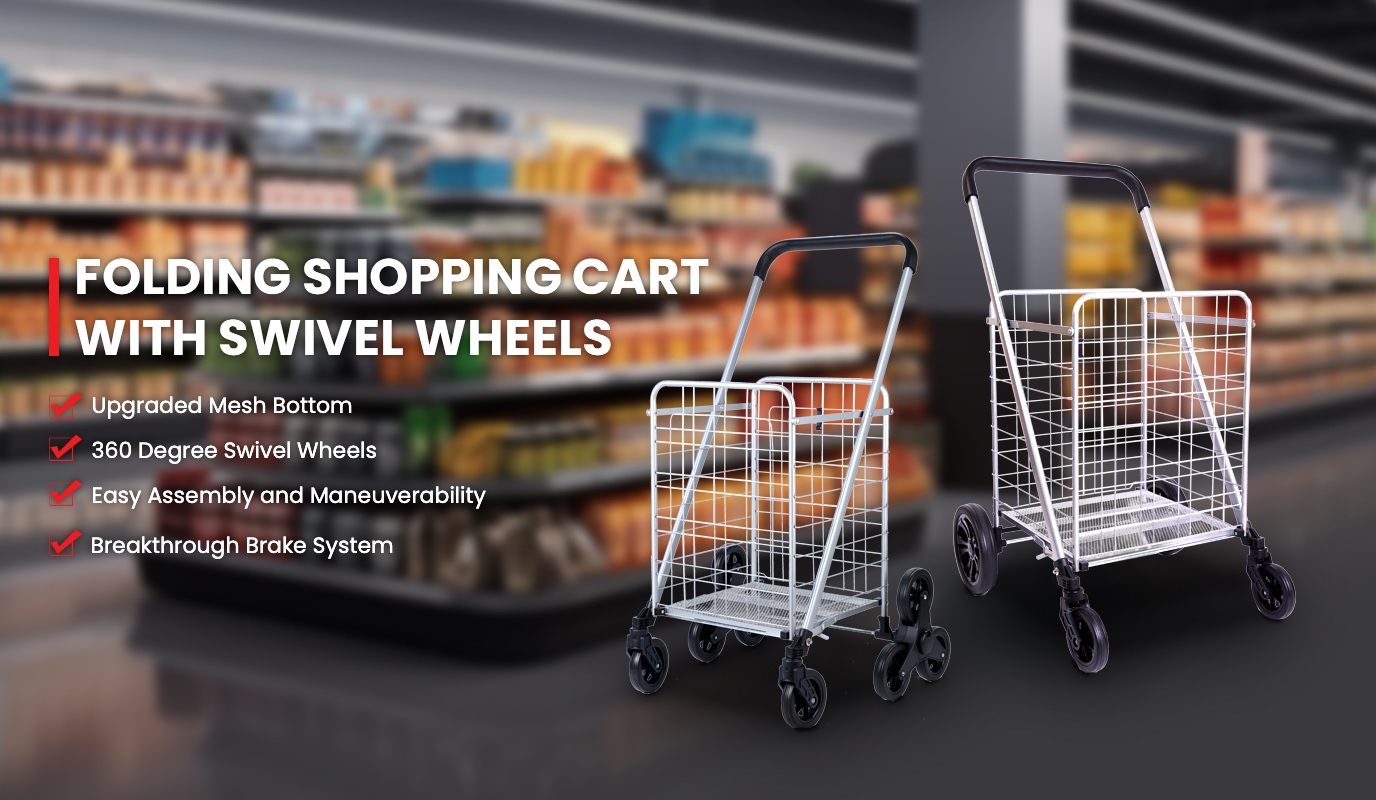
Flat Platform Cart vs Folding Platform Cart: Which Design Offers Better Flexibility?
Flat platform carts provide stronger and more consistent support for routine material handling, while folding platform carts offer greater storage and transportation flexibility. The better choice depends on load requirements, available space, handling frequency, and portability needs.
What Is the Difference Between Flat and Folding Platform Carts?
The primary difference is the way the cart is stored and transported when it is not being used.
A flat platform cart has a fixed platform and rigid frame. Its structure is designed for straightforward loading, pushing, and repeated commercial use.
A folding platform cart incorporates a collapsible handle or folding structure that allows the cart to become more compact after use.
The two designs therefore prioritize different forms of flexibility:
Flat platform cart: operational stability
Folding platform cart: storage flexibility
Flat platform cart: frequent commercial handling
Folding platform cart: portability and space saving
Neither design is universally better. The correct choice depends on the actual workflow.
What Are the Advantages of a Flat Platform Cart?
Flat platform carts are particularly practical when the trolley is used continuously in a fixed commercial environment.
Stable Working Structure
A fixed frame provides consistent support during loading and transportation.
This is useful for:
Warehouses
Factories
Stockrooms
Workshops
Distribution areas
The rigid structure also simplifies the cart's operating process because there are fewer moving structural components.
Suitable for Repeated Heavy Use
When employees move materials throughout the day, structural simplicity becomes valuable.
A flat platform cart can be designed around:
Platform strength
Frame rigidity
Caster capacity
Load distribution
This makes it suitable for routine commercial handling.
Easy Loading
The open horizontal platform provides a clear loading surface for:
Cartons
Equipment
Parts bins
Tools
Packaged goods
Different sizes of cargo can be positioned without being restricted by a fixed basket.
What Are the Advantages of a Folding Platform Cart?
Folding platform carts are designed for situations where the cart must be stored or transported after use.
Space-Saving Storage
Once folded, the trolley takes up considerably less space.
This is useful for:
Small stockrooms
Service vehicles
Delivery operations
Temporary work areas
Mobile businesses
Easier Transportation
A folding cart can be placed into a vehicle or moved between locations more conveniently than a rigid trolley.
This is particularly useful when one trolley serves several locations.
Flexible Deployment
Folding designs are practical when the trolley is not required continuously.
The cart can be unfolded when needed and stored compactly afterward.
How Do Flat and Folding Platform Carts Compare?
| Feature | Flat Platform Cart | Folding Platform Cart |
|---|---|---|
| Frame structure | Fixed | Folding |
| Storage efficiency | Standard | Excellent |
| Portability | Good | Excellent |
| Long-term fixed use | Excellent | Good |
| Heavy-duty potential | Higher | Model dependent |
| Storage space | More | Less |
| Moving components | Fewer | More |
The key distinction is that flat carts optimize working stability, while folding carts optimize space and portability.
Which Platform Cart Is Better for Warehouses?
For warehouses where carts are used throughout the day, a flat platform cart is often the more practical choice.
Warehouse operators commonly need to:
Move cartons
Transfer components
Replenish inventory
Transport packaging
Move tools
When the cart remains in constant operation, the benefits of a fixed frame can outweigh the storage advantages of a folding mechanism.
However, folding platform carts can be useful for smaller warehouses with limited storage areas or operations where carts are moved between different work zones.
Which Platform Cart Is Better for Delivery and Mobile Operations?
Folding platform carts generally have the advantage.
Delivery operators may need to transport the trolley inside:
Vans
Trucks
Service vehicles
Storage compartments
A folding structure reduces the amount of space occupied when the cart is not carrying goods.
For mobile operations, this can be more valuable than maximum structural rigidity.
How Does load capacity Affect the Choice?
Load requirements should be evaluated before choosing either design.
Flat platform carts generally provide greater freedom for reinforced construction because the frame does not need to accommodate folding movement.
Folding carts can still provide substantial load capacity, but the folding mechanism becomes part of the structural system.
Buyers should therefore examine:
Rated load capacity
Platform thickness
Frame construction
Folding mechanism
Locking structure
Caster load rating
A folding cart should always be evaluated in its fully deployed and locked condition, not only by its folded appearance.
Does Folding Affect Cart Durability?
It can, depending on the design and manufacturing quality.
A fixed platform cart has a relatively simple structure. A folding cart introduces additional components such as:
Hinges
Locking points
Folding joints
Moving connections
These components require reliable manufacturing and regular inspection.
For frequent commercial use, the quality of the folding mechanism is therefore just as important as the platform material.
A professionally manufactured folding cart should maintain a secure structure when fully opened and locked.
Which Design Is Easier to Maintain?
Flat platform carts generally have a maintenance advantage because their structures are simpler.
Routine inspection usually focuses on:
Wheels
Casters
Frame
Platform
Handle
Surface condition
Folding platform carts require these inspections plus attention to the folding mechanism.
Operators should check whether:
Hinges move smoothly
Locking points engage completely
Folding joints remain tight
The handle remains stable during use
This does not mean folding carts are difficult to maintain. It means their maintenance checklist is slightly broader.
How Do Wheels Affect the Flexibility of Platform Carts?
Wheel selection affects both designs significantly.
Important factors include:
Wheel Diameter
Larger wheels can improve movement over thresholds and uneven surfaces.
Wheel Material
Different materials provide different levels of:
Grip
Noise control
Wear resistance
Floor protection
Caster Configuration
Swivel casters improve maneuverability, while fixed wheels can provide directional stability.
For folding carts used in delivery or mobile applications, wheel size should also be considered alongside folded dimensions and vehicle storage space.
Which Cart Is Better for Limited Storage Space?
A folding platform cart generally provides the greater advantage.
When storage space is limited, the cart can be folded and positioned against:
Walls
Shelving
Vehicle interiors
Storage cabinets
Backroom areas
This can make a significant difference when several carts need to be stored in a small facility.
A flat platform cart requires more dedicated floor space because its working dimensions remain unchanged.
Can Flat and Folding Platform Carts Be Customized?
Yes. Manufacturers can customize both designs according to the application.
Possible options include:
Platform dimensions
Load capacity
Handle height
Folding mechanism
Wheel diameter
Caster configuration
Brake system
Surface treatment
Platform material
For folding models, manufacturers should pay particular attention to the relationship between folded size, working dimensions, load capacity, and structural stability.
How Should Commercial Buyers Choose Between the Two?
The selection process should start with the actual workflow rather than the product name.
Choose a Flat Platform Cart When:
The trolley is used continuously
Heavy or bulky loads are common
Storage space is sufficient
Structural simplicity is important
The cart mainly operates in one facility
Choose a Folding Platform Cart When:
Storage space is limited
The cart must be transported frequently
Vehicle storage is required
Multiple locations share the same trolley
Portability is a major priority
What Should Buyers Check Before Ordering?
Before placing a commercial order, buyers should confirm:
Working load
Define normal and maximum loads.
Platform dimensions
Measure the largest cargo that will be transported.
Folded dimensions
Check whether the folded trolley fits the intended storage or vehicle space.
Locking mechanism
Confirm that the folding structure locks securely during operation.
Wheel configuration
Match the wheels to the floor and load requirements.
Usage frequency
Daily intensive use may favor a simpler fixed structure.
Manufacturer capability
Evaluate frame fabrication, welding, folding mechanism quality, caster assembly, surface treatment, and final inspection.
Which Platform Cart Offers Better Flexibility Overall?
Folding platform carts offer greater flexibility for storage, transportation, and mobile operations, while flat platform carts offer greater flexibility for continuous material handling and heavy commercial use.
The better design depends on what “flexibility” means for the operation.
If flexibility means saving space and transporting the cart, folding is usually better. If flexibility means handling different loads reliably every day, a flat platform cart can be the more practical solution.
From a manufacturing perspective, the most suitable design should be determined by load, operating frequency, storage conditions, transportation requirements, and floor environment rather than by folding capability alone.