


What Types Of Warehouse Trolleys Are Commonly Used Today
warehouse trolley selection has become more specialized because modern logistics operations no longer move one kind of load through one kind of route. OSHA describes materials handling as the movement, storage, protection, and control of materials, and that broader view explains why different trolley structures are needed for different warehouse tasks. A trolley that works well for carton transfer may not be suitable for narrow aisles, mixed picking, or heavier loads over longer distances.
platform trolleys
Platform trolleys remain one of the most common warehouse trolley types because they are simple, stable, and adaptable to cartons, bins, and packaged goods. Their flat deck supports easy loading and unloading, while four-wheel movement makes them practical for receiving areas, staging points, and packing zones. In many facilities, this type of warehouse trolley is chosen when the load base is stable and operators need a straightforward transfer tool for repeated short-distance movement. Ergonomic guidance from NIOSH also notes that forceful pushing and pulling becomes a risk when cart design is poor, so wheel quality and handle layout are important even for basic platform models.
Basket trolleys
Basket trolleys are widely used when goods need partial containment during movement. They are especially useful for loose items, mixed SKU picking, returns handling, and retail-warehouse overlap environments. WOCHANG’s own basket trolley example uses a double-layer basket structure with a total static load capacity of 80 kg, 5 mm high-carbon steel wire, silent universal casters, and anti-rust treatment that the company says can withstand 72 hours of salt spray testing. That makes this category suitable for operations that need both mobility and item control rather than only a flat carrying surface.
Foldable trolleys
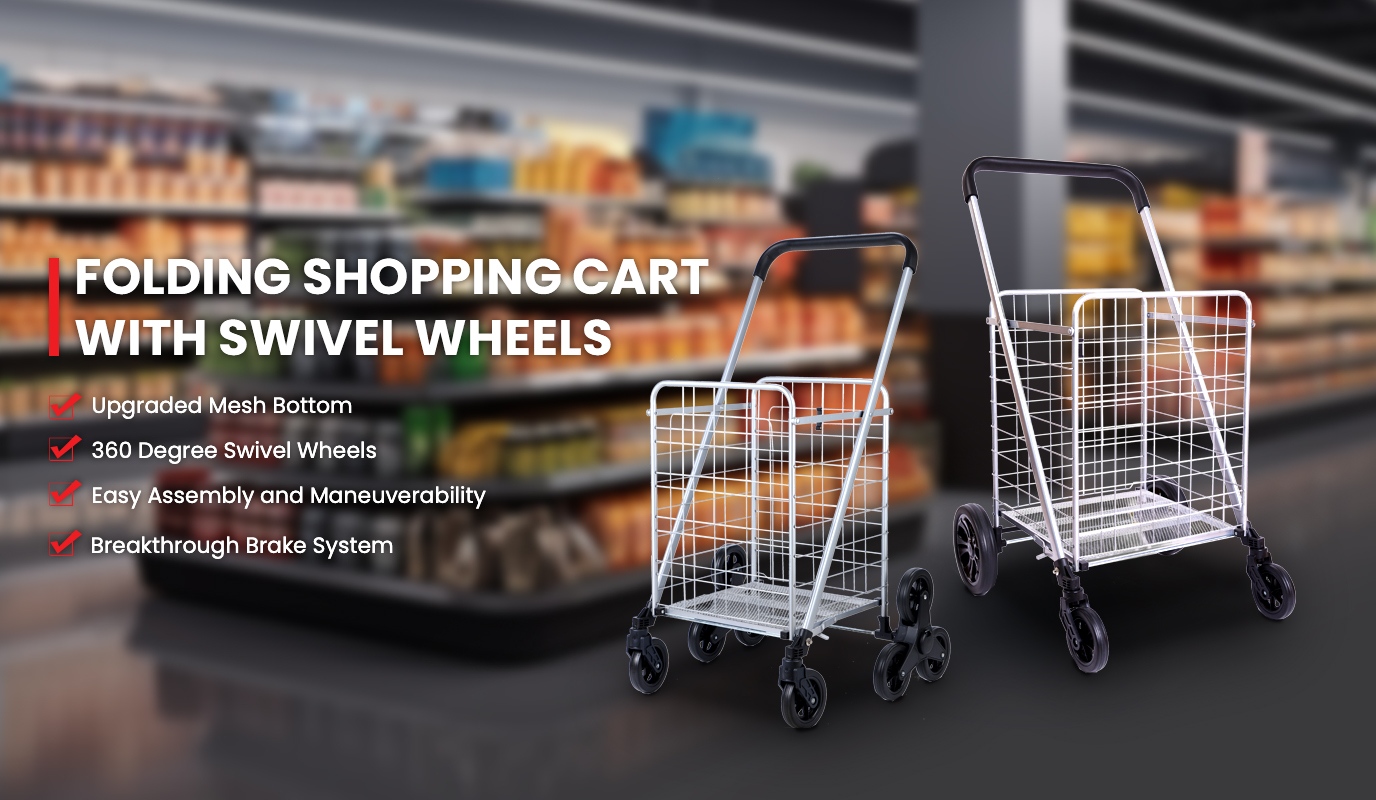
Foldable trolleys are commonly used today because many warehouses and back-of-house operations must balance movement efficiency with storage efficiency. When idle equipment takes up too much floor area, folding designs become valuable. WOCHANG’s own product articles show both two-wheel and four-wheel foldable carts designed for logistics and retail scenarios, and the company also emphasizes that different wheel layouts serve different movement needs. Two-wheel designs often suit lighter and simpler movement tasks, while four-wheel foldable carts provide better stability for continuous handling.
Heavy-duty warehouse trolleys
Heavy-duty warehouse trolleys are used where larger loads, longer routes, or more demanding surfaces require stronger frames and stronger wheels. These trolleys usually have reinforced platforms, thicker tubing, and wheel systems chosen for industrial duty rather than light retail use. WOCHANG’s customization article specifically mentions heavy-duty wheels for warehouse-style stores, which reflects how wheel choice changes with the operating environment. In real logistics operations, this category is important because ramps, corners, and uneven surfaces increase push force and make weak trolley structures less practical.
Common trolley types at a glance
| Trolley type | Typical use | Main advantage |
|---|---|---|
| Platform trolley | Cartons, boxes, general transfer | Open deck and stable support |
| Basket trolley | Mixed items, loose goods, picking | Better containment during movement |
| Foldable trolley | Flexible operations, limited storage | Saves space when not in use |
| Heavy-duty trolley | Bulk loads, longer routes, industrial use | Stronger frame and wheel performance |
These categories are common today because warehouses now operate across multiple handling scenarios instead of relying on a single cart design.
Manufacturer vs trader
When evaluating warehouse trolley types, manufacturer vs trader is an important sourcing issue. A manufacturer can usually control tube forming, wire welding, surface treatment, wheel matching, and final inspection more directly. WOCHANG states on its homepage that it is a manufacturer of Shopping Carts, Shopping Baskets, and laundry products with more than 20 years of experience, and that it holds BSCI and SCAN certifications. That matters because trolley performance depends on production consistency, not only on catalog images or sample appearance.
OEM and ODM process
A practical OEM and ODM process is especially important when standard trolley types do not fully match the warehouse task. Basket size, handle position, wheel material, anti-static options, direction locks, and load capacity may all need adjustment. WOCHANG’s own article on customization mentions heavy-duty wheels, anti-static compounds, and direction-lock systems as common buyer requests, while its modular-design article explains that one trolley structure may be adapted through wheel, handle, basket, and load-capacity changes. That is useful for buyers who need warehouse trolley solutions that fit aisle width, flooring conditions, and handling frequency more precisely.
Manufacturing process overview and quality control checkpoints
A reliable warehouse trolley manufacturer should explain the manufacturing process overview clearly. Buyers should review metal forming, welding, surface treatment, caster installation, assembly, and final inspection. Quality control checkpoints should include frame dimensions, weld consistency, wheel alignment, load testing, and rolling smoothness. NIOSH guidance shows that forceful pushing and pulling becomes a risk factor when brakes are missing, cart design promotes non-neutral posture, or carts are not available for longer-distance carrying. That is why wheel quality, handle design, and structural stability should be reviewed before bulk orders are placed.
Material standards used and bulk supply considerations
Material standards used in trolley production should match the real duty cycle of the warehouse. Buyers should confirm steel grade, tubing thickness, wheel material, bearing quality, and coating durability. Bulk supply considerations should also include packaging protection, replacement consistency, and shipment repeatability across multiple batches. WOCHANG’s product pages and news articles consistently position the company around manufacturing quality, wheel selection, anti-rust treatment, and practical structural design, which helps buyers assess long-term supply value rather than only initial price.
Export market compliance
Export market compliance becomes more important when warehouse trolleys are sourced for international projects or multi-country logistics programs. WOCHANG states that it holds BSCI and SCAN certifications and serves global markets through its manufacturing base in Jiangmen, China. For buyers, that supports factory review, compliance screening, and more confidence in repeat-order execution. In warehouse sourcing, compliance is not separate from product choice. It directly affects whether the selected trolley type can be supplied consistently at scale.
Final view
The most commonly used warehouse trolley types today are platform trolleys, basket trolleys, foldable trolleys, and heavy-duty warehouse trolleys. Each type supports a different handling need, and the best choice depends on load form, route layout, floor condition, and storage pressure. With direct manufacturing experience, customization flexibility, clear certification signals, and product structures that already cover several common trolley categories, WOCHANG is better positioned to support warehouse trolley sourcing that is practical for today’s logistics operations.