



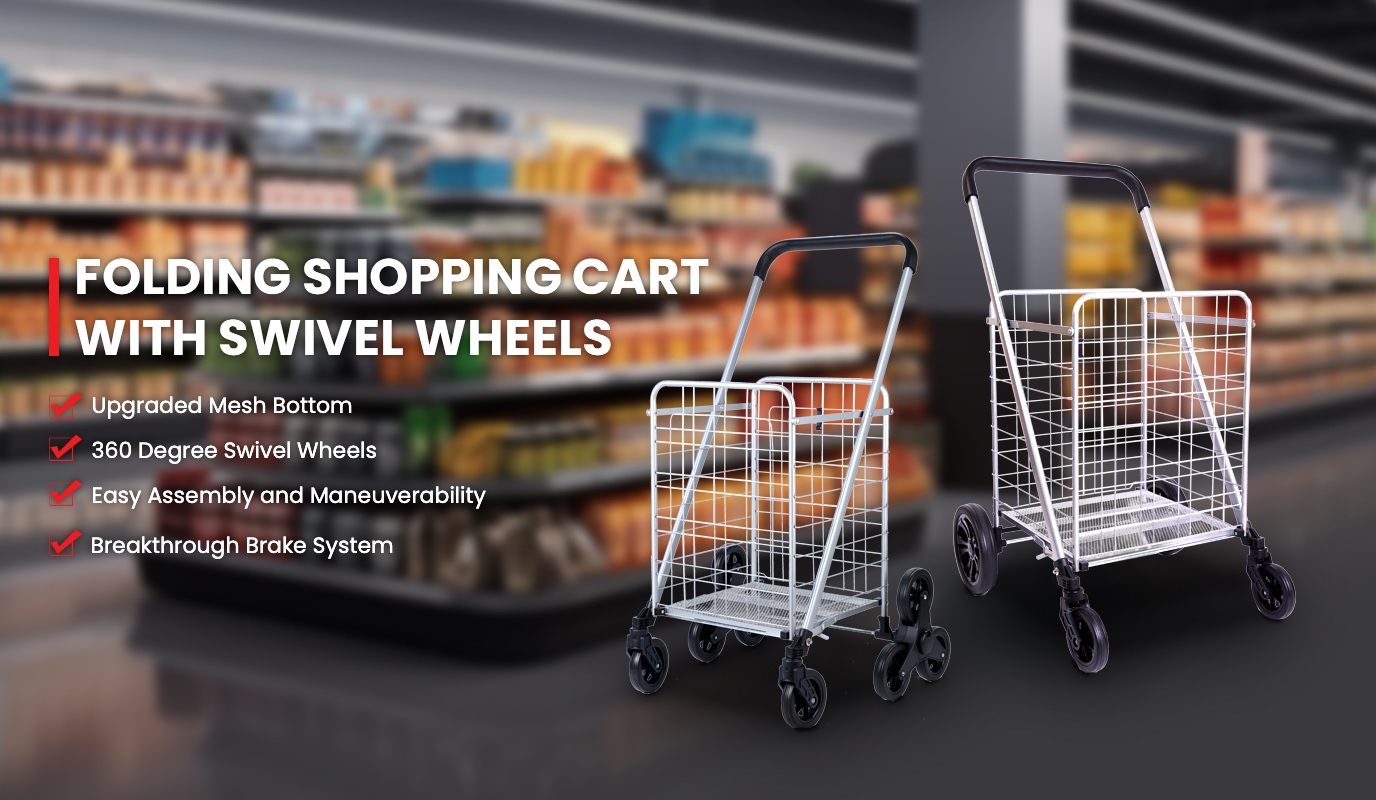
Lightweight Folding Cart vs Heavy Duty Folding Cart: Which Application Needs Which Design?
Lightweight folding carts are better for portable, low-load handling and compact storage, while heavy duty folding carts are designed for higher loads, frequent use, and demanding work environments. The right design depends on load, transport distance, usage frequency, and storage needs.
What Is the Difference Between Lightweight and Heavy Duty Folding Carts?
The primary difference is the balance between portability and structural strength.
A lightweight folding cart is designed to minimize empty-cart weight while remaining practical for everyday transportation. Its folding structure makes it easy to store in vehicles, stockrooms, offices, and other compact spaces.
A heavy duty folding cart uses stronger frames, reinforced joints, higher-capacity wheels, or other structural features to support heavier loads and more frequent operation.
Both designs provide folding convenience, but they are intended for different workloads.
When Is a Lightweight Folding Cart More Suitable?
Lightweight folding carts are most useful when the load is moderate and the cart itself needs to be easy to move.
Typical applications include:
Retail replenishment
Office supply movement
Light warehouse handling
Event transportation
Personal shopping
Small delivery tasks
Temporary workstations
The main advantage is reducing the effort required to transport and store the cart itself.
A lightweight cart can be folded and placed in a vehicle or storage area without requiring significant lifting equipment.
What Are the Advantages of Heavy Duty Folding Carts?
Heavy duty folding carts are designed for more demanding applications.
They are commonly considered for:
Warehouse handling
Factory workshops
Distribution operations
Heavy retail stock
Maintenance work
Industrial material transportation
Their main advantages include:
Higher load capacity
Stronger frame construction
Better resistance to repeated loading
More durable caster systems
Improved stability under heavy loads
The folding function provides storage flexibility without sacrificing the structural requirements of heavier applications.
How Do Lightweight and Heavy Duty Folding Carts Compare?
| Factor | Lightweight Folding Cart | Heavy Duty Folding Cart |
|---|---|---|
| Empty-cart weight | Lower | Higher |
| load capacity | Light to medium | Medium to high |
| Portability | Excellent | Good |
| Storage | Excellent | Good to excellent |
| Frequent heavy use | Limited | Excellent |
| Industrial applications | Limited to suitable tasks | Excellent |
| Vehicle transportation | Very convenient | More demanding |
| Structural reinforcement | Standard | Reinforced |
The correct choice depends on whether portability or load performance is the dominant requirement.
Which Cart Is Better for Retail Replenishment?
Both can work, depending on the products being moved.
A lightweight folding cart is suitable for:
Small cartons
Packaged products
Retail supplies
Light inventory
It can be particularly useful when employees need to move the cart frequently between storage and sales areas.
A heavy duty folding cart becomes more appropriate when replenishment involves:
Beverage cases
Bulk cartons
Heavy household products
Large packaged goods
The trolley should match the actual weight handled during a normal work shift.
Which Cart Is Better for Warehouse Operations?
Heavy duty folding carts are generally better for warehouses handling substantial loads.
Warehouse applications can involve:
Boxes
Industrial components
Tools
Parts
Packaging materials
Bulk goods
When carts are repeatedly loaded and pushed across a warehouse floor, frame strength and wheel performance become increasingly important.
A lightweight folding cart may still be suitable for order picking or small-item movement where the load remains moderate.
Which Cart Is Better for Personal or Mobile Use?
Lightweight folding carts are generally more appropriate.
They can be useful for:
Grocery shopping
Farmers' markets
Community events
Small deliveries
Personal transportation
Mobile service work
The ability to fold the cart and place it in a car or compact storage area is often more valuable than maximum load capacity.
How Does Load Capacity Determine the Design?
Load capacity should be evaluated using both the normal working load and maximum expected load.
For example, a cart may occasionally carry a heavier load, but if it operates near that weight every day, a heavy duty design is usually more appropriate.
Load performance depends on:
Frame material
Tube dimensions
Platform construction
Folding joints
Axle strength
Wheel capacity
Load distribution
A manufacturer should therefore evaluate the complete cart rather than increasing only one component.
Does a Heavy Duty Folding Cart Always Have a Longer Service Life?
Not necessarily.
Service life depends on how well the cart is matched to its application.
A lightweight folding cart used within its rated capacity may last longer than a heavy duty cart that is consistently overloaded or exposed to unsuitable conditions.
Long-term performance depends on:
Correct load selection
Folding cycle frequency
Wheel quality
Floor conditions
Frame construction
Maintenance
Storage environment
The most durable cart is the one operating within a suitable specification.
How Important Is the Folding Mechanism?
The folding mechanism is critical to both types.
A folding cart must perform two different functions:
Fold compactly for storage.
Become stable and secure during operation.
Important components include:
Hinges
Pins
Locking systems
Folding handles
Connection brackets
For heavy duty carts, these components must withstand greater forces during loading and movement.
From a manufacturing perspective, a folding mechanism should be evaluated for both cycle durability and load stability, rather than simply whether the cart can fold.
How Do Wheels Affect Folding Cart Performance?
Wheel selection can significantly change the practical difference between lightweight and heavy duty models.
Important factors include:
Wheel Diameter
Larger wheels can move more easily over thresholds and uneven surfaces.
Wheel Material
Wheel material affects:
Grip
Noise
Floor protection
Wear resistance
Caster Capacity
Heavy duty carts require casters that can support the complete loaded trolley.
Caster Configuration
Swivel casters improve maneuverability, while fixed wheels can improve directional stability.
A strong frame paired with undersized wheels cannot deliver reliable heavy-duty performance.
Which Cart Is Better for Long-Distance Transportation?
The answer depends on load weight.
For light cargo, a lightweight folding cart can be more convenient because its low weight reduces total handling effort.
For heavy cargo, a heavy duty folding cart may be more efficient because stronger wheels and structural components can support the load more reliably.
The important comparison is therefore not only cart weight but:
cart weight + cargo weight + travel distance + floor conditions.
Which Cart Is Easier to Store?
Both designs offer storage advantages because they can be folded.
However, lightweight carts generally have an additional advantage because they are easier to lift and reposition after folding.
Heavy duty carts may occupy a similar folded footprint but require more effort to move into storage.
For vehicle-based operations, buyers should compare:
Folded length
Folded width
Folded height
Total folded weight
These measurements are often more useful than the cart's open dimensions.
Can Lightweight Folding Carts Be Used for Commercial Applications?
Yes, when the workload is appropriate.
They can be suitable for:
Offices
Small retailers
Event companies
Light warehouse handling
Service businesses
Temporary operations
The important requirement is that the cart's rated capacity and construction match the actual working conditions.
Lightweight should not be interpreted as unsuitable for business use.
Can Heavy Duty Folding Carts Be Used for Lightweight Tasks?
Yes, but it may not always be economical.
A heavy duty cart can provide additional strength, but the extra frame weight may make it less convenient for applications where portability is the main requirement.
For a worker moving small cartons several times a day, an unnecessarily heavy trolley can increase handling effort.
The best commercial solution is not always the strongest cart. It is the cart with the appropriate specification.
Can Folding Carts Be Customized?
Yes. Commercial manufacturers can customize both lightweight and heavy duty folding carts.
Possible options include:
Platform dimensions
Folded dimensions
Load capacity
Frame material
Handle height
Wheel diameter
Caster configuration
Brake system
Surface treatment
Color
Logo
For heavy-duty projects, reinforcement can be added to the frame, platform, and folding joints.
For lightweight projects, manufacturers can focus on reducing structural weight while maintaining the required working strength.
What Should Buyers Check Before Ordering?
Commercial buyers should evaluate:
Normal load
Determine the weight handled during most operations.
Maximum load
Identify the highest realistic working requirement.
Folding frequency
Estimate how often the cart will be opened and closed.
Transportation distance
Consider both load weight and route length.
Floor conditions
Check thresholds, ramps, uneven areas, and smooth floors.
Storage requirements
Measure the required folded dimensions and available space.
Wheel specifications
Confirm diameter, material, bearing quality, and load rating.
Manufacturer capability
Evaluate frame construction, folding mechanism production, welding, wheel assembly, quality control, testing, and customization.
Which Folding Cart Is Better for Different Applications?
Lightweight folding carts are better for portable, low-to-medium-load applications where easy handling and compact storage matter most. Heavy duty folding carts are better for warehouses, factories, retail replenishment, and other applications requiring higher capacity and repeated operation.
The best selection should not be based solely on maximum load.
From a manufacturer's perspective, the practical specification comes from load + cart weight + folding frequency + transportation distance + wheel configuration + storage requirements.
A lightweight cart can provide better productivity when employees frequently move the empty trolley, while a heavy duty model becomes more valuable when cargo weight and repeated loading place greater demands on the structure.