



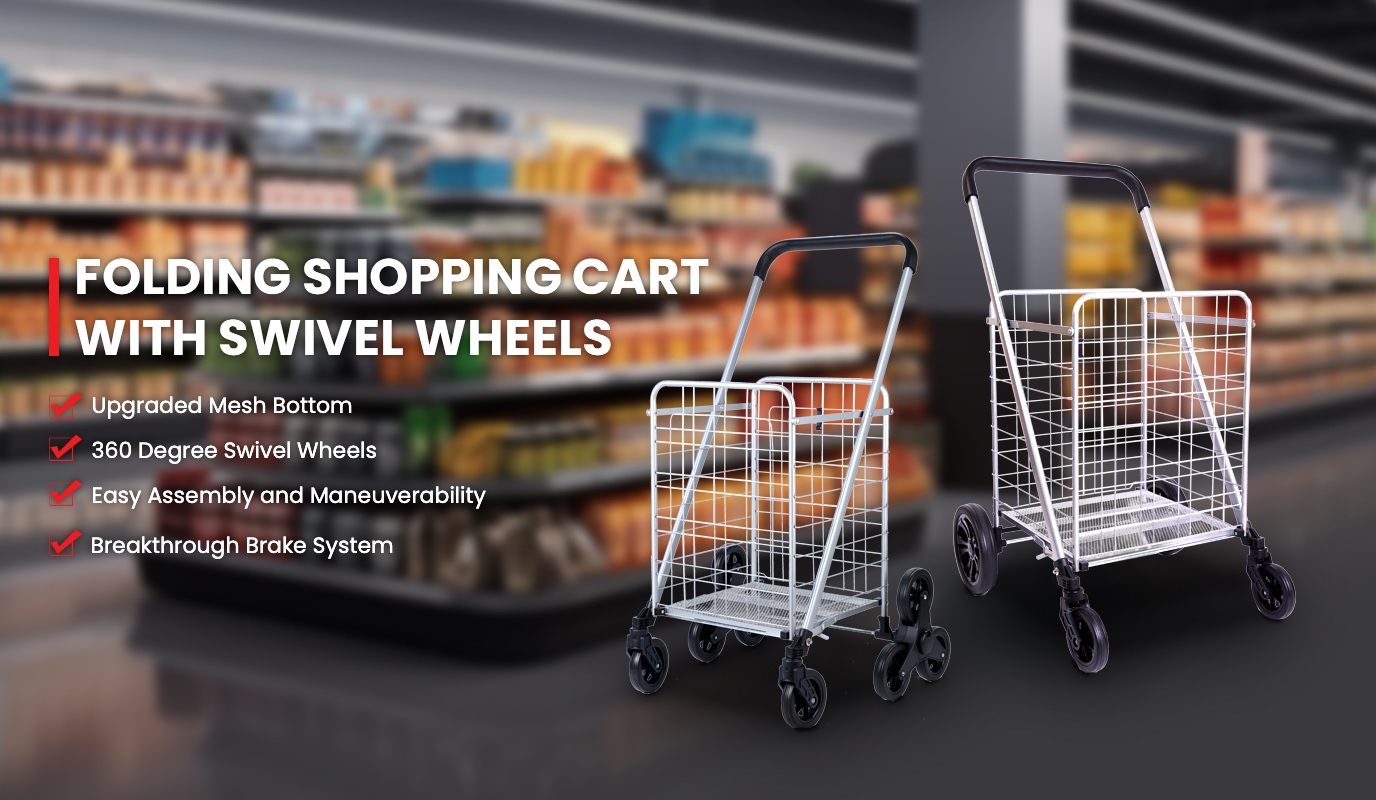
Portable Shopping Cart vs Heavy Duty Shopping Cart: Which Fits Different User Needs?
Portable Shopping Carts prioritize lightweight handling, compact storage, and easy transportation, while heavy duty shopping carts are designed for higher loads, frequent use, and demanding retail environments. The better choice depends on load, mobility, storage, and usage frequency.
What Is the Difference Between Portable and Heavy Duty Shopping Carts?
The main difference is the balance between mobility and structural strength.
A Portable Shopping Cart is designed to be easy to carry, move, fold, or transport. It is useful when users need a cart that can be stored in small spaces or moved between locations.
A heavy duty shopping cart is designed around stronger frames, higher load capacity, and repeated commercial use. It is commonly used in supermarkets, hypermarkets, warehouse-style retail stores, and other high-traffic environments.
The two designs therefore solve different problems:
Portable cart: mobility and convenience
Heavy duty cart: capacity and durability
Portable cart: flexible storage
Heavy duty cart: intensive retail operation
What Are the Advantages of Portable Shopping Carts?
Portable shopping carts are most useful when convenience and mobility are more important than maximum carrying capacity.
Lightweight Handling
A lighter cart is easier to:
Carry
Push
Reposition
Load into a vehicle
Store after use
This can be valuable for users who need to transport the cart between locations.
Compact Storage
Many portable models use folding or collapsible structures.
This allows them to be stored in:
Small apartments
Offices
Retail backrooms
Vehicles
Temporary sales areas
Flexible Applications
Portable shopping carts can support:
Small retail purchases
Convenience shopping
Mobile sales
Temporary retail events
Personal or light commercial use
Their value comes from flexibility rather than maximum capacity.
What Are the Advantages of Heavy Duty Shopping Carts?
Heavy duty shopping carts are designed for demanding retail environments.
They are particularly suitable for:
Supermarkets
Hypermarkets
Wholesale stores
Large grocery stores
High-traffic retail locations
Higher Load Capacity
A reinforced structure allows customers to carry larger quantities of products.
Stronger Frame Construction
Heavy duty models may use:
Reinforced steel frames
Stronger welded joints
Heavy-duty basket structures
Higher-capacity casters
Better Long-Term Performance
When carts are used continuously throughout the day, structural durability becomes more important than minimizing empty-cart weight.
How Do Portable and Heavy Duty Shopping Carts Compare?
| Feature | Portable Shopping Cart | Heavy Duty Shopping Cart |
|---|---|---|
| Main priority | Mobility | Strength |
| Empty-cart weight | Lower | Higher |
| Load capacity | Light to medium | Medium to high |
| Storage | Compact | Standard to nested |
| Transportation | Excellent | Moderate |
| Intensive retail use | Application dependent | Excellent |
| Typical users | Individuals and light users | Retailers and commercial customers |
| Structural complexity | Often folding | Usually reinforced |
The best choice depends on the user's actual handling requirements rather than the product category alone.
Which Shopping Cart Is Better for Small Retail Stores?
Portable shopping carts can be a practical option for small stores where storage space is limited.
Small retailers often need to use the same space for:
Merchandise
Inventory
Packaging
Equipment
Cart storage
A lightweight or collapsible cart can be moved out of the way more easily after use.
However, if the store experiences high customer traffic or customers regularly purchase large quantities, a heavy duty cart may provide better long-term value.
Which Shopping Cart Is Better for Large Supermarkets?
Heavy duty shopping carts are generally more suitable for large supermarkets.
Customers in these environments may purchase:
Bulk groceries
Household products
Beverage cases
Large packages
Multiple Shopping Bags
The cart needs to support substantial loads while remaining stable and easy to push.
For high-volume retail operations, durability and wheel performance can have a greater impact on operating costs than the initial difference in cart weight.
How Does Load Capacity Affect the Choice?
Load capacity should be evaluated according to normal customer behavior, not only the maximum possible load.
A portable shopping cart may be sufficient when users typically purchase a small number of products.
A heavy duty shopping cart becomes more appropriate when customers regularly purchase large quantities or bulky goods.
Buyers should evaluate:
Average load
Maximum expected load
Basket volume
Frame strength
Wheel load rating
Frequency of use
A cart should have an appropriate capacity margin without being unnecessarily oversized.
Which Cart Is Easier to Transport?
Portable shopping carts have the clear advantage when the cart itself must be transported.
Their lighter construction and compact design can make them easier to place in:
Cars
Vans
Delivery vehicles
Storage cabinets
This makes portable models useful for mobile businesses and locations where carts are moved frequently.
Heavy duty carts are better suited to permanent retail environments where they remain on-site.
How Does Storage Space Affect Shopping Cart Selection?
Storage requirements can be as important as load capacity.
A portable cart may be folded and stored in a small area, while heavy duty shopping carts are commonly designed for nesting.
For a large supermarket, nesting can significantly reduce the space required for dozens of carts.
For a small store, however, the ability to fold one or several carts may be more useful than nesting.
The storage method should therefore match the number of carts and available space.
Which Cart Is Better for Frequent Daily Use?
Heavy duty shopping carts are generally better when carts operate continuously throughout the day.
Frequent use increases stress on:
Frames
Welded joints
Basket structures
Wheels
Casters
Handles
A portable cart can still support daily use if it is designed for commercial operation, but lightweight construction should not be confused with heavy-duty durability.
From a manufacturing perspective, the correct question is not simply whether a cart is light or heavy. It is whether the structure is engineered for the expected number of operating cycles.
How Important Are Wheels for Both Cart Types?
Wheel performance affects both mobility and customer experience.
Important factors include:
Wheel Diameter
Larger wheels can move more easily over thresholds and minor floor irregularities.
Wheel Material
The material affects:
Noise
Floor protection
Grip
Wear resistance
Caster Configuration
Swivel casters can improve maneuverability in crowded retail aisles.
Load Rating
Heavy duty carts require casters capable of supporting the combined cart and customer load.
For commercial applications, wheel selection should be matched to the actual floor conditions and expected load.
Can Portable Shopping Carts Also Be Used for Commercial Applications?
Yes, provided the model is designed for the required load and usage frequency.
Portable designs can be useful for:
Convenience stores
Small retailers
Temporary shops
Mobile sales operations
Light stock handling
However, buyers should verify the rated capacity and structural durability before using a portable model for intensive commercial work.
A cart that is convenient to transport may not be suitable for repeated heavy loading.
Can Heavy Duty Shopping Carts Be Customized?
Yes. Commercial shopping cart manufacturers can customize heavy duty models according to retailer requirements.
Possible options include:
Cart dimensions
Basket capacity
Frame strength
Wheel configuration
Handle design
Child seat
Color
Logo
Surface treatment
Customization can be particularly useful for retail chains that need consistent cart specifications across multiple locations.
What Should Buyers Check Before Ordering?
Commercial buyers should evaluate:
User profile
Determine whether the cart is mainly for individual users, supermarket customers, or commercial operations.
Typical load
Estimate what customers or employees normally place in the cart.
Maximum load
Confirm the highest realistic working requirement.
Storage conditions
Determine whether carts will be folded, nested, or stored individually.
Usage frequency
Daily intensive operation requires stronger components.
Transportation requirements
Check whether carts need to be moved between stores or transported in vehicles.
Wheel performance
Evaluate wheel size, material, caster configuration, and load rating.
Manufacturer capability
For bulk orders, evaluate frame construction, welding, quality control, customization, packaging, and production capacity.
Which Is Better Overall: Portable or Heavy Duty Shopping Cart?
Portable shopping carts are better for users who prioritize lightweight handling, compact storage, and transportation. Heavy duty shopping carts are better for supermarkets and commercial environments where high loads, frequent use, and long service life are more important.
Neither design is universally superior.
For small stores, mobile operations, and light shopping needs, portability can create greater practical value. For supermarkets, wholesale retailers, and high-traffic stores, structural strength and load capacity usually matter more.
From a manufacturer's perspective, the most reliable selection considers load + usage frequency + storage space + transportation requirements + wheel performance + expected service life together. This prevents buyers from choosing a cart based on one specification while overlooking the conditions that actually determine long-term performance.