


Collapsible Shopping Cart vs Standard Shopping Cart: Which Is Easier to Store?
Collapsible Shopping Carts are generally easier to store because their frames can be folded or compressed when not in use. Standard shopping carts rely mainly on nesting, making them practical for large-volume storage but less flexible in small spaces.
What Is the Difference Between Collapsible and Standard Shopping Carts?
The main difference is the way each cart reduces its storage footprint.
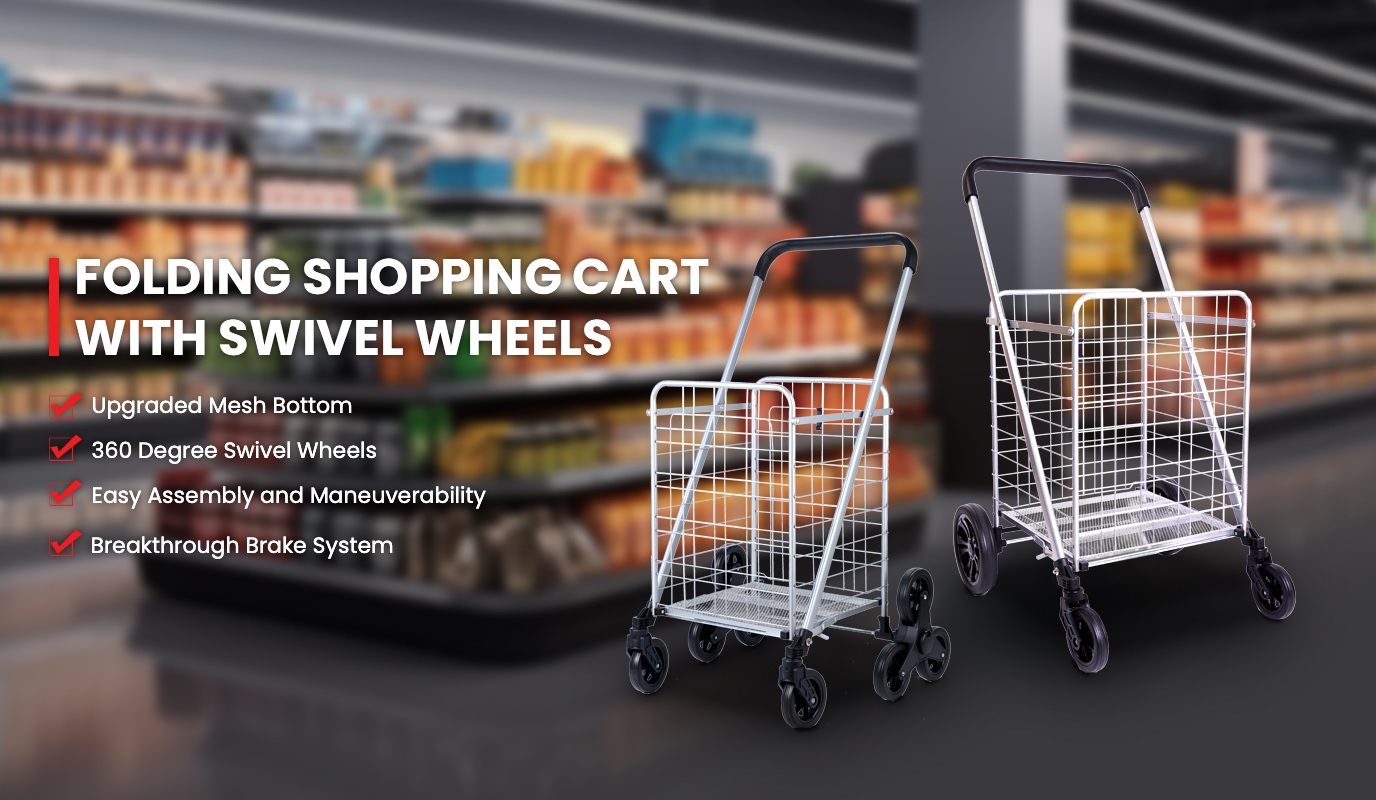
A collapsible shopping cart uses a folding frame, handle, basket, or other mechanism to reduce its overall dimensions after use. This makes it suitable for stores, vehicles, and facilities where storage space is limited.
A standard shopping cart normally maintains its basic working structure during storage. Many models can nest together, allowing multiple carts to occupy less space than individual carts placed separately.
The two approaches solve different storage problems:
Collapsible cart: reduces the size of each individual cart
Standard cart: reduces space through nesting
Collapsible cart: better for flexible storage
Standard cart: better for high-volume cart collection
Why Are Collapsible Shopping Carts Easier to Store?
The main advantage is the ability to reduce the cart's dimensions when it is not being used.
Depending on the design, a collapsible cart may reduce:
Overall height
Overall depth
Handle projection
Basket volume
Floor footprint
This allows retailers to store carts in locations that may not accommodate a full-size shopping cart.
Potential storage areas include:
Small stockrooms
Behind service counters
Narrow corridors
Delivery vehicles
Storage cabinets
Temporary retail spaces
For commercial buyers, the actual folded dimensions are more useful than simply knowing that a cart is "collapsible."
How Do Standard Shopping Carts Save Storage Space?
Standard shopping carts commonly use nesting rather than folding.
The front of one cart can fit partially inside another, allowing a long row of carts to occupy substantially less space than separate carts.
Nesting works particularly well in:
Supermarkets
Hypermarkets
Shopping centers
Large grocery stores
Retail chains
For stores that need dozens or hundreds of carts, nesting can be highly efficient.
However, nesting still requires a dedicated cart storage area because the carts retain their basic overall height and width.
How Do Collapsible and Standard Shopping Carts Compare?
| Feature | Collapsible Shopping Cart | Standard Shopping Cart |
|---|---|---|
| Storage method | Folding or collapsing | Nesting |
| Individual storage footprint | Smaller | Larger |
| Large-volume storage | Good | Excellent |
| Small storage areas | Excellent | More limited |
| Vehicle transportation | Easier | Requires more space |
| Deployment | Requires opening | Ready to use |
| Structural complexity | Higher | Lower |
| Storage flexibility | Excellent | Good |
The better design depends on whether the retailer needs to store individual carts compactly or large numbers of carts together.
Which Is Better for Small retail stores?
Collapsible shopping carts are generally better for stores with limited storage space.
Small retailers often have to use the same backroom for:
Inventory
Packaging
Cleaning supplies
Employee equipment
Shopping carts
A conventional cart storage area can consume valuable floor space.
A collapsible model allows unused carts to be placed closer together or stored in locations that would otherwise be unavailable.
This can be particularly useful for convenience stores, compact supermarkets, and urban retail locations.
Which Is Better for Large Supermarkets?
Standard nesting shopping carts can be highly practical for large supermarkets.
Large stores often have dedicated cart collection areas and sufficient space to arrange carts in long rows.
In this situation, nesting provides several advantages:
Simple collection
Fast deployment
Easy employee management
Familiar customer operation
Efficient storage of large quantities
A collapsible cart may provide less additional value if the supermarket already has an optimized nesting area.
Is Collapsing Better Than Nesting for Storage?
Not necessarily.
The two systems should be evaluated according to the number of carts and available storage space.
Collapsing is usually better when:
Storage space is very limited
Carts are transported between locations
Individual carts need compact storage
Vehicles are used for transportation
Nesting is usually better when:
Many carts are stored together
The store has a dedicated cart area
Carts remain at one location
Fast deployment is important
A retailer should calculate total storage requirements rather than assuming one method is always superior.
How Does Cart Quantity Affect Storage Efficiency?
Cart quantity can change the result significantly.
For example, storing 10 collapsible carts individually may be very efficient because each unit occupies a small footprint after folding.
For 100 or more carts, however, a well-designed nesting system can make traditional shopping carts highly space-efficient.
The relevant calculation is:
Total storage space = cart quantity × effective stored footprint
For nesting carts, the actual footprint also depends on the nesting depth of each additional unit.
For collapsible carts, the calculation should use the actual folded length, width, and height.
Which Cart Is Easier to Store in a Delivery Vehicle?
Collapsible shopping carts generally have the advantage.
Once folded, they can occupy less cargo volume and may be easier to arrange inside:
Delivery vans
Service vehicles
Trucks
Temporary storage areas
This is useful for businesses that move carts between multiple branches.
Standard shopping carts are better suited to permanent retail locations where transportation is infrequent and carts remain on site.
Does a Collapsible Cart Require More Maintenance?
It can.
The folding structure introduces additional moving components that may require inspection.
A standard shopping cart typically requires checks of:
Wheels
Casters
Basket
Frame
Handle
Welded joints
A collapsible model may additionally require inspection of:
Hinges
Folding joints
Locking mechanisms
Moving connections
The mechanism should remain secure when the cart is fully opened and in operation.
From a manufacturing perspective, storage efficiency should not be achieved by creating a folding structure that becomes unreliable under repeated commercial use.
Does Collapsible Design Affect Durability?
Potentially, depending on the engineering and manufacturing quality.
A traditional fixed-frame shopping cart has fewer moving structural components.
A collapsible cart must combine two requirements:
It must fold easily for storage.
It must become stable when fully opened.
The locking mechanism is therefore particularly important.
Buyers should check whether the deployed structure remains rigid and whether the folding joints can withstand repeated operating cycles.
Which Design Is Better for Long-Term Commercial Use?
Neither design is automatically better.
Standard shopping carts can be advantageous for high-frequency supermarket operations because their structures are generally simple and familiar.
Collapsible shopping carts can provide greater value when storage efficiency and transportation flexibility are major requirements.
Long-term performance should be evaluated through:
Frame strength
Folding mechanism quality
Wheel durability
Basket structure
Surface treatment
Usage frequency
Storage convenience should always be balanced against structural reliability.
Can Collapsible Shopping Carts Be Customized?
Yes. Commercial manufacturers can customize collapsible shopping carts according to specific storage and operational requirements.
Possible options include:
Cart dimensions
Folded dimensions
Basket capacity
Frame structure
Handle configuration
Wheel arrangement
Color
Logo
Child seat configuration
For a space-constrained project, the buyer should provide the maximum available storage dimensions before product development.
This allows the manufacturer to design the folding structure around the actual storage environment.
Can Standard Shopping Carts Be Customized for Better Storage?
Yes.
Standard carts can be designed for improved nesting efficiency through changes to:
Basket geometry
Frame width
Handle position
Wheel arrangement
Nesting depth
A well-designed nesting system can significantly reduce the total storage footprint of a large number of traditional carts.
For large supermarkets, optimizing nesting depth may sometimes provide more practical value than switching to a collapsible design.
What Should Buyers Check Before Ordering?
Commercial buyers should evaluate:
Available storage dimensions
Measure the actual length, width, and height available for cart storage.
Number of carts
Determine the total number of units that must be stored.
Folded dimensions
For collapsible carts, confirm the exact dimensions after folding.
Nesting depth
For standard carts, determine how closely multiple carts can nest.
Deployment method
Consider how quickly employees or customers need to put carts into service.
Folding mechanism
Check the strength and locking reliability of hinges and joints.
Wheel performance
Confirm wheel diameter, material, load rating, and floor compatibility.
Manufacturer capability
Evaluate frame production, folding mechanism manufacturing, wheel assembly, quality control, customization, and bulk-order capacity.
Which Is Easier to Store: Collapsible or Standard Shopping Cart?
Collapsible shopping carts are generally easier to store when space is limited because they reduce the dimensions of each individual cart. Standard shopping carts can be more efficient when large quantities are stored together because their nesting design compresses multiple carts into a smaller group.
The better option depends on the storage environment.
For small stores, mobile retail operations, and businesses transporting carts between locations, collapsible designs offer clear advantages. For large supermarkets with dedicated cart areas, traditional nesting carts can remain highly efficient.
From a manufacturer's perspective, the most useful comparison is based on cart quantity + stored dimensions + nesting depth + available floor space + transportation requirements. This provides a more accurate purchasing decision than simply comparing "collapsible" and "standard" as product categories.