



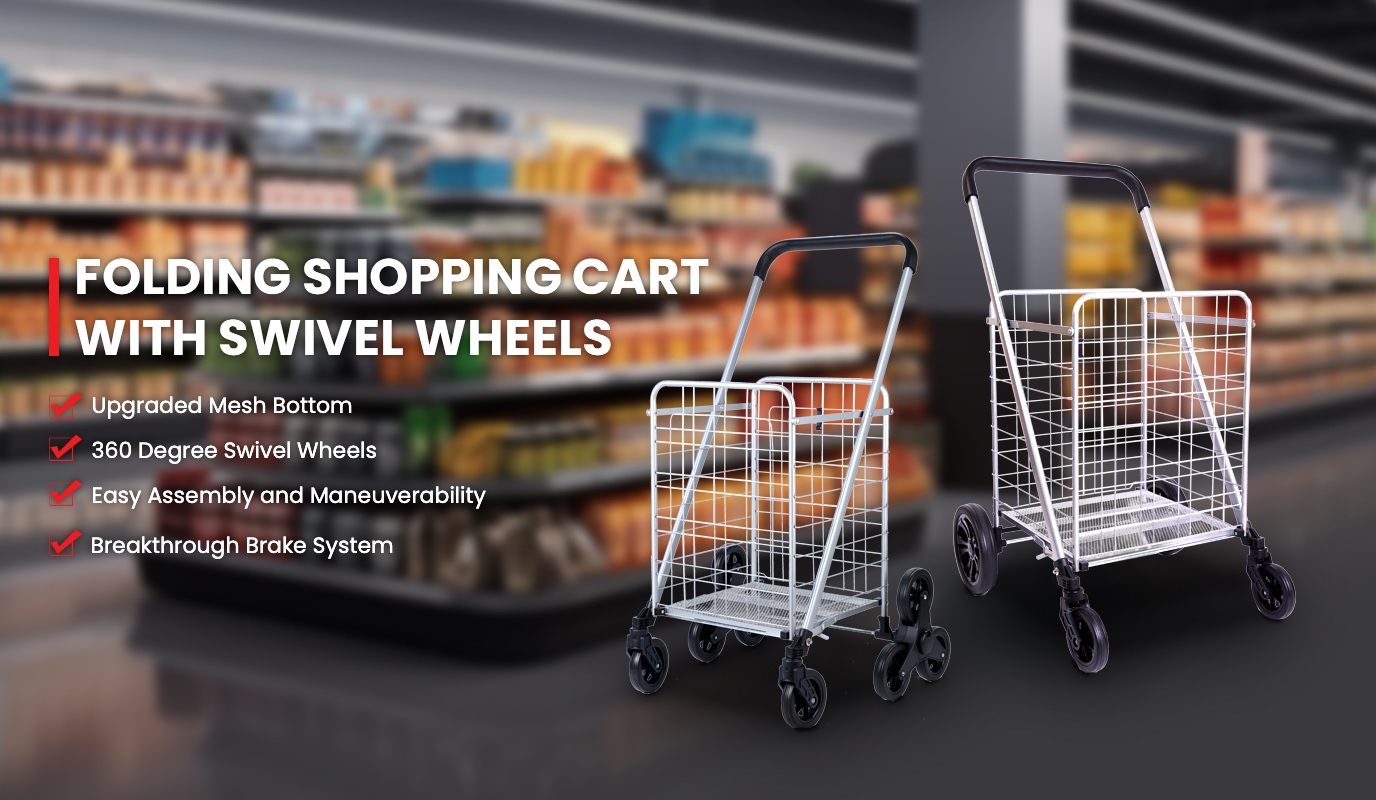
Foldable Trolley vs Fixed Trolley: Which Is Better for Urban Retail Applications?
Foldable trolleys are generally better for urban retail when storage space, vehicle transportation, and flexible deployment are limited. Fixed trolleys are better for stores with continuous daily handling where structural simplicity and frequent use are the priority.
What Is the Difference Between Foldable and Fixed trolleys?
The main difference is how the trolley handles storage and transportation when it is not being used.
A foldable trolley uses a collapsible handle or frame so its overall dimensions can be reduced after operation. This makes it useful for compact retail environments where storage space is limited.
A fixed trolley maintains its working structure at all times. Its rigid construction can provide straightforward operation and strong structural stability for repeated commercial use.
For urban retail, the difference becomes important because stores often operate with:
Limited backroom space
Narrow aisles
Restricted loading areas
Frequent deliveries
Short-distance stock movement
High real-estate costs
Why Are Foldable Trolleys Useful for Urban Retail?
Urban retail locations often have less storage space than large suburban supermarkets or warehouse-style stores.
A foldable trolley can be compacted after use, allowing it to be stored in:
Small stockrooms
Narrow service areas
Behind counters
Delivery vehicles
Compact storage zones
This can help retailers use valuable floor space for merchandise rather than permanently storing full-size handling equipment.
What Are the Advantages of Fixed Trolleys?
Fixed trolleys are designed around straightforward daily operation.
Their rigid structure provides several practical benefits:
Simple deployment
Stable working structure
Fewer moving components
Easier routine inspection
Good suitability for continuous use
For an urban supermarket with a dedicated stockroom and high-frequency replenishment, a fixed trolley can be more practical when storage limitations are not severe.
How Do Foldable and Fixed Trolleys Compare?
| Feature | Foldable Trolley | Fixed Trolley |
|---|---|---|
| Storage efficiency | Excellent | Standard |
| Portability | Excellent | Good |
| Structural simplicity | Moderate | Excellent |
| Frequent daily use | Good | Excellent |
| Vehicle transportation | Easier | More space required |
| Limited backroom | Excellent | Application dependent |
| Maintenance | Folding mechanism requires attention | Generally simpler |
The key difference is that foldable trolleys prioritize space and mobility, while fixed trolleys prioritize simplicity and continuous operation.
Which Trolley Is Better for Small Urban Stores?
Foldable trolleys are often the better choice for small urban stores.
Limited floor space means that unused equipment can interfere with:
Customer movement
Product displays
Stockroom organization
Employee work areas
A foldable trolley can be stored compactly after stock replenishment is completed.
This makes it useful for convenience stores, compact supermarkets, specialty retailers, and other businesses operating in dense urban areas.
Which Trolley Is Better for Urban Supermarkets?
The answer depends on the supermarket's operating pattern.
A foldable trolley is useful when:
Storage space is restricted
Deliveries occur frequently
Trolleys are transported between locations
The store has limited backroom capacity
A fixed trolley can be preferable when:
Replenishment occurs continuously
The trolley remains inside the store
Loads are relatively heavy
Dedicated trolley storage is available
Large urban supermarkets may use both types for different handling tasks.
How Does Storage Space Affect Trolley Selection?
Storage space is one of the most important factors in urban retail procurement.
The buyer should measure:
Backroom width
Storage height
Door clearance
Available floor area
Number of trolleys
Required storage arrangement
A trolley that saves 30–50% of its footprint when folded may provide meaningful benefits when dozens of units are stored in a small area.
However, the actual folded dimensions should be measured rather than estimated from the product's appearance.
Are Foldable Trolleys Easier to Transport Between Stores?
Generally, yes.
When folded, a trolley can occupy less space in:
Delivery vans
Service vehicles
Trucks
Temporary storage areas
This is particularly useful for retailers managing multiple urban branches.
A fixed trolley can still be transported efficiently when vehicle space is sufficient, but several units may require significantly more cargo volume.
How Does Urban Delivery Affect Trolley Choice?
Urban delivery environments can involve:
Narrow loading zones
Limited parking
Short delivery windows
Elevators
Narrow corridors
Multiple floors
A compact trolley can be easier to move through these environments.
Foldable designs can also be useful when the trolley needs to travel in a delivery vehicle and then be deployed at the destination.
For multi-floor urban stores, overall trolley weight and wheel performance can be just as important as folding capability.
Which Trolley Is Better for Heavy Loads?
A fixed trolley generally provides greater freedom for heavy-duty structural design.
Because it does not require a folding mechanism, manufacturers can focus on:
Frame reinforcement
Platform strength
Welded joints
Caster capacity
Load distribution
Foldable trolleys can also support substantial loads, but their folding joints and locking structures must be engineered to withstand working loads.
For heavy urban stock handling, buyers should compare the actual rated capacity rather than assuming that fixed always means stronger.
How Important Are Wheels for Urban Retail Trolleys?
Wheel performance becomes especially important in urban retail because trolleys may move across different surfaces.
Typical environments include:
Smooth retail floors
Concrete loading areas
Thresholds
Elevators
Ramps
Pavement
Important wheel factors include:
Wheel Diameter
Larger wheels can improve movement across thresholds and uneven surfaces.
Wheel Material
Wheel material affects:
Noise
Floor protection
Grip
Wear resistance
Caster Configuration
Swivel casters provide better maneuverability, while fixed wheels can improve directional stability.
For urban retail, the best wheel configuration depends on the route between receiving, storage, sales areas, and delivery points.
Does Folding Make a Trolley More Difficult to Maintain?
It can add some maintenance requirements.
Fixed trolleys generally require inspection of:
Wheels
Casters
Frame
Platform
Handle
Welded joints
Foldable trolleys require these checks plus inspection of:
Hinges
Folding joints
Locking mechanisms
Moving connections
The folding mechanism should remain secure during operation and should not develop excessive play after repeated use.
From a manufacturing perspective, the quality of the folding mechanism is therefore a key factor in determining whether a foldable trolley remains reliable in long-term commercial use.
Can Foldable Trolleys Be Customized for Urban Retail?
Yes. Commercial manufacturers can customize foldable trolleys according to store requirements.
Possible customization includes:
Overall dimensions
Folded dimensions
Platform size
Handle design
Wheel diameter
Caster configuration
Brake system
Surface treatment
Color
For urban retail projects, folded dimensions should be included in the initial specification because storage and vehicle transportation are often major purchasing constraints.
Can Fixed Trolleys Also Be Optimized for Small Retail Spaces?
Yes.
A fixed trolley does not necessarily require a large footprint.
Manufacturers can adjust:
Platform length
Platform width
Handle height
Wheelbase
Overall height
A compact fixed trolley may therefore be more suitable than a folding model when the retailer prioritizes structural simplicity and uses the trolley continuously.
What Should Urban Retail Buyers Check Before Ordering?
Before purchasing, buyers should evaluate:
Storage area
Measure the actual space available for unused trolleys.
Transportation route
Check aisles, doors, elevators, ramps, and loading areas.
Load requirements
Define both normal and maximum working loads.
Usage frequency
Daily intensive use may favor a simpler fixed structure.
Folded dimensions
For foldable models, confirm the exact dimensions after folding.
Wheel configuration
Match wheel diameter and material to the actual floor conditions.
Maintenance requirements
Consider whether employees can regularly inspect folding mechanisms and casters.
Manufacturer capability
Evaluate frame production, welding, folding mechanism quality, wheel assembly, quality control, customization, and bulk-order capability.
Which Is Better for Urban Retail Applications?
Foldable trolleys are generally better for urban retail environments where storage space, transportation, and flexible deployment are major constraints. Fixed trolleys are better when the trolley is used continuously and structural simplicity is more important than compact storage.
Urban retail does not automatically require folding equipment. The better solution depends on how the trolley moves through the store and where it is stored between tasks.
From a manufacturer perspective, the most reliable selection considers storage space + load + route + usage frequency + folded dimensions + wheel configuration together. A well-designed fixed trolley can be highly efficient in a compact store, while a foldable model can create significant value when every square meter of storage space matters.