



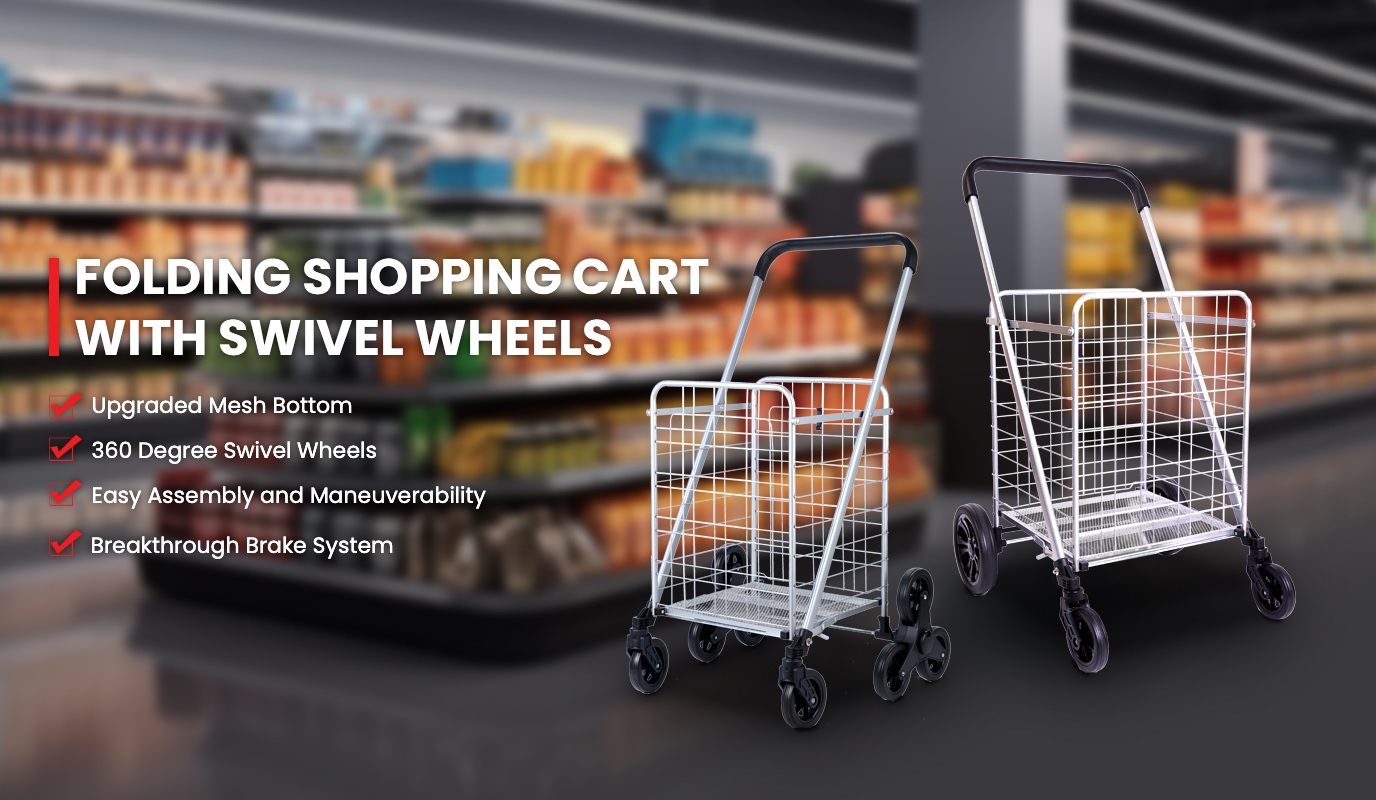
Foldable Shopping Cart vs Traditional Shopping Cart: Which Saves More Space?
Foldable Shopping Carts generally save more storage space because the frame can collapse when the cart is not in use. Traditional fixed-frame shopping carts require more floor and stacking space, but they usually provide stronger structural stability for continuous high-volume retail use.
What Is the Difference Between Foldable and Traditional Shopping Carts?
The main difference is whether the cart can reduce its overall dimensions during storage.
A Foldable Shopping Cart uses a collapsible structure that allows the basket, frame, or handle section to fold into a smaller footprint.
A traditional shopping cart normally uses a fixed frame and basket. Multiple carts can often be nested together, but their overall structure remains relatively large.
For commercial buyers, the important question is not simply whether a cart folds. It is how much usable storage volume the design actually saves.
Why Does Storage Space Matter for Retailers?
Shopping carts occupy valuable space when they are not being used.
Retailers may need to store carts:
Near entrances
In stockrooms
In loading areas
Inside delivery vehicles
In temporary retail spaces
During store renovations
In stores with limited back-of-house space, reducing the cart footprint can make daily operations easier.
Storage efficiency becomes even more important when hundreds of carts need to be collected and organized.
How Much Space Can a Foldable Shopping Cart Save?
The amount depends on the folding mechanism and final folded dimensions.
A foldable design may reduce:
Overall height
Width
Depth
Stacking volume
However, the practical storage benefit should be measured by comparing the stored volume per cart, not simply whether the cart has a folding feature.
A well-designed foldable cart can occupy substantially less space than an equivalent fixed-frame model when stored individually or in compact groups.
Can Traditional Shopping Carts Also Save Space?
Yes.
Traditional shopping carts commonly use a nesting structure.
The front basket of one cart slides partially into another, allowing multiple carts to be stored together.
This can significantly reduce the footprint compared with storing each cart separately.
For high-volume supermarkets, nesting efficiency can be more important than folding capability because carts are normally stored in groups.
The correct comparison is therefore:
folded dimensions vs nested dimensions, not simply foldable vs non-foldable.
How Do Foldable and Traditional Carts Compare?
| Factor | Foldable Shopping Cart | Traditional Shopping Cart |
|---|---|---|
| Individual storage footprint | Excellent | Moderate |
| Group storage efficiency | Good to excellent | Excellent when nested |
| Storage flexibility | Excellent | Good |
| Transport efficiency | Excellent | Moderate to good |
| Structural simplicity | Moderate | Excellent |
| High-volume retail use | Application dependent | Excellent |
| Storage in small spaces | Excellent | Moderate |
| Folding mechanism maintenance | Required | Minimal |
| Long-term heavy use | Design dependent | Excellent |
| Space-saving potential | Very high | High when nested |
A foldable cart does not automatically provide better overall storage efficiency if a traditional cart has highly optimized nesting.
Which Is Better for Small Retail Stores?
Foldable shopping carts can provide a strong advantage for small stores.
Small retailers may have limited:
Entrance space
Stockroom capacity
Storage areas
Delivery space
A cart that can be collapsed after use can be moved into a compact storage zone.
This can free floor space for merchandise or customer movement.
For small-format retail, storage efficiency can therefore be a major purchasing factor.
Which Is Better for Large Supermarkets?
Traditional nesting carts can remain highly competitive for large supermarkets.
Large stores typically use carts continuously, and carts are often collected into long nested rows.
A traditional cart can offer:
Simple operation
Fast nesting
Strong structure
Proven commercial durability
Efficient large-volume deployment
If a supermarket already has a dedicated cart bay, the additional space-saving benefit of folding may be less important.
Does Folding Always Save More Space Than Nesting?
No.
This is an important distinction for commercial procurement.
A foldable cart may become very compact when folded individually, but retailers normally store many carts together.
A traditional cart designed for efficient nesting can reduce its collective footprint dramatically.
For example, if a fixed-frame cart nests deeply into the next cart, a long row may require surprisingly little additional space per unit.
The best option should therefore be evaluated using the actual number of carts that need to be stored.
How Does Cart Quantity Affect Storage Efficiency?
Cart quantity can change the result significantly.
For a small number of carts, folding may provide a major advantage because each cart can be compressed individually.
For hundreds of carts, nesting efficiency becomes increasingly important.
Commercial buyers should calculate:
Total storage footprint = stored cart footprint × quantity + required access space.
The calculation should include practical access for staff to remove carts.
A tightly packed storage area is not efficient if employees cannot safely retrieve individual carts.
Which Is Better for Transportation?
Foldable carts can provide a significant advantage during transportation.
When folded, more units may fit into:
Delivery vehicles
Containers
Warehouses
Temporary storage areas
This can reduce unused transport volume.
However, transportation efficiency depends on the actual folded dimensions and packaging method.
A fixed-frame cart may also be highly efficient when nested, particularly when the basket and frame are designed for deep nesting.
How Does Folding Affect Cart Design?
A folding mechanism introduces additional moving components.
These may include:
Hinges
Locking mechanisms
Folding joints
Pivot points
Reinforcement components
These parts must withstand repeated operation.
For commercial carts, the folding system should remain stable when the cart is opened and loaded.
The folding mechanism should therefore be evaluated for both space efficiency and repeated-use durability.
Does a Foldable Cart Have to Be Less Durable?
No.
A properly engineered foldable shopping cart can provide reliable commercial performance.
However, folding joints create additional areas that must be designed and tested.
Important factors include:
Hinge strength
Locking reliability
Joint wear
Frame rigidity
Load capacity
Repeated folding cycles
A foldable design should not sacrifice structural performance simply to achieve a smaller storage footprint.
Are Traditional Carts More Durable?
Traditional fixed-frame carts generally have a structural simplicity advantage.
They have fewer moving components and are commonly designed for:
Frequent customer use
Heavy shopping loads
Repeated nesting
Long service periods
This can make them particularly suitable for supermarkets and high-traffic retail environments.
However, actual durability depends on frame material, welding, basket construction, wheels, surface treatment, and manufacturing quality.
How Do Wheels Affect Storage and Handling?
Wheels affect both the cart's operating performance and stored dimensions.
Important specifications include:
Wheel diameter
Wheel width
Fixed or swivel configuration
Caster construction
Bearing quality
A foldable cart with a compact frame may still require significant storage space if its wheels or caster assemblies remain outside the folded structure.
The entire cart should therefore be evaluated as a three-dimensional product.
Which Wheel Size Is Better for Foldable Carts?
Smaller wheels can help maintain a compact structure, but wheel size should not be reduced at the expense of mobility.
Larger wheels can provide better performance over:
Thresholds
Floor joints
Uneven surfaces
The appropriate wheel size depends on:
Cart load
Store flooring
Folding dimensions
Turning requirements
For commercial use, storage efficiency should be balanced with movement performance.
Does Basket Design Affect Storage Efficiency?
Yes.
The basket often determines a major portion of the cart's stored volume.
Important design factors include:
Basket depth
Basket width
Sidewall height
Nesting angle
Folding direction
Frame geometry
A traditional cart with deep nesting may be highly space-efficient even without a folding mechanism.
A foldable cart needs a basket structure that can reduce its footprint without compromising load capacity.
Can Plastic and Metal Carts Both Be Foldable?
Yes.
Foldable carts can use:
Steel frames
Aluminum components
Plastic baskets
Composite components
Mixed-material structures
Material selection affects:
Weight
Folding force
Structural strength
Durability
Corrosion resistance
Manufacturing cost
Mixed-material construction can allow manufacturers to use stronger materials in load-bearing areas while reducing weight in other components.
Which Is Better for Mobile Retail and Temporary Stores?
Foldable carts can be particularly useful.
Temporary retail environments may not have permanent cart storage facilities.
Examples include:
Pop-up stores
Seasonal retail
Outdoor markets
Temporary supermarkets
Event-based retail
A compact cart can be transported to the site, deployed during operation, and folded away afterward.
This makes storage flexibility more valuable than it would be in a permanent large supermarket.
Which Is Better for Urban Retail?
Foldable carts can offer strong advantages in compact urban environments.
Urban stores often operate with:
Limited floor space
Smaller stockrooms
Narrow entrances
High rental costs
Compact delivery areas
Reducing unused cart volume can help retailers use available space more efficiently.
Traditional carts remain practical when the store has dedicated cart storage and efficient nesting areas.
Can Foldable Shopping Carts Improve Logistics?
Yes.
A compact folded structure can make it easier to:
Move carts between locations
Load delivery vehicles
Store replacement carts
Transport carts between branches
Reduce unused warehouse volume
For retailers operating multiple stores, these logistical benefits can become more significant.
However, the savings should be calculated based on actual folded dimensions, shipping quantities, and transport costs.
Does Folding Affect Manufacturing Cost?
It can.
Foldable carts generally require additional components and assembly steps.
Potential cost factors include:
Hinges
Locks
Reinforcement
Additional tooling
Assembly
Folding-cycle testing
Traditional carts may have a simpler manufacturing structure.
However, a foldable cart can create value through lower storage and transportation requirements.
The relevant commercial comparison is therefore:
product cost + storage cost + transportation cost + maintenance cost.
How Does OEM Customization Affect Storage Efficiency?
OEM manufacturers can optimize the cart specifically for the buyer's storage conditions.
Possible customization includes:
Folded dimensions
Basket dimensions
Folding direction
Handle structure
Wheel configuration
Load capacity
Cart color
Logo
Packaging
For retailers with strict storage limitations, folded dimensions should be treated as a design specification from the beginning of the project rather than adjusted after the cart has already been developed.
What Should Buyers Measure Before Ordering?
Commercial buyers should evaluate:
Available storage area
Measure length, width, and height.
Cart quantity
Calculate the total number of carts stored at one time.
Folded dimensions
For foldable carts, record the actual folded size.
Nested dimensions
For traditional carts, calculate the incremental depth per additional cart.
Access space
Leave enough room for staff to retrieve carts safely.
Transportation requirements
Consider vehicle capacity and shipping volume.
Load capacity
Confirm the cart's working load after folding components are fully engaged.
Manufacturer capability
Evaluate frame fabrication, basket production, folding mechanism development, wheel assembly, load testing, folding-cycle testing, quality control, customization, and production capacity.
Which Saves More Space: Foldable or Traditional Shopping Cart?
Foldable shopping carts generally save more space when carts must be stored individually or in small quantities. Traditional shopping carts can be equally or more efficient for large-volume storage when their nesting structure is optimized for deep stacking.
The key factor is the actual stored footprint per cart at the required quantity.
For small stores, temporary retail locations, and transport-intensive operations, foldable carts can provide significant space and logistics advantages. For large supermarkets with dedicated cart bays, traditional nesting carts remain highly practical because many units can be stored in a compact row.
From a manufacturer's perspective, storage efficiency should be evaluated through folded dimensions + nested dimensions + cart quantity + access space + transportation volume.
The best space-saving design is therefore not simply the cart that folds the smallest. It is the cart that creates the lowest practical storage and logistics footprint for the retailer's actual operating model.