



Heavy Duty Warehouse Cart vs Commercial Cart: Which Supports Higher Load Capacity?
Heavy duty warehouse carts generally support higher loads because they use reinforced frames, stronger platforms, and higher-capacity wheels. Commercial carts are better suited to routine retail or business handling where extreme load capacity is not required.
What Is the Difference Between a Heavy Duty Warehouse Cart and a Commercial Cart?
The primary difference is the level of handling demand each cart is designed to support.
A heavy duty warehouse cart is engineered for higher loads, frequent transportation, and demanding working environments. It may be used for cartons, industrial components, equipment, tools, and bulk materials.
A commercial cart is a broader category covering carts used in retail stores, offices, commercial facilities, warehouses, and general business environments. Its design usually prioritizes flexibility, ease of use, and practical daily transportation rather than maximum load capacity.
The distinction matters because "commercial" does not automatically mean low capacity. Some commercial carts can carry substantial loads, but a heavy duty warehouse cart is specifically designed around higher structural demands.
Why Can Heavy Duty Warehouse Carts Support Higher Loads?
Higher load capacity comes from the entire trolley structure rather than one component.
A heavy duty warehouse cart may use:
Reinforced steel frames
Stronger platform construction
Reinforced welded joints
Larger load-bearing casters
Larger diameter wheels
Improved load distribution
WOCHANG's warehouse trolley guidance identifies heavy-duty trolleys as suitable for heavier industrial goods, bulk materials, appliances, hardware, and other demanding applications. It also emphasizes that load capacity depends on the frame, platform, wheels, and overall construction. (wochangtrolley.com)
This system-based approach is important because increasing the platform size alone does not necessarily increase the safe working load.
What Are Commercial Carts Designed to Handle?
Commercial carts are generally designed around common business transportation tasks.
Depending on the model, applications may include:
Retail stock movement
Office supplies
Grocery products
Packaging materials
Small equipment
Customer shopping
General warehouse goods
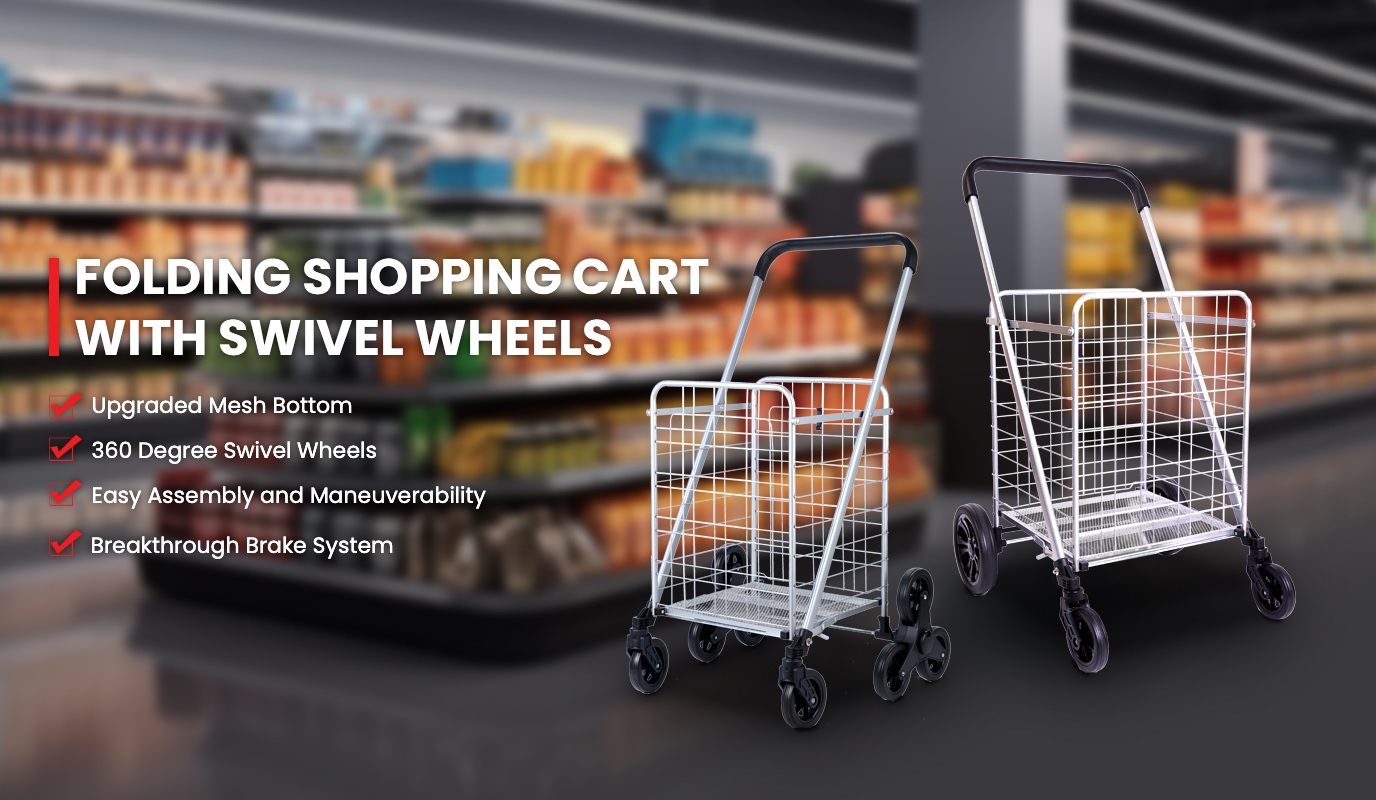
Commercial carts may include platform carts, utility carts, Shopping Carts, folding carts, and other configurations.
Their advantage is versatility. A business may not need a heavy-duty structure if the daily load is moderate and the transportation route is short.
How Do Heavy Duty Warehouse and Commercial Carts Compare?
| Feature | Heavy Duty Warehouse Cart | Commercial Cart |
|---|---|---|
| Load capacity | Higher | Low to high, model dependent |
| Frame construction | Reinforced | Standard or reinforced |
| Platform support | Heavy duty | Application dependent |
| Wheel capacity | Higher | Standard to heavy duty |
| Typical use | Warehouse and industrial handling | General commercial use |
| Frequent heavy loads | Excellent | Model dependent |
| Maneuverability | Stable under heavy loads | Often more flexible |
| Initial cost | Usually higher | Usually lower |
The comparison should always be made between specific models rather than categories alone.
What Determines the Actual Load Capacity of a Warehouse Cart?
Load capacity is influenced by several engineering factors.
Frame Strength
The frame carries the platform and transfers cargo weight toward the wheels.
Important factors include:
Steel specification
Tube dimensions
Cross supports
Welded joints
Frame geometry
A reinforced frame reduces deformation when the cart is repeatedly loaded.
Platform Construction
The platform needs to support the cargo without excessive bending.
Platform performance depends on:
Material thickness
Support structure
Platform dimensions
Load distribution
Wheel and Caster Capacity
The wheels must support the combined weight of the cart and its cargo.
If the frame is strong but the casters are undersized, the overall trolley cannot safely perform at the frame's theoretical capacity.
Which Cart Is Better for Heavy Warehouse Loads?
A heavy duty warehouse cart is generally the better choice when the normal working load is high.
Typical applications include:
Metal components
Machinery parts
Heavy cartons
Tools
Industrial supplies
Bulk materials
It is especially appropriate when these loads are transported repeatedly throughout the working day.
For occasional heavy loads, however, a commercial cart with a suitable rated capacity may be sufficient.
How Does Load Distribution Affect Capacity?
Total weight is only part of the equation.
A 400 kg load distributed evenly across a large platform can place different stresses on the frame than a 400 kg concentrated load placed in one small area.
Buyers should therefore consider:
Total weight
Load center
Cargo footprint
Weight distribution
Loading method
From a manufacturing perspective, the platform, frame, and caster system should be designed together to manage these forces.
This is why a trolley's published load rating should always be interpreted together with its intended loading conditions.
How Important Are Wheels for High-Capacity Warehouse Carts?
Wheels are critical to both capacity and operational efficiency.
Heavy-duty warehouse carts may require:
Higher Load-Rated Casters
Casters must support the combined cart and cargo weight with an appropriate safety margin.
Larger Wheels
Larger diameter wheels can make it easier to move loaded carts across thresholds and minor floor irregularities.
Suitable Wheel Materials
Different wheel materials provide different combinations of:
Load support
Grip
Noise control
Floor protection
Wear resistance
WOCHANG's trolley guidance notes that wheel diameter, tire material, bearings, and caster configuration should be selected according to load and operating conditions rather than treated as generic components. (wochangtrolley.com)
Does a Larger Cart Always Have a Higher Load Capacity?
No.
A larger platform provides more cargo space but does not automatically mean the cart can safely carry more weight.
Capacity depends on:
Frame construction
Platform reinforcement
Welding quality
Wheel capacity
Axle and bearing design
Load distribution
A compact heavy-duty cart can therefore have a higher working capacity than a larger but lightweight commercial cart.
The correct evaluation should focus on the rated working load and engineering structure, not visual size.
Which Cart Is Better for Daily High-Frequency Use?
Heavy duty warehouse carts are usually more suitable when the trolley is:
Loaded repeatedly
Used throughout multiple shifts
Moved over long distances
Exposed to impacts
Used in demanding warehouse conditions
Commercial carts can be more efficient when the workload is moderate.
A business should avoid overspecifying equipment when the additional strength provides little operational benefit. The best trolley is the one that matches the actual workload with an appropriate capacity margin.
How Does Floor Condition Affect Load Capacity?
Floor conditions influence how easily a loaded cart can move.
Smooth indoor warehouse floors are relatively favorable.
More demanding environments may include:
Rough concrete
Ramps
Thresholds
Uneven surfaces
Outdoor loading areas
A heavy load increases rolling resistance. Therefore, wheel diameter, material, bearing quality, and caster configuration become more important as the load increases.
A trolley rated for a high load should still be matched to the floor on which it will operate.
Can Heavy Duty Warehouse Carts Be Customized?
Yes. Customization can help buyers match the cart to specific handling requirements.
Possible options include:
Platform dimensions
Frame reinforcement
Load capacity
Handle height
Wheel diameter
Caster configuration
Brake system
Surface treatment
Folding or nesting features
For industrial projects, manufacturers should understand the actual cargo weight, dimensions, transportation distance, floor conditions, and frequency of use before finalizing the trolley structure.
Can Commercial Carts Also Support High Loads?
Yes, depending on the specific model.
"Commercial cart" describes the application category rather than one fixed load rating.
Some commercial platform carts can support substantial loads when they use:
Strong steel frames
Reinforced platforms
Heavy-duty casters
Appropriate wheel systems
The key is to compare the actual technical specification rather than assume that every commercial cart has limited capacity.
What Should Buyers Check Before Ordering a High-Capacity Cart?
Commercial buyers should evaluate:
Rated working load
Confirm the manufacturer's specified capacity.
Normal daily load
Do not base the selection only on an occasional maximum load.
Cargo dimensions
Check platform size and load distribution.
Frame structure
Review material, reinforcement, welding, and support points.
Wheel system
Confirm caster capacity, wheel diameter, material, and bearing design.
Floor conditions
Consider thresholds, ramps, rough surfaces, and operating routes.
Usage frequency
Daily intensive operation may justify a heavy-duty design.
Manufacturer capability
Evaluate production experience, quality control, testing, customization, and packaging.
Which Supports Higher Load Capacity: Heavy Duty Warehouse Cart or Commercial Cart?
Heavy duty warehouse carts generally support higher loads because their frames, platforms, and wheel systems are specifically engineered for demanding material handling. Commercial carts can also support substantial loads, but their capacity varies significantly by model and application.
For procurement decisions, the category name should never be the final selection criterion. Buyers should compare the complete trolley specification, including frame strength + platform construction + caster capacity + wheel design + load distribution + operating environment.
From a manufacturer's perspective, high load capacity is a system result. Increasing one component without matching the rest of the trolley can create an apparent capacity advantage without delivering reliable performance in daily operation.