



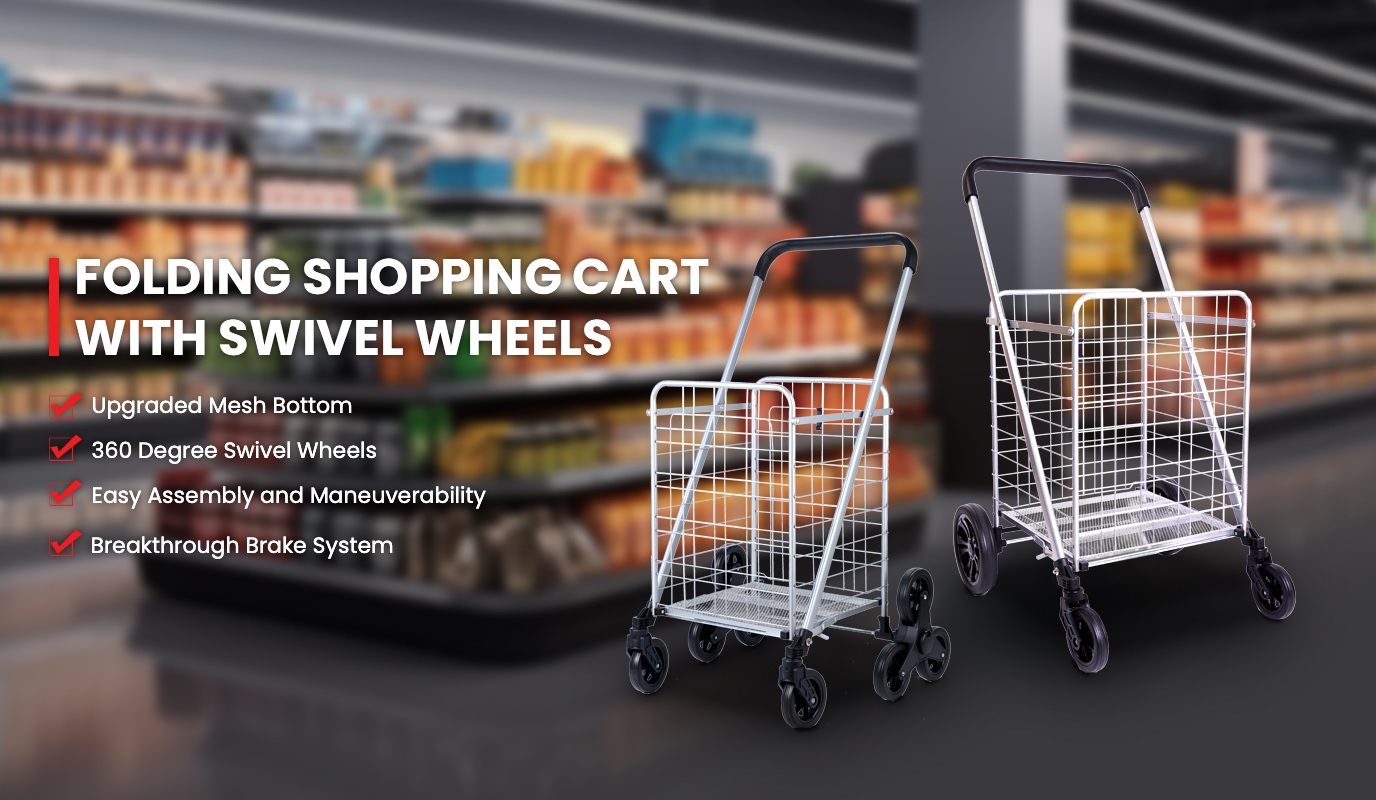
Platform Cart vs Shopping Cart: Which Is Better for Commercial Material Handling?
Platform carts are generally better for commercial material handling because their open deck, stronger frame, and load-focused design support boxes, equipment, and supplies. Shopping Carts are better suited to customer-facing retail transport.
What Is the Difference Between a Platform Cart and a Shopping Cart?
The key difference is what the cart is designed to transport and who operates it.
A platform cart is a workplace handling tool. Its flat deck is designed for cartons, bins, tools, equipment, and packaged goods that need to move between storage, production, receiving, or retail areas.
A shopping cart is designed around the customer journey. Its basket, handle, wheels, and dimensions are optimized for shoppers moving through supermarket aisles and carrying purchased products.
From a manufacturing perspective, these are not simply two versions of the same trolley. The frame structure, wheel configuration, load requirements, and usability priorities are different.
When Is a Platform Cart Better for Material Handling?
A platform cart is usually the better choice when the load is bulky, boxed, heavy, or difficult to carry by hand.
Typical applications include:
Warehouse stock transfer
Retail shelf replenishment
Factory material movement
Packing and staging areas
Maintenance work
Commercial storage operations
The flat platform is particularly useful because operators can place different sizes of cartons or equipment directly onto the deck without being restricted by a fixed Shopping Basket.
For example, WOCHANG's platform trolley content identifies cartons, tools, supplies, parts, and packaged goods as typical loads and emphasizes the importance of matching platform size, load capacity, wheel quality, and frame construction to the handling task. :chatgpt-content-reference{index="0"}
Why Is a Shopping Cart Not Usually the First Choice for Material Handling?
A shopping cart can move goods, but its design is primarily intended for retail customers rather than warehouse operators.
Its basket structure is useful for:
Groceries
Household products
Packaged retail goods
Small and medium shopping loads
However, the basket can restrict how larger cartons or irregularly shaped materials are positioned.
shopping carts also prioritize customer-oriented features such as comfortable handles, easy steering, product visibility, and maneuverability through retail aisles.
That makes them highly effective for shopping, but not necessarily the most efficient choice for internal commercial material movement.
How Do Platform Carts and Shopping Carts Compare in Structure?
The structural difference becomes more important as load size and handling frequency increase.
| Feature | Platform Cart | Shopping Cart |
|---|---|---|
| Main purpose | Material handling | Customer shopping |
| Load area | Flat open platform | Basket |
| Typical load | Cartons, tools, equipment | Retail products |
| Load orientation | Flexible | More controlled |
| Heavy-duty use | More suitable | Depends on model |
| Operator | Staff / workers | Customers |
| Main design priority | Handling efficiency | Shopping convenience |
A platform cart gives operators more freedom to position loads, while a shopping cart gives shoppers a more controlled and accessible storage area.
Which Cart Provides Better Load Capacity?
Platform carts generally provide the stronger starting point for commercial material handling.
The reason is not simply the size of the deck. Load capacity depends on the complete system:
Frame material
Platform construction
Welding quality
Wheel load rating
Axle and caster design
Load distribution
A platform cart can be engineered around a defined commercial load requirement. A shopping cart, by comparison, is normally designed around the expected weight and volume of customer purchases.
For heavier commercial applications, buyers should evaluate the rated load of the complete trolley rather than judging strength by appearance alone.
How Do Wheels Affect Material Handling Performance?
Wheel selection can determine whether a trolley remains practical when fully loaded.
Platform carts used in warehouses or commercial facilities may need larger or heavier-duty casters because they can encounter higher loads, longer travel distances, or different floor conditions.
Important wheel factors include:
Wheel Load Rating
The combined wheel capacity must be appropriate for the actual cart load and operating conditions.
Wheel Diameter
Larger wheels can make it easier to move loaded carts across small floor irregularities.
Swivel Configuration
Swivel casters improve turning flexibility, while fixed wheels can improve directional stability. The combination should match the route and handling task.
Floor Compatibility
Smooth supermarket floors and warehouse floors do not always require the same wheel solution. Wheel material and diameter should be selected according to the actual operating environment.
WOCHANG's own shopping-cart guidance also treats wheel diameter, tire material, bearing type, and front/rear wheel configuration as engineering variables rather than simple accessories. :chatgpt-content-reference{index="1"}
Which Cart Is Better for Retail Store Restocking?
For customer shopping, a shopping cart is normally the better solution.
For backroom-to-shelf transportation, a platform cart is often more practical.
Retail employees may need to move cartons from a stockroom to sales aisles, then transfer multiple products to shelves. A flat platform can accommodate different carton sizes and reduce repeated manual carrying.
WOCHANG's retail handling experience specifically identifies platform trolleys as useful for moving cartons and replenishment goods from stockrooms to shelves. :chatgpt-content-reference{index="2"}
This distinction is important for retailers: the trolley used by customers does not necessarily need to be the same trolley used by employees.
Which Cart Is Easier to Use With Bulky or Irregular Loads?
Platform carts have a clear structural advantage when cargo does not fit neatly into a basket.
A flat deck can accommodate:
Large cartons
Long packages
Equipment cases
Maintenance tools
Multiple boxes of different sizes
The operator can also arrange the load according to weight and stability.
Shopping carts are more suitable when the products are relatively small and need to remain contained during customer movement.
Which Cart Is Better for Long-Term Commercial Use?
The answer depends on the application, but heavy commercial handling generally favors a purpose-built platform cart.
Long-term performance depends on:
Frame strength
Welding consistency
Platform support
Caster durability
Surface treatment
Load distribution
Manufacturing consistency
From a manufacturer's perspective, durability should be evaluated as a complete system rather than by material alone. WOCHANG's product content similarly emphasizes that trolley durability comes from the combination of material selection, frame structure, welding, wheels, surface treatment, and production control. :chatgpt-content-reference{index="3"}
Can a Platform Cart Be Customized for Different Material Handling Tasks?
Yes. Platform carts are particularly suitable for application-based customization.
Depending on the project, manufacturers can adjust:
Platform dimensions
Frame structure
Load capacity
Handle height
Wheel configuration
Surface treatment
Additional rails or supports
This is valuable when a buyer already knows the dimensions and weight of the goods being transported.
For example, a warehouse handling cartons may require a different platform size from a maintenance team moving tools and equipment. Designing the cart around the actual load can be more effective than selecting a generic trolley.
When Should a Business Choose a Shopping Cart Instead?
A shopping cart is the better choice when the primary user is the retail customer.
It is appropriate when the operation requires:
Customer-friendly handling
Basket-style storage
Easy aisle navigation
Retail product visibility
High-frequency customer use
Shopping carts are therefore essential for supermarkets and retail stores even when those businesses also need platform carts for internal logistics.
What Should Buyers Check Before Purchasing a Platform Cart?
Commercial buyers should check the following points before placing an order:
Actual load weight
Define both normal and maximum working loads.
Cargo dimensions
Measure the largest cartons, equipment, or materials to determine platform size.
Floor conditions
Specify whether the cart will operate on smooth concrete, warehouse flooring, outdoor surfaces, or mixed conditions.
Transportation distance
Longer routes may require different wheel and handle configurations.
Storage requirements
Consider whether the cart needs to be foldable, nested, or compact when not in use.
Manufacturing capability
Check whether the factory can control frame fabrication, welding, wheel assembly, surface treatment, and final inspection.
Is a Platform Cart or Shopping Cart Better for Commercial Material Handling?
For commercial material handling, a platform cart is generally the better choice because its open deck and load-oriented construction provide greater flexibility for cartons, equipment, and supplies.
A shopping cart remains the better option for customer-facing retail use.
The most efficient commercial operation may actually require both: shopping carts for customers and platform carts for staff replenishment and internal material movement. Choosing each trolley according to its real task avoids forcing one product to perform a job it was not designed for.