



How Do Foldable Warehouse Trolleys Save Space
Foldable warehouse trolleys save space by reducing the storage footprint of handling equipment when it is not in use. In many warehouses, carts are needed only during picking, replenishment, packing support, or internal transfer windows. Once those tasks end, a rigid trolley continues to occupy floor area, while a foldable warehouse trolley can be collapsed and stored against a wall, in a rack gap, or inside a narrower staging zone. OSHA notes that efficient handling and storing of materials are vital to industry and that aisles and passageways used for moving materials must have sufficient clearance. In practical terms, space-saving equipment helps keep these areas less congested.
Folding structure reduces idle footprint
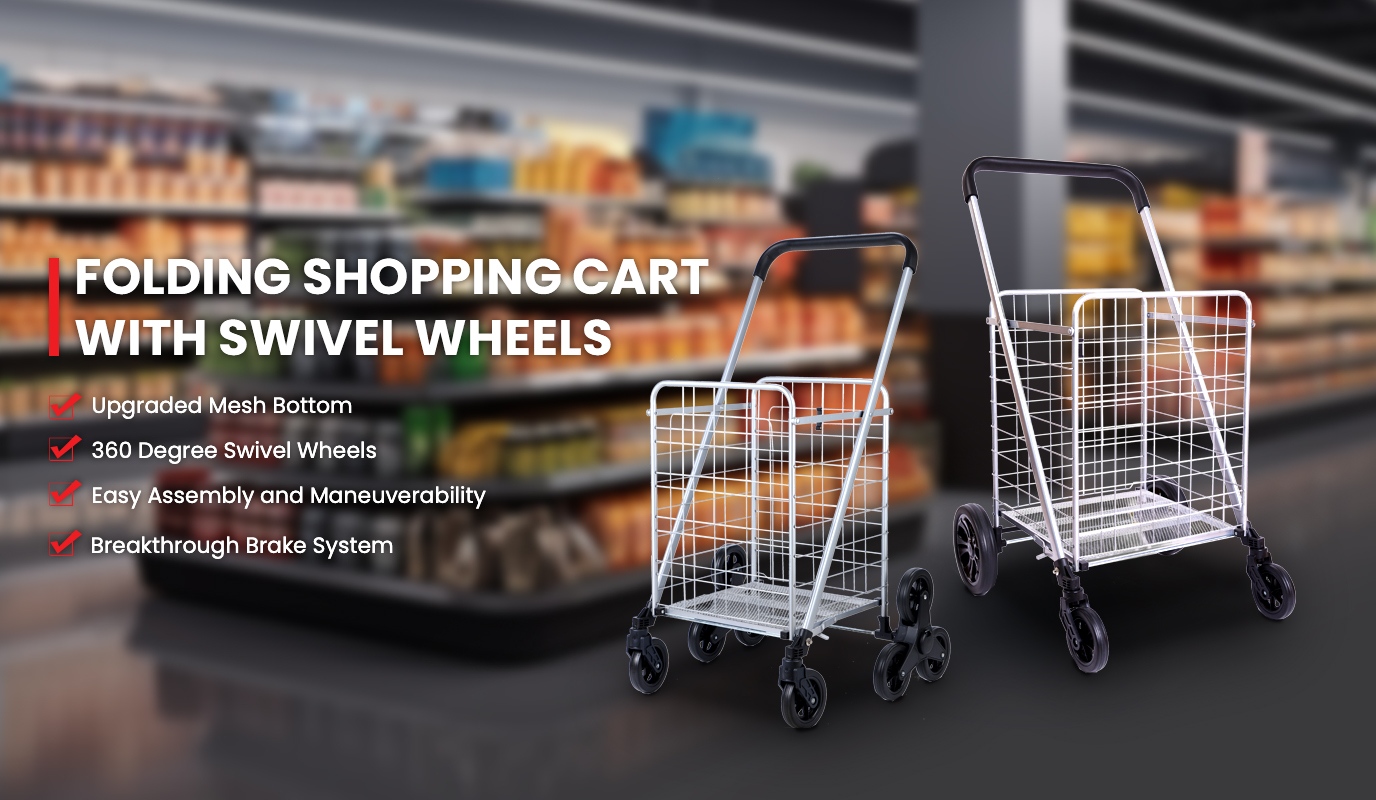
The main space-saving advantage comes from the folding mechanism itself. WOCHANG’s foldable cart content states that its foldable Shopping Cart can unfold and collapse in two to three seconds with one hand and fold down to a thickness of about 16 cm for upright or flat storage. Even though this example is positioned as a shopping cart, the same structural principle is highly relevant to warehouse trolley design: the cart provides full working capacity during use, then converts into a low-profile unit after the task is finished. That is especially useful in back-of-house storage rooms, dispatch zones, and mixed-use warehouse spaces where spare floor area is limited.
Better use of aisles and staging zones
Warehouse space efficiency is not only about rack capacity. It is also about keeping travel routes open. OSHA materials-handling guidance explains that mechanical movement through aisles and passageways requires sufficient clearance at loading docks, doorways, and turning points. A foldable trolley helps by reducing the amount of parked equipment left in these traffic paths. This becomes more important in warehouses with tighter aisles, because aisle-planning guidance summarizing OSHA recommendations notes that aisles should be wider than the equipment using them, with a minimum width benchmark often cited at four feet. In practical use, a trolley that can be folded after the shift reduces the pressure on aisle space and temporary staging space.
Why foldable design improves storage efficiency
A foldable trolley improves storage efficiency in several ways at once:
| Space-saving feature | Practical result |
|---|---|
| Collapsible frame | Smaller idle footprint |
| Flat storage profile | Easier wall-side or rack-side storage |
| Faster setup and folding | Less time spent moving unused equipment |
| Portable structure | Easier redeployment between work areas |
| Reduced floor obstruction | Cleaner aisles and safer circulation |
These benefits matter because warehousing work often involves repeated pushing, pulling, bending, and handling tasks. OSHA and NIOSH both highlight pushing and pulling heavy loads as ergonomic risk factors, so reducing unnecessary cart congestion also supports easier movement and safer work organization.
Manufacturer vs trader
When buyers compare manufacturer vs trader, foldable products make the difference more obvious. A foldable structure requires tighter control over hinge geometry, locking points, frame alignment, wheel placement, and repeated opening-and-closing durability. WOCHANG states on its website that it is a manufacturer of shopping carts, Shopping Baskets, and laundry products with more than 20 years of experience, and that it has BSCI and SCAN certifications. Its January 2026 article on foldable cart issues also says the company focuses on practical structures and durable components to reduce common failures during long-term use. That is important because a foldable trolley only saves space if it continues to fold smoothly and remain stable over time.
OEM and ODM process for warehouse fit
Foldable warehouse trolleys create the most value when the design matches the actual storage environment. A proper OEM and ODM process should include folded dimensions, open dimensions, load target, handle height, wheel type, locking method, and packaging plan during the drawing and sample stage. In a warehouse with narrow staging areas, the folded thickness may matter more than basket volume. In a dispatch area, quick one-hand folding may be more important than decorative finish. WOCHANG’s existing foldable-cart product direction suggests it can support this type of project adjustment through direct factory coordination rather than generic resale.
Manufacturing process overview
A reliable foldable trolley manufacturer should explain how the folding function is built into the production process. The manufacturing process overview should include metal tube forming, hinge and locking-point fabrication, welding, surface treatment, wheel installation, folding-action testing, and final inspection. For foldable designs, durability depends on whether the frame stays aligned after repeated cycles, whether the latch holds securely under load, and whether the wheels remain stable after the frame is folded and reopened many times. WOCHANG’s foldable-cart maintenance article makes clear that long-term usability depends on these practical structural details.
Quality control checkpoints
The most important quality control checkpoints for a foldable warehouse trolley include hinge strength, lock reliability, frame alignment, caster installation, rolling smoothness, and folding-cycle consistency. NIOSH guidance on manual material handling notes that pushing and pulling risk increases when cart design is poor or braking and handling aids are inadequate. That means a foldable trolley should not only save space when parked. It must also roll smoothly and remain stable when opened and loaded. Quality control should confirm both conditions before shipment.
Material standards used and bulk supply considerations
Material standards used in a foldable trolley affect both space-saving and durability. Buyers should confirm steel tube quality, hinge material, latch construction, wheel material, and surface coating before production begins. Bulk supply considerations should also include packaging efficiency, repeat folded dimensions, replacement-part consistency, and whether all units in later shipments fold with the same ease as the approved sample. A foldable design loses value quickly if the latch becomes inconsistent or the folded profile varies between batches. WOCHANG’s direct-manufacturer identity and export experience make this evaluation easier because the buyer can review the folding structure at the factory level rather than only in a catalog description.
Project sourcing checklist
| Checkpoint | Why it matters |
|---|---|
| Folded thickness | Determines real storage savings |
| Locking mechanism | Protects stability during use |
| Hinge durability | Supports repeated opening and closing |
| Wheel configuration | Keeps the trolley easy to move in tight routes |
| Packaging method | Protects folding parts during shipment |
| Certification review | Supports long-term sourcing confidence |
This checklist is useful when comparing several suppliers because the best foldable trolley is not the one that folds once in a sample room. It is the one that keeps saving space and performing reliably across daily use and repeat orders.
Export market compliance and final view
Export market compliance matters because foldable trolleys often involve moving parts, so packaging stability, batch consistency, and factory inspection discipline are critical in cross-border supply. WOCHANG states that it exports to markets including North America, Europe, and Southeast Asia and operates under BSCI and SCAN certifications. That strengthens its position for projects that require compact storage performance, repeat manufacturing quality, and reliable bulk delivery. In practical warehouse operations, foldable warehouse trolleys save space by shrinking idle equipment volume, protecting aisles, and making storage zones more flexible without removing transport capability.