



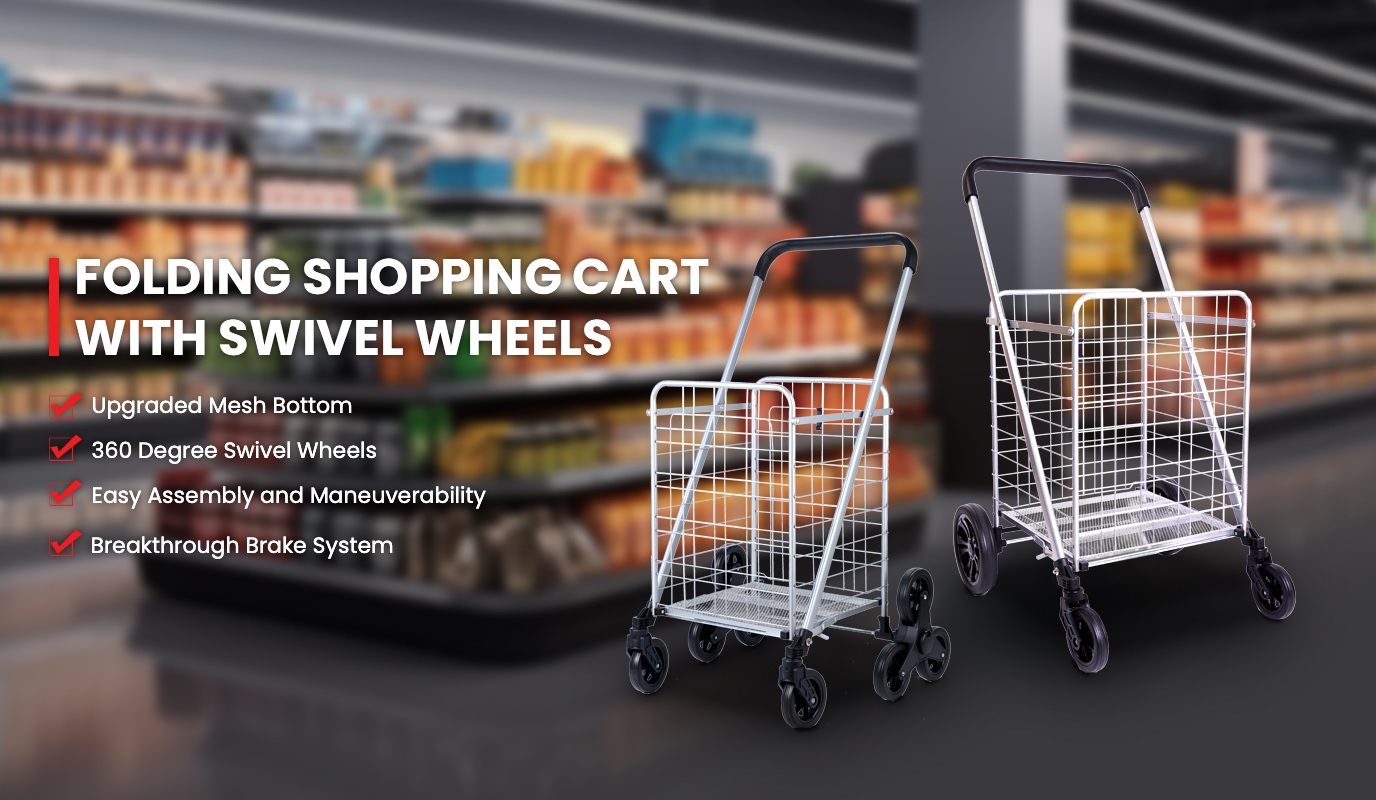
Chrome Plated Cart vs Powder Coated Cart: Which Surface Treatment Is More Durable?
Powder coating generally provides better long-term durability for carts exposed to impacts, moisture, and frequent handling, while chrome plating offers a hard, attractive surface with good wear resistance. The better treatment depends on corrosion exposure, impact frequency, appearance requirements, and maintenance conditions.
What Is the Difference Between Chrome Plating and Powder Coating?
The two treatments protect metal carts in different ways.
Chrome plating deposits a thin chromium layer over the underlying metal, often with additional plating layers beneath it. The resulting surface has a bright metallic appearance and good surface hardness.
Powder coating applies dry powder to a prepared metal surface and then cures it into a continuous protective film. It can provide both corrosion protection and decorative color options.
For commercial carts, the treatment should be evaluated according to:
Surface hardness
Impact resistance
Corrosion resistance
Coating adhesion
Scratch resistance
Cleaning conditions
Appearance requirements
Expected service life
Why Is Chrome Plating Used on Shopping Carts?
Chrome plating has traditionally been popular for wire and tubular carts because it creates a bright, clean metallic appearance.
Its advantages can include:
Attractive surface finish
Good surface hardness
Wear resistance
Easy visual inspection
Established production technology
Chrome-plated carts can be particularly suitable for indoor retail environments where appearance is important and exposure to severe corrosion is limited.
The quality of the underlying plating system is critical. A visually bright chrome surface does not automatically indicate excellent long-term corrosion resistance.
Why Is Powder Coating Used on Carts?
Powder coating creates a protective polymer layer over the metal substrate.
It can provide:
Strong surface coverage
Good corrosion protection
Color customization
Impact resistance
Consistent appearance
Powder coating is widely used for commercial carts because the coating can be adapted to different frame structures and application requirements.
The final performance depends heavily on surface preparation, pretreatment, powder formulation, coating thickness, and curing.
How Do Chrome Plated and Powder Coated Carts Compare?
| Factor | Chrome Plated Cart | Powder Coated Cart |
|---|---|---|
| Surface hardness | Excellent | Good to excellent |
| Corrosion protection | Good when plating is intact | Good to excellent |
| Impact resistance | Moderate to good | Good to excellent |
| Scratch resistance | Good | Good |
| Color options | Limited | Excellent |
| Metallic appearance | Excellent | Limited |
| Indoor retail use | Excellent | Excellent |
| Humid environments | Application dependent | Good to excellent |
| Surface repair | More difficult | Relatively practical |
| Custom branding | Limited | Excellent |
Neither treatment is automatically superior. The better choice depends on how the cart will be used.
Which Surface Treatment Is Better for High-Traffic Retail?
Powder coating often provides a practical advantage in high-traffic retail environments.
shopping carts can experience repeated contact with:
Other carts
Shelves
Store fixtures
Parking barriers
Floors and thresholds
Powder coating can provide a relatively resilient protective layer across the frame.
However, coating performance depends on the formulation and application process. A poorly prepared powder-coated surface can fail earlier than a properly manufactured plated surface.
Is Chrome Plating More Scratch Resistant?
Chrome plating has high surface hardness, which can provide good resistance to certain types of surface wear.
However, scratch resistance should not be confused with impact resistance.
A hard chrome surface can still be damaged by:
Strong impacts
Deep scratches
Bending
Deformation of the underlying steel
If the substrate is damaged severely, the plating layer may crack or detach.
Powder coating is generally softer than chrome, but its flexibility can help it tolerate certain impacts without immediately exposing the substrate.
Which Has Better Corrosion Resistance?
The answer depends heavily on process quality.
Chrome plating can provide good corrosion protection when the complete plating system is correctly applied.
However, corrosion can begin if the plating is damaged or if moisture reaches the underlying steel.
Powder coating can provide excellent corrosion protection when the steel is properly pretreated and the coating remains intact.
Important powder-coating factors include:
Degreasing
Surface cleaning
Pretreatment
Coating thickness
Curing
Adhesion
For both systems, the weakest areas often include edges, joints, welds, and damaged surfaces.
What Happens When Chrome Plating Is Damaged?
A deep scratch or chip can expose the underlying material.
Once the substrate is exposed to moisture and oxygen, corrosion can develop beneath or around the damaged area.
This makes plating quality and substrate preparation important.
A cart used in a dry indoor supermarket may experience little corrosion even with minor surface damage.
A cart used outdoors or in a humid environment faces a much greater risk.
What Happens When Powder Coating Is Scratched?
A deep scratch can also expose the steel beneath the coating.
The difference is that powder coating can often be repaired or refinished more practically than a damaged decorative plating system.
For commercial buyers, this can be useful when carts remain in service for many years.
However, a damaged coating should not be ignored in wet or corrosive environments.
Which Treatment Is Better for Wet Environments?
Powder coating can provide strong performance in wet environments when the pretreatment and coating system are designed correctly.
Potential applications include:
Laundry facilities
Wet storage areas
Outdoor retail
Cleaning areas
Humid warehouses
Chrome plating can also work in moderately humid environments, but the integrity of the plating system becomes increasingly important as moisture exposure increases.
For severe corrosion conditions, the substrate material and protection system should be evaluated together rather than selecting a surface treatment based only on appearance.
Which Is Better for Outdoor Use?
Powder coating is often more practical for Outdoor Carts because the coating system can be specifically designed for environmental exposure.
Outdoor carts may experience:
Rain
UV radiation
Humidity
Dirt
Temperature changes
Road salt
The powder formulation and pretreatment should match these conditions.
Chrome-plated carts can be used outdoors in suitable environments, but long-term exposure to moisture and damaged plating can increase corrosion risk.
Does Powder Coating Provide Better Color Customization?
Yes.
Powder coating offers a much broader range of visual options.
Manufacturers can provide:
Black
White
Gray
Blue
Red
Custom brand colors
Different gloss levels
Textured finishes
This makes powder coating attractive for retailers that want shopping carts to match their corporate identity.
Chrome plating is mainly selected when the bright metallic appearance itself is part of the desired design.
Which Surface Is Easier to Clean?
Both surfaces can be relatively easy to clean.
Chrome provides a smooth, reflective surface that can be wiped effectively.
Powder coating can also provide a smooth and cleanable surface, depending on the finish.
Cleaning chemicals should be compatible with the selected treatment.
Repeated use of highly aggressive chemicals can gradually affect certain coatings, so commercial buyers should confirm chemical resistance when carts are subject to frequent sanitation.
Which Treatment Is Better for Commercial Kitchens?
Powder-coated carts may be suitable for dry storage and general handling areas.
For areas involving:
Steam
Hot water
Frequent washing
Food residues
Cleaning chemicals
the coating specification becomes particularly important.
For demanding hygiene environments, stainless steel may be more appropriate than either conventional chrome-plated or powder-coated carbon steel.
The surface treatment should therefore be selected as part of the complete material system.
How Does Manufacturing Quality Affect Durability?
Surface treatment alone does not determine service life.
For chrome plating, manufacturing quality includes:
Surface preparation
Base-metal condition
Plating-layer sequence
Plating thickness
Adhesion
Final inspection
For powder coating, important controls include:
Degreasing
Pretreatment
Powder application
Film thickness
Curing temperature
Curing time
Adhesion inspection
From a manufacturer's perspective, surface treatment should be treated as a controlled production process rather than a final decorative step.
Does Cart Design Affect Surface Treatment Durability?
Yes.
A cart's frame geometry can influence how much stress reaches the surface.
High-stress areas may include:
Welds
Bends
Corners
Joints
Handle connections
Caster mounting points
A strong coating cannot compensate for poor frame design.
For example, repeated flexing at a poorly designed joint can eventually damage the surface regardless of whether the cart is plated or powder coated.
Which Treatment Requires More Maintenance?
Both treatments require routine inspection.
Chrome-plated carts should be checked for:
Chips
Peeling
Corrosion spots
Deep scratches
Damaged plating
Powder-coated carts should be checked for:
Chipped coating
Deep scratches
Rust around damaged areas
Surface peeling
Weld-area damage
The main maintenance objective is to identify surface damage before corrosion spreads into the underlying structure.
Which Offers Better Long-Term Value?
The answer depends on the purchasing environment.
Chrome plating can provide strong value when:
A metallic appearance is important
The cart is mainly used indoors
Humidity is controlled
Surface aesthetics are a major priority
Powder coating can provide better overall value when:
Color customization is needed
Corrosion protection is important
Carts experience frequent impacts
Outdoor or humid use is expected
Long-term maintenance flexibility matters
The correct comparison should include purchase price + treatment durability + maintenance + replacement frequency.
Can Chrome Plated and Powder Coated Carts Be Customized?
Yes.
Manufacturers can customize both types through:
Cart dimensions
Basket structure
Frame design
Handle design
Wheel configuration
Powder-coated carts provide greater freedom in:
Color
Gloss
Texture
Branding
Chrome-plated carts provide a distinctive metallic finish and can be combined with different frame structures and basket designs.
For OEM projects, the surface treatment should be selected after defining the target environment and desired appearance.
What Should Buyers Check Before Ordering?
Commercial buyers should evaluate:
Operating environment
Determine whether the cart will be used indoors, outdoors, in wet areas, or in humid climates.
Impact frequency
Consider contact with other carts, shelves, barriers, and loading areas.
Corrosion exposure
Check humidity, salt, cleaning chemicals, and water exposure.
Surface treatment process
Ask how the metal is prepared and how the coating or plating is applied.
Treatment thickness
Confirm that production specifications are controlled consistently.
Adhesion
Surface adhesion is critical to long-term protection.
Repair requirements
Consider whether damaged surfaces can be practically repaired during service.
Manufacturer capability
Evaluate frame fabrication, welding, surface preparation, plating or powder coating, quality control, testing, assembly, and bulk production capability.
Which Is More Durable: Chrome Plated or Powder Coated Cart?
Powder coated carts generally offer better overall durability for demanding commercial use because the coating can provide strong corrosion protection, impact resistance, and flexible color options. Chrome plated carts remain highly durable for indoor applications where surface hardness and a bright metallic finish are important.
The result depends strongly on manufacturing quality.
A well-prepared substrate, controlled coating or plating process, appropriate thickness, and reliable adhesion can significantly extend service life. Conversely, poor pretreatment or inconsistent surface treatment can cause premature failure regardless of the selected finish.
From a manufacturer's perspective, the right decision should be based on environment + impact level + corrosion exposure + appearance requirements + maintenance strategy.
For general indoor retail, either treatment can perform effectively. For high-impact, humid, outdoor, or highly customized applications, powder coating often provides greater practical flexibility and long-term value.