



Compact Shopping Cart vs Large Capacity Shopping Cart: Which Is More Popular in Modern Retail?
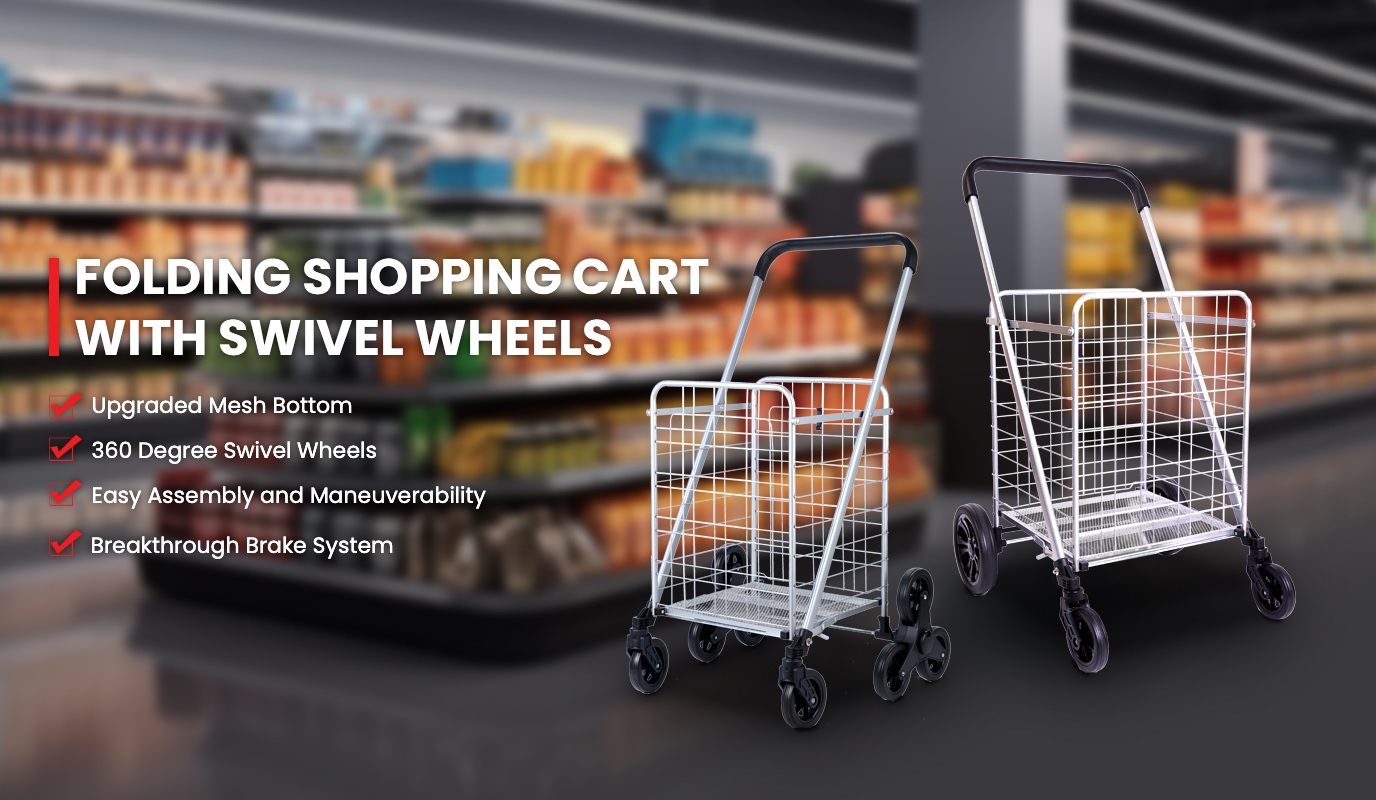
Compact Shopping Carts are increasingly suitable for urban stores, convenience-focused shopping, and smaller baskets, while large capacity carts remain essential for supermarkets and bulk shopping. Neither is universally more popular; demand depends strongly on store format, customer behavior, and shopping mission.
Why Are Compact shopping carts Becoming More Relevant?
Modern retail is increasingly diverse. Large supermarkets still require high-capacity carts, but many urban and convenience-oriented stores have limited floor space and customers often make smaller, more frequent purchases.
Compact shopping carts can provide several practical advantages:
Easier movement through narrow aisles
Smaller turning radius
Lower storage requirements
Easier handling for short shopping trips
Better suitability for compact stores
For retailers operating in dense urban areas, a smaller cart can improve the relationship between customer convenience and usable selling space.
What Are the Advantages of Large Capacity Shopping Carts?
Large capacity shopping carts remain important because customers still need to transport substantial quantities of products.
They are particularly suitable for:
Supermarkets
Hypermarkets
Wholesale stores
Warehouse-style retailers
Large grocery stores
A larger basket can accommodate bulky or high-volume purchases such as beverages, household supplies, packaged food, and larger retail products.
For these environments, reducing cart capacity can create an unnecessary limitation on the customer's shopping journey.
How Do Compact and Large Capacity Shopping Carts Compare?
| Factor | Compact Shopping Cart | Large Capacity Shopping Cart |
|---|---|---|
| Basket capacity | Small to medium | Large |
| Aisle maneuverability | Excellent | Moderate to good |
| Storage footprint | Smaller | Larger |
| Small-store suitability | Excellent | Limited |
| Bulk shopping | Limited | Excellent |
| Short shopping trips | Excellent | Good |
| Large family shopping | Moderate | Excellent |
| Customer mobility | Easier in crowded areas | Better for large loads |
The better format depends on what customers typically buy and how much space the store can allocate to cart movement.
Which Shopping Cart Is Better for Convenience Stores?
Compact shopping carts are generally better suited to convenience stores.
Customers in these stores often purchase a limited number of products and spend less time navigating the sales floor.
A large shopping cart may occupy unnecessary space and make narrow aisles feel more crowded.
Compact carts can support:
Quick shopping trips
Narrow aisles
Small baskets
Limited backroom storage
Frequent customer turnover
For convenience-oriented retail, the objective is often not maximum carrying capacity but easy movement with sufficient capacity for the typical basket size.
Which Shopping Cart Is Better for Supermarkets?
Large capacity shopping carts are generally better for full-size supermarkets.
Supermarket customers may purchase products across multiple categories during one visit.
A larger cart reduces the need for customers to:
Carry products by hand
Return to the cart area
Use multiple baskets
Limit purchases because of insufficient space
For large supermarkets, cart capacity can therefore directly influence customer convenience.
Are Compact Shopping Carts Better for Urban Retail?
They can be.
Urban stores often face restrictions that large suburban or warehouse-style stores do not.
These may include:
Smaller floor areas
Narrower aisles
Limited storage rooms
Higher rental costs
Greater pedestrian traffic
A compact cart can help retailers preserve aisle space while still giving customers a more convenient alternative to carrying products.
This makes compact shopping carts particularly relevant to modern urban retail formats.
Why Do Large Capacity Carts Remain Popular?
Large capacity carts solve a problem that compact carts cannot: high-volume product transportation.
A customer buying a weekly household supply may need substantial basket volume.
Large carts are therefore valuable for:
Family shopping
Bulk purchasing
Weekend shopping
Wholesale retail
Large grocery trips
Their popularity is supported by the fact that supermarkets still need to accommodate customers with very different purchasing volumes.
How Does Store Size Affect Cart Selection?
Store size is one of the strongest indicators of the appropriate cart format.
A compact store may benefit from smaller carts because every aisle needs to remain accessible.
A large supermarket can accommodate wider carts because its floor plan usually provides:
Wider aisles
Larger entrances
Dedicated cart storage
Larger customer circulation areas
The same cart can therefore perform very differently in two retail environments.
How Does Customer Shopping Behavior Affect Cart Size?
Customer behavior should be analyzed before choosing a cart.
A retailer should consider:
Average number of products per visit
Average shopping value
Frequency of small purchases
Frequency of bulk purchases
Customer demographics
Average shopping duration
For example, a city-center convenience store may have many customers making short daily purchases, while a suburban supermarket may have customers completing large weekly shopping trips.
The cart design should follow the dominant shopping pattern.
Which Cart Is Easier to Maneuver?
Compact shopping carts generally provide better maneuverability.
Their smaller dimensions can make it easier to:
Turn at aisle intersections
Navigate crowded areas
Enter narrow aisles
Move around displays
Approach checkout areas
Large capacity carts can still maneuver effectively when equipped with suitable caster systems, but their larger footprint requires more circulation space.
How Important Are Wheels and Casters?
Wheel performance affects both compact and large-capacity carts.
Important factors include:
Wheel Diameter
Larger wheels can move more easily over thresholds and minor floor irregularities.
Caster Configuration
Swivel casters can improve turning flexibility in crowded retail environments.
Wheel Material
The material influences:
Noise
Floor protection
Grip
Wear resistance
Load Rating
Large-capacity carts require wheel and caster systems capable of supporting higher combined loads.
A cart with a large basket but underspecified wheels can become difficult to push when fully loaded.
Which Cart Requires More Storage Space?
Large capacity shopping carts normally require more storage space per unit.
However, nesting design can significantly reduce the total footprint when many carts are stored together.
Compact carts can provide an advantage because they require less space even before nesting.
For procurement, retailers should compare:
Cart quantity × individual dimensions × nesting depth
rather than judging storage requirements from one cart alone.
Can Compact Shopping Carts Still Carry Enough Products?
Yes.
Compact does not mean unsuitable for commercial shopping.
A well-designed compact cart can provide enough capacity for:
Daily groceries
Convenience purchases
Small household shopping
Personal shopping
Urban retail visits
The important question is whether the basket volume matches the store's typical customer basket.
Oversizing a cart can waste space, while undersizing it can frustrate customers.
Can Large Capacity Shopping Carts Be Designed for Better Maneuverability?
Yes.
Manufacturers can optimize large carts through:
Wheel placement
Caster configuration
Basket geometry
Frame dimensions
Handle position
Wheel material
The goal is to provide sufficient carrying capacity without making the cart unnecessarily difficult to steer.
From a manufacturing perspective, increasing basket size should always be considered together with wheel performance and frame stability.
Can Shopping Cart Size Be Customized?
Yes. Commercial shopping cart manufacturers can customize products according to retail requirements.
Possible customization includes:
Basket dimensions
Frame width
Basket depth
Handle height
Wheel configuration
Child seat
Color
Logo
Surface treatment
For retail chains, customization can also help standardize cart dimensions across different store formats.
What Should Retail Buyers Check Before Ordering?
Before choosing compact or large capacity shopping carts, buyers should evaluate:
Average basket size
Determine how many products customers typically purchase.
Aisle width
Measure the actual circulation space available.
Store format
Identify whether the location is a convenience store, supermarket, wholesale store, or another retail format.
Customer traffic
Consider peak-hour congestion.
Storage area
Check both the available area and nesting requirements.
Maximum expected load
Confirm that the basket, frame, wheels, and casters can support realistic loads.
Wheel performance
Evaluate maneuverability, floor protection, noise, and durability.
Manufacturer capability
For bulk procurement, check frame construction, basket production, wheel assembly, quality control, customization, and production capacity.
Which Is More Popular in Modern Retail?
Compact shopping carts are increasingly relevant in urban and space-conscious retail, while large capacity shopping carts remain more popular for supermarkets, wholesale stores, and high-volume shopping environments.
There is no single cart size that dominates every modern retail format.
From a manufacturer's perspective, cart popularity should be evaluated by store format + customer basket size + aisle space + shopping frequency + storage capacity. A compact cart can be the better commercial solution for a dense urban store, while a large-capacity model can create greater customer value in a supermarket.
The strongest retail strategy is often not to choose the "most popular" cart universally, but to select the cart size that best matches the store's actual customer behavior and floor plan.