


What Causes Shopping Cart Wheels to Wear Out Quickly
Shopping Cart wheels are one of the most frequently used components in retail transportation equipment. Although wheels look simple, their performance directly affects pushing comfort, cart stability, noise levels, and maintenance costs.
When shopping cart wheels wear out quickly, the problem is usually not caused by the wheel itself alone. Material selection, floor conditions, load weight, wheel structure, maintenance habits, and manufacturing quality all influence wheel lifespan.
As a professional shopping cart manufacturer with more than 20 years of production experience, WOCHANG focuses on improving cart structures, wheel systems, and product durability through continuous design development. The company produces shopping carts, Laundry Carts, Outdoor Carts, and related products exported to more than 30 countries. (WOCHANG)
Common Reasons Shopping Cart Wheels Wear Out Quickly
Shopping cart wheels experience repeated stress every day. In supermarkets, warehouses, and retail environments, carts may be pushed hundreds of times daily, creating continuous pressure on wheel materials and bearings.
The main causes of early wheel wear include:
| Cause | Impact On Wheel Performance |
|---|---|
| Excessive loading | Increases pressure on wheel surface and bearings |
| Poor wheel material selection | Causes faster abrasion |
| Uneven floors | Creates additional vibration and impact |
| Low-quality bearings | Reduces smooth movement |
| Incorrect wheel size | Increases pushing resistance |
| Poor maintenance | Allows small problems to become major failures |
A durable shopping cart wheel system must be designed according to the actual usage environment rather than only focusing on initial production cost.
Overloading Causes Faster Wheel Damage
One of the most common reasons shopping cart wheels wear out quickly is excessive loading.
Every wheel has a specific load capacity. When a cart carries weight beyond its designed limit, several problems can occur:
Increased friction
Bearing damage
Wheel deformation
Reduced steering performance
Faster material fatigue
For commercial applications, manufacturers need to balance:
Cart frame strength
Wheel diameter
Bearing capacity
Product weight
Expected usage frequency
For example, heavy-duty shopping trolleys require stronger wheel systems compared with lightweight personal shopping carts.
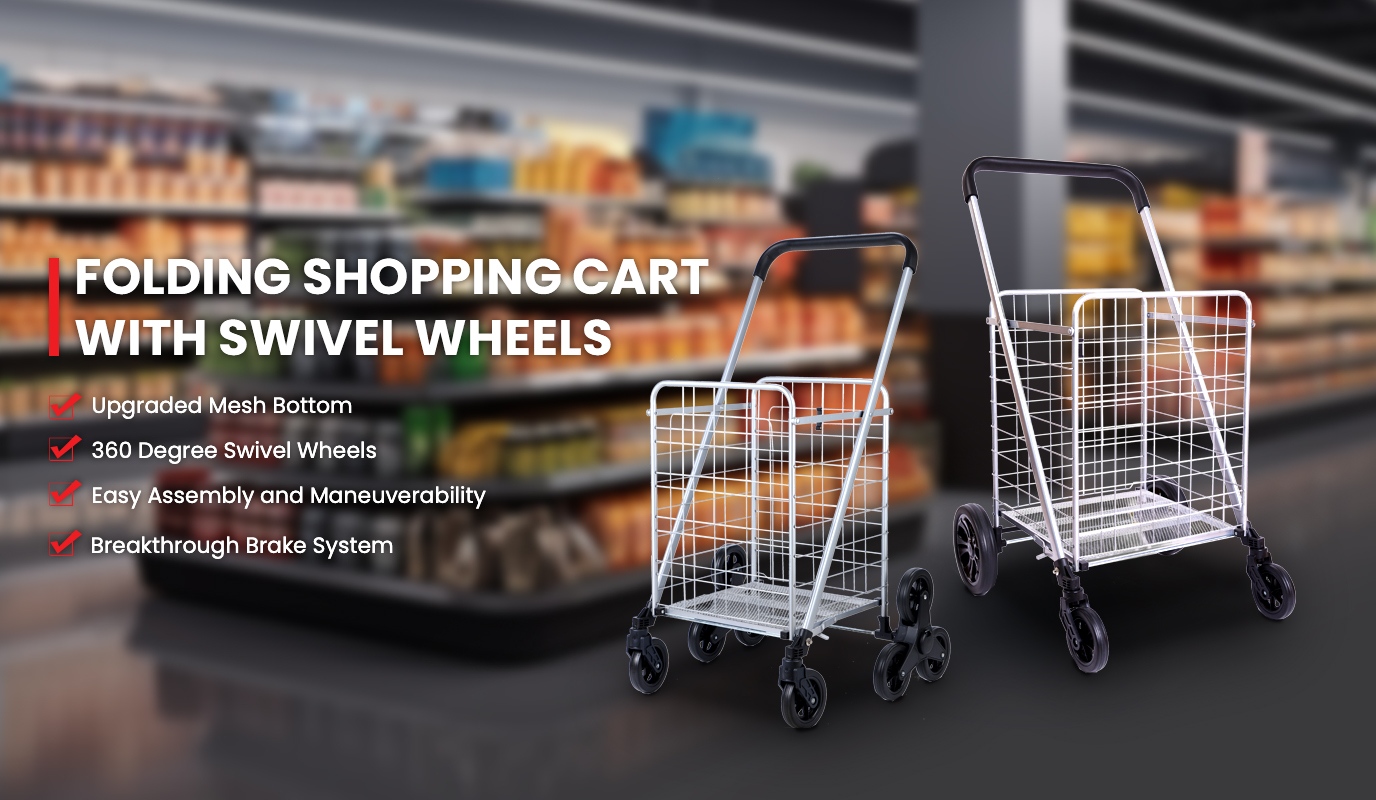
WOCHANG develops different cart structures according to application requirements, including foldable shopping carts, metal shopping carts, and heavy-duty trolley solutions. (WOCHANG)
Wheel Material Selection Determines Service Life
The material used for shopping cart wheels directly affects durability and movement performance.
Common wheel materials include:
| Wheel Material | Advantages |
|---|---|
| EVA | Quiet operation and shock absorption |
| PU | Wear resistance and smooth rolling |
| Rubber | Better grip and outdoor adaptability |
| PP | Lightweight and economical |
Different environments require different wheel solutions.
For example:
Indoor supermarkets need low-noise wheels
Outdoor carts need weather-resistant materials
Heavy-duty carts require stronger wheel structures
WOCHANG uses materials such as EVA, PP, rubber, and other components according to different product designs to achieve better performance in various applications. (WOCHANG)
Floor Conditions Affect Shopping Cart Wheel Wear
Even high-quality wheels can wear faster when used on unsuitable surfaces.
Common challenging environments include:
Rough concrete floors
Outdoor pavement
Uneven warehouse surfaces
Floor gaps and obstacles
These conditions create:
Additional impact force
Increased vibration
Higher rolling resistance
For commercial environments, wheel design should consider:
| Environment | Recommended Wheel Features |
|---|---|
| Supermarket floor | Quiet and smooth rolling wheels |
| Warehouse | Heavy-duty bearings and stronger materials |
| Outdoor area | Wear-resistant and weather-resistant wheels |
| Shopping center | Low-noise and easy steering design |
A professional manufacturer evaluates the application environment before selecting wheel specifications.
Poor Bearing Quality Increases Wheel Failure
The wheel surface is not the only factor affecting performance. Internal bearing quality is equally important.
A poor bearing system may cause:
Difficult pushing
Wheel locking
Uneven rotation
Increased noise
Faster wheel damage
A reliable shopping cart wheel system should include:
Smooth rotation structure
Stable axle connection
Proper lubrication design
Suitable bearing materials
During manufacturing, quality inspection should include movement testing to ensure wheels operate smoothly after assembly.
Manufacturing Process Overview For Shopping Cart Wheels
Wheel durability depends heavily on manufacturing precision.
A professional production process includes:
Material Inspection
Factories check:
Raw material quality
Hardness
Size accuracy
Component consistency
Wheel Production
The process may include:
Material forming
Wheel assembly
Bearing installation
Axle fitting
Cart Assembly
After wheel installation, manufacturers test:
Rolling performance
Steering flexibility
Load stability
Overall movement
| Production Stage | Quality Control Checkpoint |
|---|---|
| Material preparation | Verify specifications |
| Wheel assembly | Ensure correct installation |
| Bearing testing | Check smooth rotation |
| Cart assembly | Confirm stability |
| Final inspection | Verify product performance |
Manufacturer Vs Trader: Why Factory Control Matters
Shopping cart wheels are small components, but they influence the entire product experience.
Working directly with a manufacturer provides better control over:
Wheel material selection
Cart structure design
Load requirements
Product testing
Custom specifications
A trader usually depends on external suppliers, while a manufacturer can adjust:
Wheel type
Frame design
Product dimensions
Packaging requirements
For long-term supply projects, direct factory cooperation helps maintain consistent quality between different production batches.
WOCHANG specializes in manufacturing shopping carts, baskets, laundry carts, and related products with its own production experience and product development capabilities. (WOCHANG)
OEM And ODM Process For Shopping Cart Wheel Solutions
Different markets may require different wheel designs.
A professional OEM and ODM process includes:
Requirement Analysis
Confirm:
Usage environment
Load capacity
Wheel material preference
Cart structure
Engineering Development
Optimize:
Wheel size
Bearing structure
Frame connection
Folding mechanism
Sample Testing
Evaluate:
Movement performance
Load ability
Noise level
Durability
Mass Production
Maintain:
Stable specifications
Consistent quality
Reliable delivery
Customization helps manufacturers create wheel solutions suitable for different retail and transportation scenarios.
Quality Control Checkpoints For Bulk Supply
For large-volume shopping cart supply, wheel consistency is critical.
Important inspection points include:
| Inspection Item | Purpose |
|---|---|
| Wheel material | Ensure durability |
| Bearing performance | Maintain smooth movement |
| Load testing | Confirm safety |
| Assembly inspection | Prevent installation problems |
| Final testing | Maintain batch consistency |
A single defective wheel can affect the usability of an entire cart fleet, so preventive quality control is essential.
Export Market Compliance And Material Standards
International markets often have different expectations for product durability and safety.
A professional shopping cart manufacturer should consider:
Material requirements
Product testing
Packaging standards
Transportation protection
Regional usage conditions
WOCHANG operates with BSCI and SCAN certifications and has experience supplying products to North America, Europe, Southeast Asia, and other global markets. (WOCHANG)
Project Sourcing Checklist For Shopping Cart Wheels
Before selecting a shopping cart manufacturer, consider:
| Evaluation Item | Questions |
|---|---|
| Wheel material | Is it suitable for the usage environment? |
| Load capacity | Can wheels support expected weight? |
| Bearings | Are they designed for frequent use? |
| Manufacturing | Are production processes controlled? |
| Testing | Are durability checks completed? |
| Customization | Can wheel solutions be adjusted? |
| Export ability | Can international requirements be supported? |