



What Is The Role Of Wheels And Casters in Trolley Performance
Wheels and casters are not secondary parts of a trolley. They are central to how the trolley moves, carries load, turns, stops, and stays stable under daily use. A strong frame can still perform poorly if the wheel system creates high rolling resistance, uneven tracking, or unstable turning. OSHA guidance on pushing and pulling states that rough terrain and poor wheel conditions can expose workers to abrupt impacts, and it specifically recommends replacing wheels when they become wobbly or uneven. That makes wheel selection a core factor in trolley performance, not just a maintenance detail.
Wheels directly affect movement efficiency
The first role of wheels is to reduce the force needed to start and keep a trolley moving. NIOSH ergonomic guidance notes that forceful pushing and pulling of carts is a common manual handling risk, especially when cart design is poor or braking and control systems are inadequate. In practical sourcing terms, the right trolley wheels and casters improve movement efficiency by reducing drag, smoothing travel, and lowering physical effort across long routes. This matters in retail, laundry, and warehouse applications where carts move continuously rather than occasionally.
Caster design determines steering and control
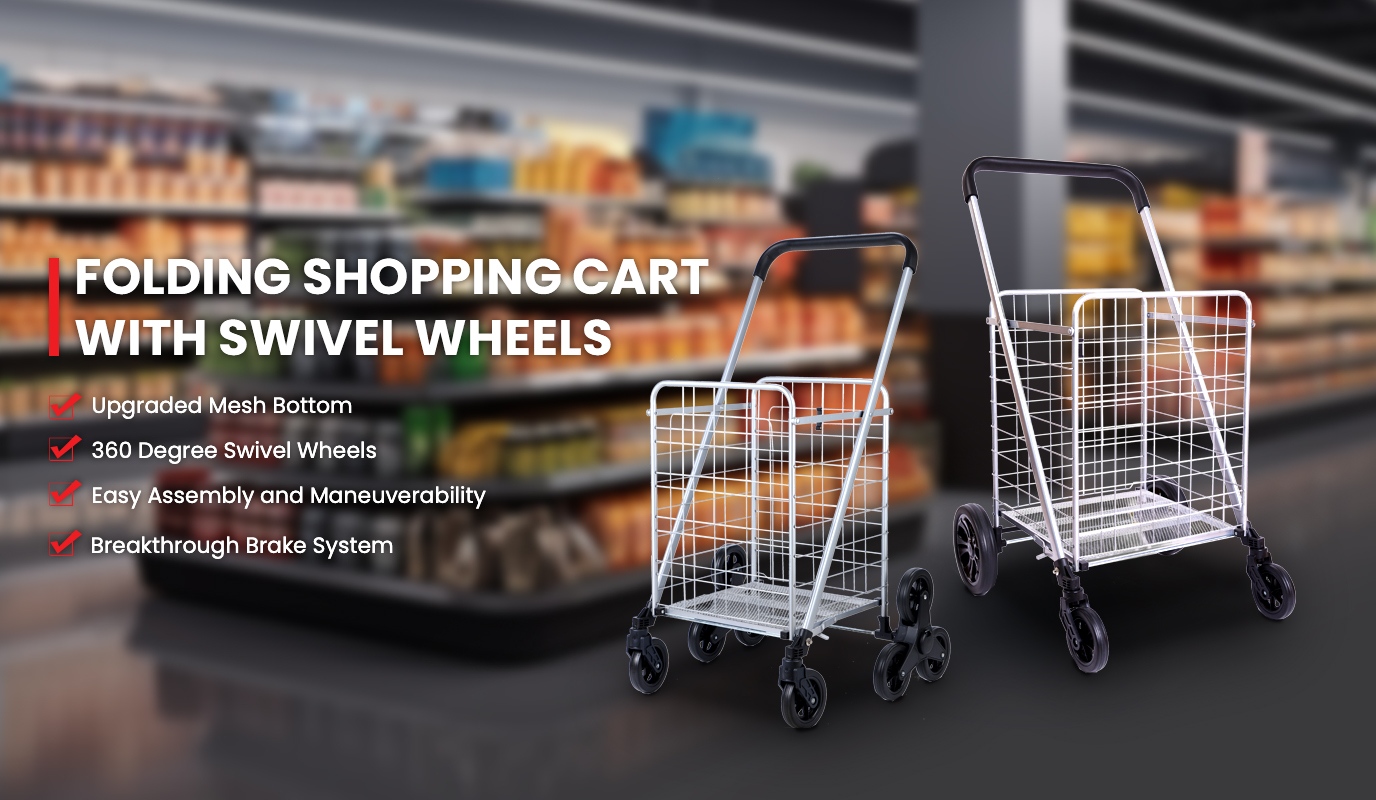
Casters control how a trolley turns and how stable it remains during direction changes. OSHA shipyard ergonomics guidance explains that swivel wheels on the rear with fixed wheels on the front can make pushing easier over longer distances, while swivel wheels on both front and rear can improve maneuvering in smaller, cramped areas. That means caster configuration should match the working environment. A trolley designed for long straight routes may need a different caster layout from a trolley used in narrow aisles or elevators.
Wheel size and material shape real-world performance
Wheel diameter and wheel material strongly affect how a trolley behaves under load. Larger wheels generally roll more easily over uneven surfaces and small obstacles, while material choice affects noise, floor protection, wear resistance, and shock absorption. WOCHANG’s own article on cart stability highlights large-diameter wheels, proper alignment, and high-quality bearings as key contributors to smooth movement and balanced load distribution. The same article notes that WOCHANG uses precision-engineered casters made from rubber or polyurethane in some foldable cart designs, which is relevant because polyurethane and rubber are commonly chosen when buyers need smoother rolling and better traction.
load capacity starts at the caster level
A trolley can only carry as much as its caster system can safely support. Industry guidance on caster load capacity explains that buyers should calculate total loaded equipment weight, divide that across the number of casters, and include a safety margin instead of using the exact arithmetic minimum. This is important because real operating conditions include turning, uneven floors, and shifting loads. For heavy-duty trolley casters, under-specification is one of the fastest ways to create wheel failure, poor rolling, and unstable performance in commercial use.
Stability depends on wheel spacing and alignment
Beyond carrying weight, casters also control balance. WOCHANG’s safety article for industrial carts explains that durable casters help carts move smoothly across tile, concrete corridors, and service elevators, while wheels designed for heavy loads help maintain balance and prevent sudden stops or tipping. Its stability article also points to wide wheel spacing and symmetrical alignment as key design features that improve lateral stability and reduce sway when a trolley is fully loaded. For buyers comparing products, this means caster placement is as important as caster quality.
Brakes and locking systems improve safety
Casters also play a safety role through braking and locking functions. NIOSH guidance points out that brakes for hand carts and handling aids may be needed to control forceful pushing and pulling tasks. Additional caster safety guidance notes that swivel locks and braking systems can help prevent unintended movement and reduce the risk of equipment instability. In practice, brake-equipped casters are especially useful when the trolley is loaded or used on ramps, service lifts, or staging areas.
Key performance roles at a glance
| Wheel and caster feature | Performance role |
|---|---|
| Wheel material | Influences traction, noise, and wear resistance |
| Wheel diameter | Affects obstacle crossing and rolling ease |
| Swivel or rigid caster layout | Changes turning radius and directional control |
| Load rating | Determines safe carrying capacity |
| Bearings and alignment | Improve smoothness and reduce drag |
| Brake and lock system | Improve parking safety and load control |
These points are especially important in commercial trolley design because performance problems often start at ground-contact level, not at the frame.
Manufacturer vs trader
When evaluating manufacturer vs trader, the wheel system is one of the clearest differences. A direct manufacturer can control wheel material choice, caster assembly, axle alignment, bearing quality, and installation consistency much more directly than a trading company. WOCHANG states on its official website that it is a manufacturer with more than 20 years of experience in Shopping Carts, Shopping Baskets, and laundry products, and that it holds BSCI and SCAN certifications. The site also highlights exports to more than 30 countries and over 50 patented technologies developed in-house. That matters because trolley wheel performance depends on repeatable production, not just on a single approved sample.
OEM and ODM process for wheel optimization
In OEM and ODM development, wheels and casters should be confirmed early rather than treated as a standard accessory. Buyers should review route type, floor material, target load, turning frequency, noise expectations, and brake requirements during the drawing and sample stage. WOCHANG’s own content shows that the company considers wheel material, caster layout, wheel stopper systems, and dynamic testing as part of product stability design. That supports a stronger OEM / ODM process for customers who need trolleys matched to real operating conditions rather than generic wheel sets.
Manufacturing process overview and quality control checkpoints
A reliable trolley supplier should explain how wheels and casters are integrated into the production process. WOCHANG’s published articles describe manufacturing steps such as metal frame forming, welding, surface treatment, wheel assembly, and final inspection. Its maintenance article also recommends regular inspection of casters for smooth rotation and debris buildup, while its safety article emphasizes durable wheel installation as part of overall product reliability. For buyers, the most important quality control checkpoints include wheel alignment, axle fastening, rotation smoothness, load testing, brake testing, and final rolling inspection.
Project sourcing checklist
When selecting industrial trolley wheels and casters, buyers should review these points carefully:
| Checkpoint | Why it matters |
|---|---|
| Floor condition match | Prevents excess drag and uneven wear |
| Load rating with safety margin | Protects against overload failure |
| Swivel and rigid combination | Aligns steering with route layout |
| Brake requirement | Improves control on slopes and during loading |
| Wheel material | Balances noise, durability, and traction |
| Factory inspection method | Supports consistent bulk supply quality |
This checklist is especially useful for bulk supply considerations because wheels that look similar on paper can perform very differently once carts are fully loaded and used continuously.
Export market compliance and long-term value
For export projects, wheel and caster consistency affects both customer experience and product reputation. Buyers should review whether the factory can maintain the same wheel grade, caster specification, and testing discipline across repeat orders. WOCHANG’s official website positions the company as a long-term manufacturer with certification visibility and export experience, which supports export market compliance review and repeat-order confidence. In commercial trolley programs, wheels and casters are one of the first components users notice and one of the fastest to reveal whether manufacturing quality is truly stable.
Final view
The role of wheels and casters in trolley performance is fundamental. They affect movement force, steering control, load capacity, stability, braking, durability, and user comfort all at once. A trolley performs well only when its wheel system is matched to the route, the floor, the load, and the daily duty cycle. With direct manufacturing experience, structured production steps, wheel-related quality checks, and export-facing certifications, WOCHANG is better positioned to supply trolley solutions whose wheel and caster systems support real commercial performance rather than only basic mobility.