



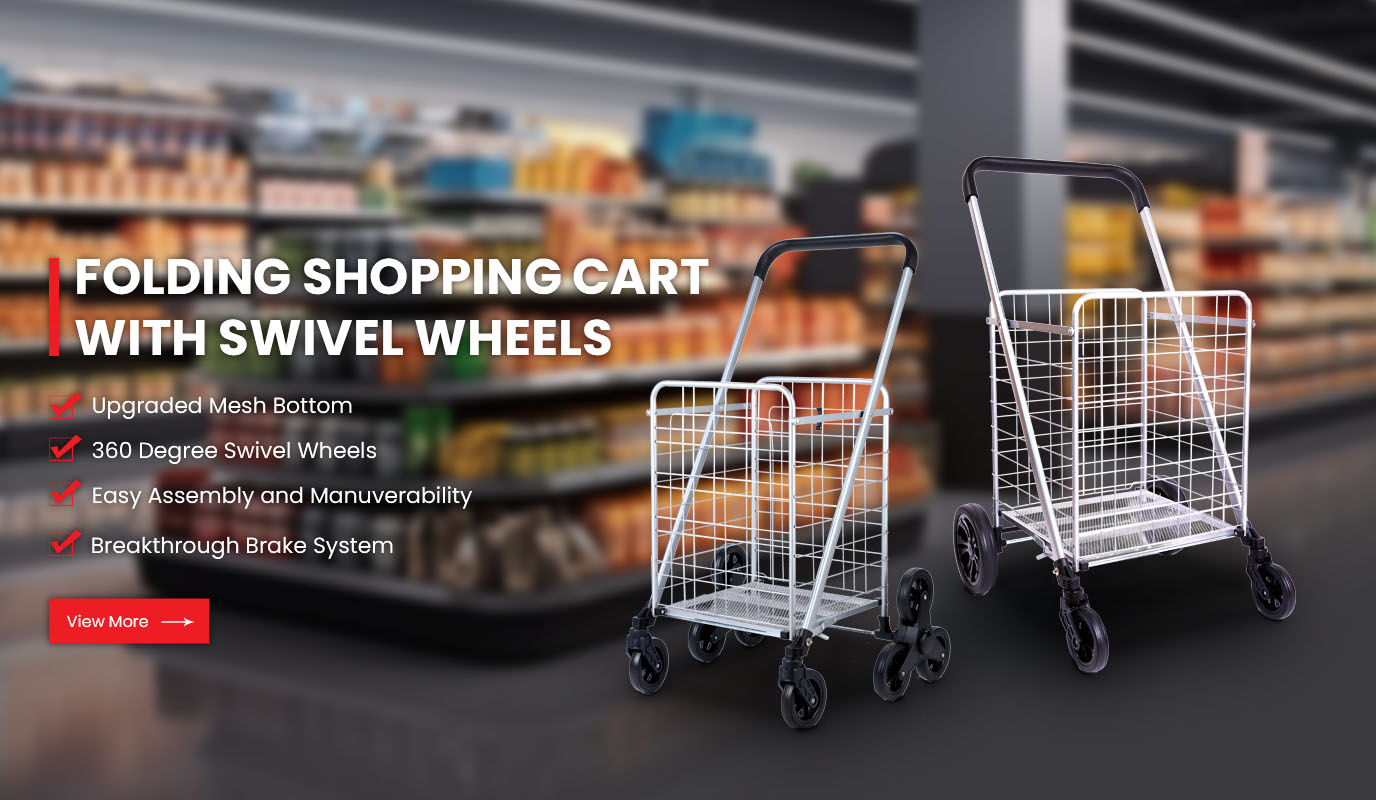
How Does A Foldable Shopping Cart Differ From A Regular Trolley?
Shopping Carts and trolleys are essential tools for transporting goods in supermarkets, warehouses, and households. However, with the increasing demand for mobility and storage efficiency, Foldable Shopping Carts have emerged as a practical alternative to traditional trolleys.
Understanding the differences between these two designs helps buyers, retailers, and facility managers choose the most suitable option for their daily operations. As an experienced manufacturer, WOCHANG develops both foldable and fixed-frame carts to meet various commercial and personal needs.
1. Structural Design
The most noticeable difference lies in the frame structure and flexibility.
Foldable Shopping Cart:
Uses a collapsible frame made of hinged joints and locking mechanisms that allow the cart to fold flat or partially collapse for storage. This structure enables quick folding and unfolding while maintaining balance and strength when in use.Regular Trolley:
Has a fixed, welded, or riveted frame that does not collapse. The structure provides maximum rigidity but requires more storage space. It is ideal for facilities where carts remain in constant use and space is not limited.
In short, foldable carts focus on portability and space efficiency, while regular trolleys emphasize structural permanence and heavy-duty stability.
2. Portability and Storage
One of the greatest advantages of a Foldable Shopping Cart is its compact storage ability.
Foldable Cart:
Can be reduced to a fraction of its original size and stored in small spaces such as car trunks, closets, or warehouse shelves. This is particularly useful for urban households, delivery services, or mobile vendors.Regular Trolley:
Occupies more space and usually requires designated storage areas. Because it cannot be folded, it’s less convenient for transport between locations or for seasonal use.
For businesses that value mobility and limited storage, the foldable design offers a clear advantage.
3. Weight and Material Composition
Foldable Shopping Cart:
Usually made from lightweight metals such as aluminum alloy or thin-gauge steel tubing. It’s designed for moderate loads but prioritizes ease of handling.Regular Trolley:
Constructed from heavier-gauge steel or full metal mesh for higher load capacity. This design supports heavy items and frequent industrial use.
While foldable carts are easier to lift and carry, regular trolleys provide greater strength and durability under extreme load conditions. Choosing between them depends on the intended environment and frequency of use.
4. Load Capacity and Application
| Type | Typical Load Capacity | Suitable Environments |
|---|---|---|
| Foldable Shopping Cart | 50–120 kg | Homes, offices, delivery routes, light retail |
| Regular Trolley | 150–300 kg or more | Supermarkets, warehouses, logistics centers |
Foldable carts are ideal for lighter duties and flexible transport, while regular trolleys are preferred in industrial or high-traffic commercial settings where continuous heavy use is expected.
5. Maintenance and Service Life
Because of their moving joints and folding mechanisms, foldable carts require periodic inspection of hinges, locks, and screws to maintain reliability.
Regular trolleys, having fewer movable parts, require less maintenance and are less prone to mechanical wear. However, they are harder to repair or modify due to their fixed structure.
In both cases, the use of corrosion-resistant materials and proper lubrication extends service life. WOCHANG designs its products with precision-engineered components and anti-rust coatings to ensure long-term durability in various climates.
6. Cost and Operational Efficiency
Foldable carts generally have a slightly higher initial manufacturing cost due to the complexity of the folding mechanism, but they save space and reduce logistics costs in the long term.
Regular trolleys, though simpler and more affordable per unit, can incur higher warehouse and transport costs because of their larger volume.
For export buyers and distributors, the compact packaging of foldable carts significantly reduces freight expenses—a major advantage for international trade.
7. WOCHANG’s Engineering Perspective
At WOCHANG, both cart types are designed with user needs in mind:
Foldable Shopping Carts:
Built with reinforced folding joints, lightweight yet durable materials, and easy-lock systems for quick setup. Ideal for flexible use and compact storage.Regular Trolleys:
Constructed with high-strength steel frames, large-capacity baskets, and heavy-duty wheels to handle continuous use in demanding environments.
By maintaining rigorous quality control, WOCHANG ensures that both designs deliver stability, smooth movement, and long-lasting performance.
Conclusion
A foldable shopping cart differs from a regular trolley mainly in its collapsible design, weight, portability, and intended use. Foldable models excel in space-saving and transport convenience, while regular trolleys provide superior load capacity and structural stability.
With years of manufacturing expertise, WOCHANG offers both options—combining functionality, durability, and user comfort. Whether for household errands or large-scale retail operations, WOCHANG carts deliver efficiency, safety, and reliability in every movement.